
 Akshay Dinesh
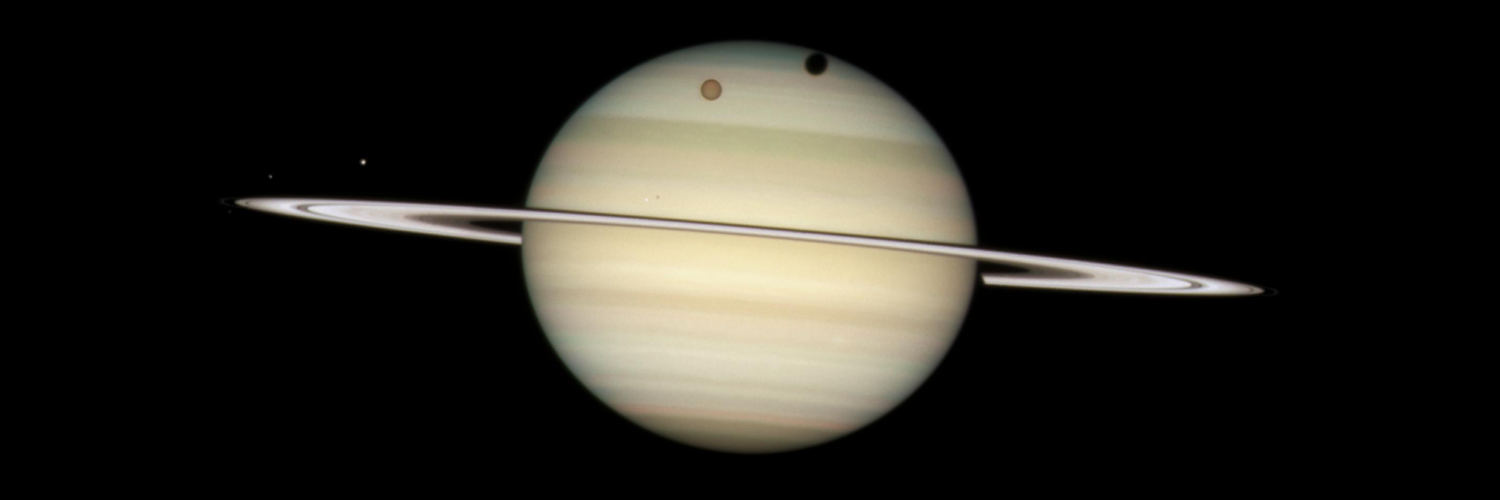
Saturn is famous because it rarely looks like any other planet through a telescope. Even a modest backyard view can show a small golden disk with a bright ring system wrapped around it, like a tiny model of the solar system made visible in one glance. In 2026, though, many observers are seeing something different: Saturn’s rings look unusually narrow, sometimes more like a bright line than the wide oval people expect. The rings have not vanished, and Saturn has not changed shape. What has changed is the angle from which Earth is looking at them.
NASA’s July 2026 skywatching notes point out that Saturn is a rewarding telescope target later in the month because the rings are still tilted at a very shallow angle from our point of view. That small angle makes a familiar planet feel new again. It is also a neat geometry lesson in the sky: a wide, bright structure can nearly disappear when it is turned edge-on toward the viewer.
The rings are wide, but not very thick
Saturn’s rings look enormous because they stretch far beyond the planet’s cloud tops. They are not one solid sheet. NASA’s Cassini mission showed the rings as a system of many bands, gaps, waves, clumps, and icy particles, with pieces ranging from tiny grains to much larger chunks. From Earth, all of that detail usually blends into a graceful ring shape.
The surprising part is how thin the ring system is compared with its width. NASA’s Cassini ring overview describes the main rings as generally only about 30 feet, or 10 meters, thick in many places, while extending across a huge distance around the planet. A comparison on Earth would be extreme: something could be wider than a city but vertically thinner than a small house. Seen from above or below, it can reflect a lot of sunlight. Seen from the side, there is much less bright surface facing us.
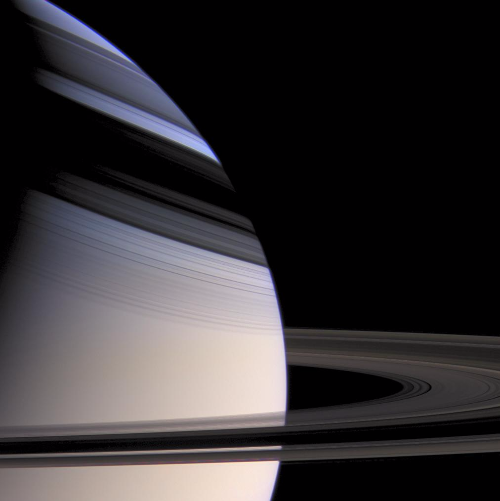
That thinness is why the rings can look so dramatic one year and so faint another year. Their brightness is not just a property of the icy particles themselves. It also depends on how much of the ring surface is tilted toward both the Sun and Earth. When the rings open wide from our point of view, they seem grand and obvious. When the ring plane turns toward edge-on, their light is squeezed into a narrow line.
Saturn’s tilt changes what Earth can see
Saturn is tilted as it orbits the Sun, much as Earth is tilted and has seasons. Saturn’s trip around the Sun takes almost 30 Earth years, so our view of its ring system changes slowly. For several years, Earth may see the north side of the rings. Later, the rings appear less open. Then they cross edge-on, after which Earth begins seeing more of the opposite side.
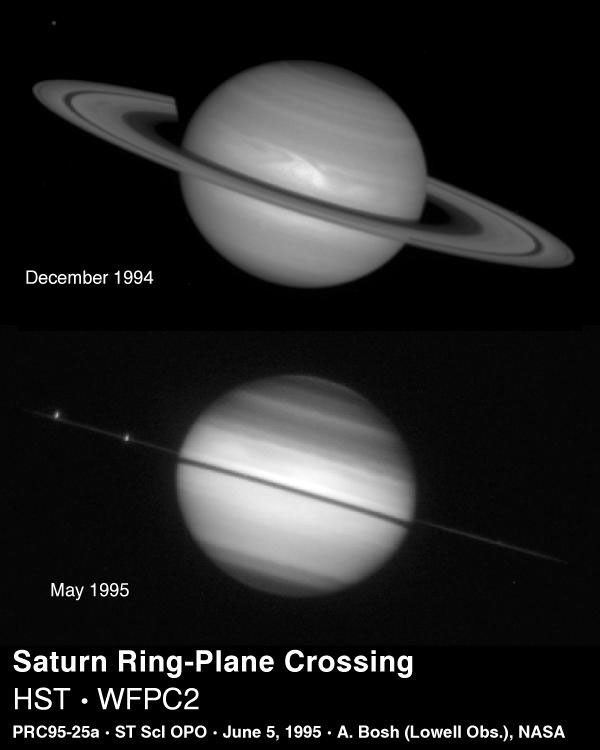
This changing view creates what astronomers call a ring-plane crossing. During such a crossing, Earth lines up with Saturn’s ring plane closely enough that the rings can appear extremely thin or nearly absent. NASA’s Hubble materials note that these crossings happen roughly every 13 to 15 years, tied to Saturn’s long orbit and the way Earth and Saturn line up. The same planet can therefore move through a cycle of wide-open rings, narrowing rings, an edge-on phase, and widening rings again.
The 2025 crossing was not easy for many observers because Saturn was near the Sun from Earth’s perspective at key moments. But the geometry did not stop mattering after that. In 2026, the rings are still not back to their broad, showpiece angle, so telescope users get a lingering look at Saturn with a flatter profile. That is why the planet can seem oddly changed even though the rings are still physically there.
Why edge-on rings can seem to disappear
A simple classroom object can make the effect easier to picture. Hold a sheet of paper flat in front of your face and it looks broad. Turn it slowly until only the edge faces you, and the same sheet becomes a thin line. Saturn’s rings are far more complex than paper, but the visual trick is similar. A broad structure can lose most of its apparent area when its edge points toward the observer.
Saturn’s rings also have to compete with the glare of the planet itself. The planet’s disk reflects sunlight, and so do the rings, but when the rings are edge-on there is much less illuminated area to see. In small telescopes, atmospheric blur and optical limits can make the thin line even harder to separate from the bright planet. Under poor seeing, the ring system may look like a narrow slash, tiny handles on either side of the planet, or a subtle bright band crossing the disk.
This is why headlines about the rings disappearing can be misleading. The rings are not gone in the physical sense. They are still circling Saturn, still made mostly of icy material, and still interacting with moons and gravity. They are simply turned so close to edge-on that Earth receives a much less dramatic view. The disappearance is an effect of perspective.
What a telescope user may notice
Saturn is visible to the unaided eye as a steady point of light, but the ring shape requires a telescope. When the rings are wide open, even a small telescope can make Saturn look unmistakable. In 2026, the planet may look more compact and less postcard-like. The rings can appear as a thin bar, and the dark gap between ring and planet may be harder to see.
That does not make Saturn less worth observing. A shallow ring angle can make other details more interesting. The planet’s largest moon, Titan, is often within reach of small telescopes as a nearby point of light. A steadier sky may reveal more of Saturn’s disk, its muted bands, or the way the thin rings cut across the planet’s face. The view rewards patience more than a quick glance.
Conditions matter. Saturn is best observed when it is higher in the sky, away from the thickest part of Earth’s atmosphere near the horizon. A telescope that has cooled to outdoor temperature usually gives a steadier image. Higher magnification is not always better, especially when air turbulence makes the planet shimmer. A sharp, modest view often teaches more than a larger blurry one.
Why astronomers care about ring-plane crossings
Ring-plane crossings are not only beautiful skywatching events. They have also helped astronomers study Saturn’s system. When the bright rings are less overwhelming, faint moons and subtle ring structures can become easier to detect. Historical and modern observations of edge-on rings have helped refine knowledge of Saturn’s moons, ring thickness, and orbital geometry.
The Hubble Space Telescope has recorded ring-plane crossings in detail, including a 1995 sequence that showed Saturn’s rings narrowing dramatically. Those observations show why the event is more than a trick of appearance. A rare viewing angle can reveal information that is hidden when the rings are fully open and bright. The same system looks different because different parts of it are emphasized.
There is also a larger lesson in how astronomy works. The solar system is not a set of fixed pictures. Every view depends on motion: Earth’s orbit, Saturn’s orbit, Saturn’s tilt, sunlight, telescope position, and time. A planet can look familiar for years and then quietly change its presentation because the geometry has shifted.
A reminder that perspective is part of science
Saturn’s thin rings in 2026 are a good example of why observation and explanation belong together. The first impression may be surprise: the planet looks different, maybe even less impressive than expected. The explanation makes the view richer. Saturn is showing the edge of a vast, icy ring system, and Earth happens to be watching from a shallow angle.
That makes the sight both temporary and repeatable. The rings will slowly open wider again as the viewing geometry changes, and future ring-plane crossings will bring the thin-ring effect back for another generation of observers. Nothing has to be wrong with Saturn for it to look different. Sometimes the most interesting change in the sky is not in the object itself, but in the angle from which we finally get to see it.





Add comment