

 Akshay Dinesh
Radon is easy to ignore because it gives no warning. It has no smell, no color, and no taste. A house can look clean, dry, and well cared for while still having radon levels high enough to deserve attention. That quietness is exactly what makes radon worth understanding: it is not a problem people can see forming, but it comes from ordinary geology beneath ordinary buildings.
The short version is simple. Radon forms when uranium in rocks and soil breaks down over time. The gas can move upward through tiny spaces in the ground, slip through openings in a foundation, and collect inside rooms where air does not exchange quickly enough. The U.S. Environmental Protection Agency and Centers for Disease Control and Prevention both emphasize the same practical point: testing is the only way to know a home’s radon level.
Radon Begins With Natural Radioactive Decay
Radon is not made by household products, dirty air filters, or visible mold. It begins much deeper in the natural environment. Many rocks and soils contain small amounts of uranium, a radioactive element that has been present in Earth’s crust for billions of years. As uranium atoms decay, they change through a chain of other radioactive elements, including radium. One step in that chain produces radon gas.
That detail matters because radon is a gas, unlike the solid minerals locked into rock. Once radon forms, it can leave the mineral grain where it was produced and enter the tiny air spaces between soil particles. From there, it may move through soil, gravel, cracks, utility openings, and foundation joints. The U.S. Geological Survey describes this as a geology problem as much as a building problem: the amount of radon available depends partly on local rock and soil, but the amount that reaches indoor air depends on the structure above it.
Radon also has a short half-life compared with uranium, but that does not make it harmless. Radon-222, the isotope most often discussed in homes, decays into radioactive particles sometimes called radon decay products. When those particles are breathed in, they can lodge in lung tissue and release radiation nearby. That is why public health agencies connect long-term radon exposure with lung cancer risk, especially in homes where people spend many hours over many years.
Why Radon Moves Toward Houses
A house does not need to “pull” radon in dramatically for radon to enter. Air pressure differences can be enough. Indoor air often becomes slightly lower in pressure than the soil air around the foundation, especially when warm air rises through the building and exits through upper leaks, vents, or fans. That small pressure difference can draw soil gas toward the lower parts of the home.
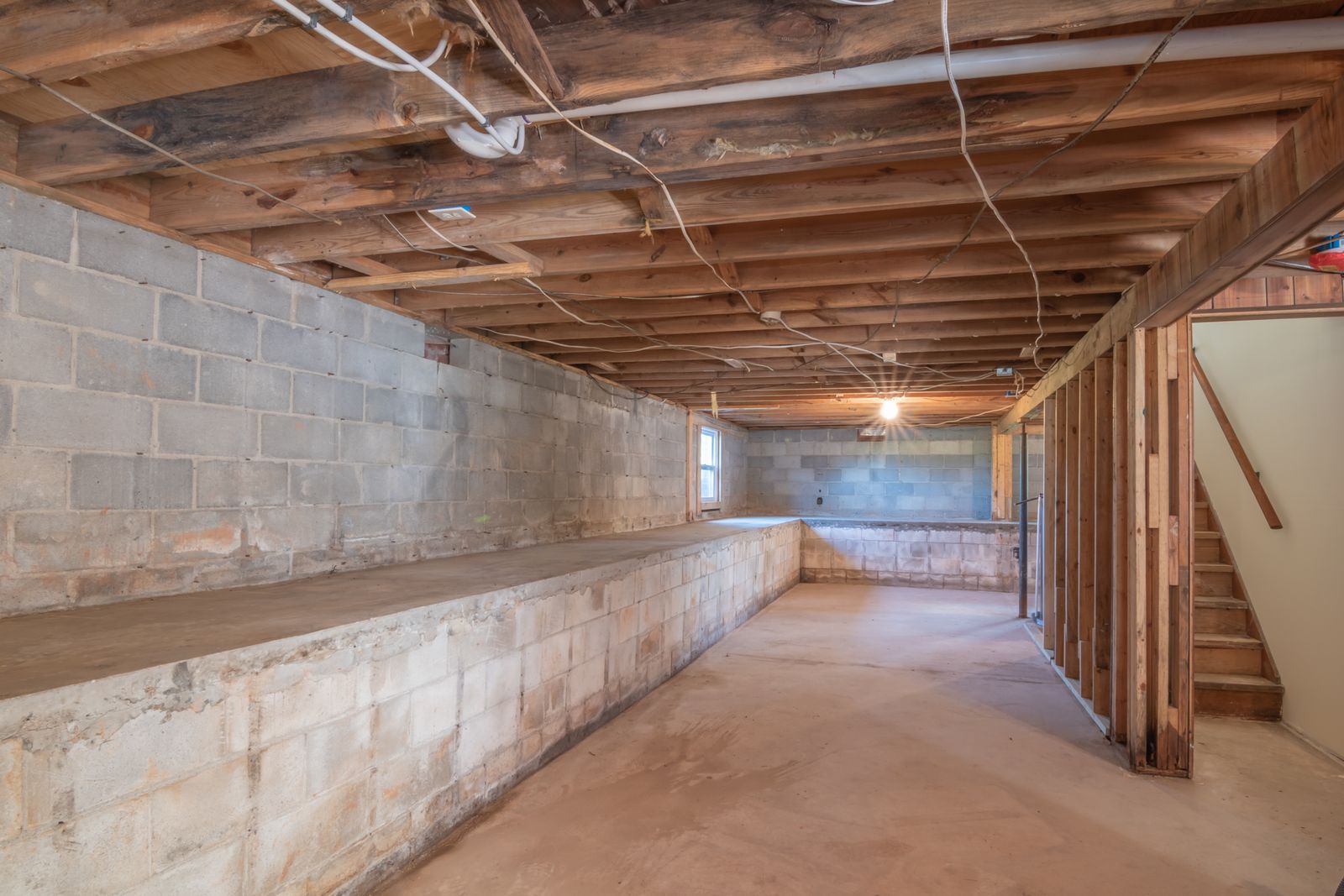
Radon can enter through cracks in basement floors, gaps around pipes, construction joints, crawl spaces, sump openings, and hollow block walls. These openings may be too small to notice during a quick walk-through. A hairline crack in concrete can matter because gas does not need a wide doorway. It follows pressure, available spaces, and the movement of air.
Some homes have more obvious risk factors than others, such as basements, crawl spaces, exposed soil, or private wells. But the EPA warns against assuming that only old or visibly cracked houses need testing. New homes can have elevated radon too. So can homes without basements. Two neighboring houses can test differently because their foundations, air leakage, soil contact, and ventilation patterns are not identical.
Geology Raises the Possibility, but Testing Gives the Answer
Radon maps are useful, but they cannot replace a home test. Areas with uranium-rich bedrock, certain granites, shales, phosphate deposits, or glacial sediments may have higher radon potential. Soil texture also matters. Loose, porous soil can allow gas to move more easily than dense, wet soil, although local conditions can vary sharply within a neighborhood.
The reason a map is not enough is that radon is shaped by both ground and building. One house may have a foundation opening directly connected to soil gas, while another nearby house may be better sealed or ventilated. Weather can change readings too. Frozen ground, rain, wind, heating patterns, and closed windows can all affect how radon moves and accumulates during a test period.
That is why the EPA recommends measuring the air inside the home rather than guessing from county averages or a neighbor’s result. A low-risk zone does not guarantee a low reading. A high-risk zone does not prove a particular home has a problem. Testing turns a geological possibility into a specific number for a specific building.
What a Radon Test Measures
Radon in indoor air is commonly measured in picocuries per liter, written as pCi/L. A curie is a unit connected to radioactive decay, and a picocurie is a very small fraction of that amount. For a household test, the number tells how much radon activity is present in a liter of air. The measurement is not about dustiness, odor, or general cleanliness; it is specifically about radioactive gas and its decay products.
Short-term tests usually stay in place for a few days. Long-term tests may measure for several months, giving a better picture of average exposure across changing weather and living patterns. The right choice depends on the situation, but both types work best when directions are followed carefully. Placement matters: tests are usually set in a lived-in lower level, away from drafts, exterior walls, high humidity, and direct heat unless the kit instructions say otherwise.
The EPA’s widely used action level is 4 pCi/L. At or above that level, the agency recommends fixing the home. The EPA also says people may consider action between 2 and 4 pCi/L because risk does not suddenly appear at one exact boundary. That can be confusing at first, but the idea is straightforward: lower radon is better, and the action level is a practical threshold for deciding when mitigation is strongly recommended.
How Radon Problems Are Usually Reduced
Radon reduction is not usually about opening a window once in a while. Temporary ventilation may change indoor levels for a short time, but it does not solve the route by which radon enters. Professional mitigation systems are designed to lower the pressure beneath the foundation or redirect soil gas before it collects indoors. A common method, called sub-slab depressurization, uses a pipe and fan to draw radon from beneath the concrete slab and vent it safely above the roofline.
Other approaches depend on the building. Crawl spaces may need sealed membranes and ventilation changes. Foundation gaps may be sealed as part of a system, though sealing alone is rarely the whole answer. Homes with private wells may also need water testing in some regions, because radon can enter indoor air when radon-rich water is used for showers, laundry, or cooking. Air remains the main exposure concern in most homes, but groundwater can matter in certain geologic settings.
A useful way to think about mitigation is that it changes the path of least resistance. Instead of letting soil gas drift through cracks and openings into living space, the system gives it a controlled route outdoors. After mitigation, another test confirms whether the level actually dropped. Without a follow-up measurement, the system’s success is still an assumption.
Why an Invisible Gas Deserves a Simple Routine
Radon is not a reason to panic, but it is a reason to measure. The risk comes from long-term exposure, and the solution begins with a low-cost test rather than guesswork. That makes radon unusual among environmental hazards: the problem is invisible, but the first step is usually simple enough for homeowners, renters, schools, and building managers to understand.
The most important habit is not trying to judge radon by how a home feels. A dry basement, a finished family room, or a newly built house can still have elevated radon. A modest home on ordinary soil can test low. The only reliable difference is the number from a properly used test.
Radon connects chemistry, geology, building design, and public health in one quiet chain. Uranium decays in rock. Radon moves through soil. Foundations and pressure differences shape the path indoors. Testing breaks the uncertainty. Once the number is known, people can decide whether the home needs no immediate action, a longer follow-up test, or a mitigation system that sends the gas somewhere safer than the air they breathe every day.





Add comment