
 Akshay Dinesh
An earthquake early warning can feel almost impossible the first time someone hears about it. If earthquakes cannot be predicted, how can a phone warn people before the shaking reaches them? The answer is not fortune-telling. It is a race between different kinds of waves, sensors, computers, and communication networks.
The basic idea is simple enough to picture. When a fault ruptures, energy spreads outward through the ground. Some waves travel faster and arrive first, while other waves usually bring stronger shaking later. A warning system tries to detect the first waves quickly, estimate what is happening, and send an alert to places where stronger shaking has not arrived yet.
That may give only a few seconds. In some places, it may give no warning at all. But a few seconds can still matter when they help people drop, cover, and hold on, or when automated systems slow trains, open firehouse doors, stop delicate equipment, or close valves before the worst shaking begins.
The race between earthquake waves and information
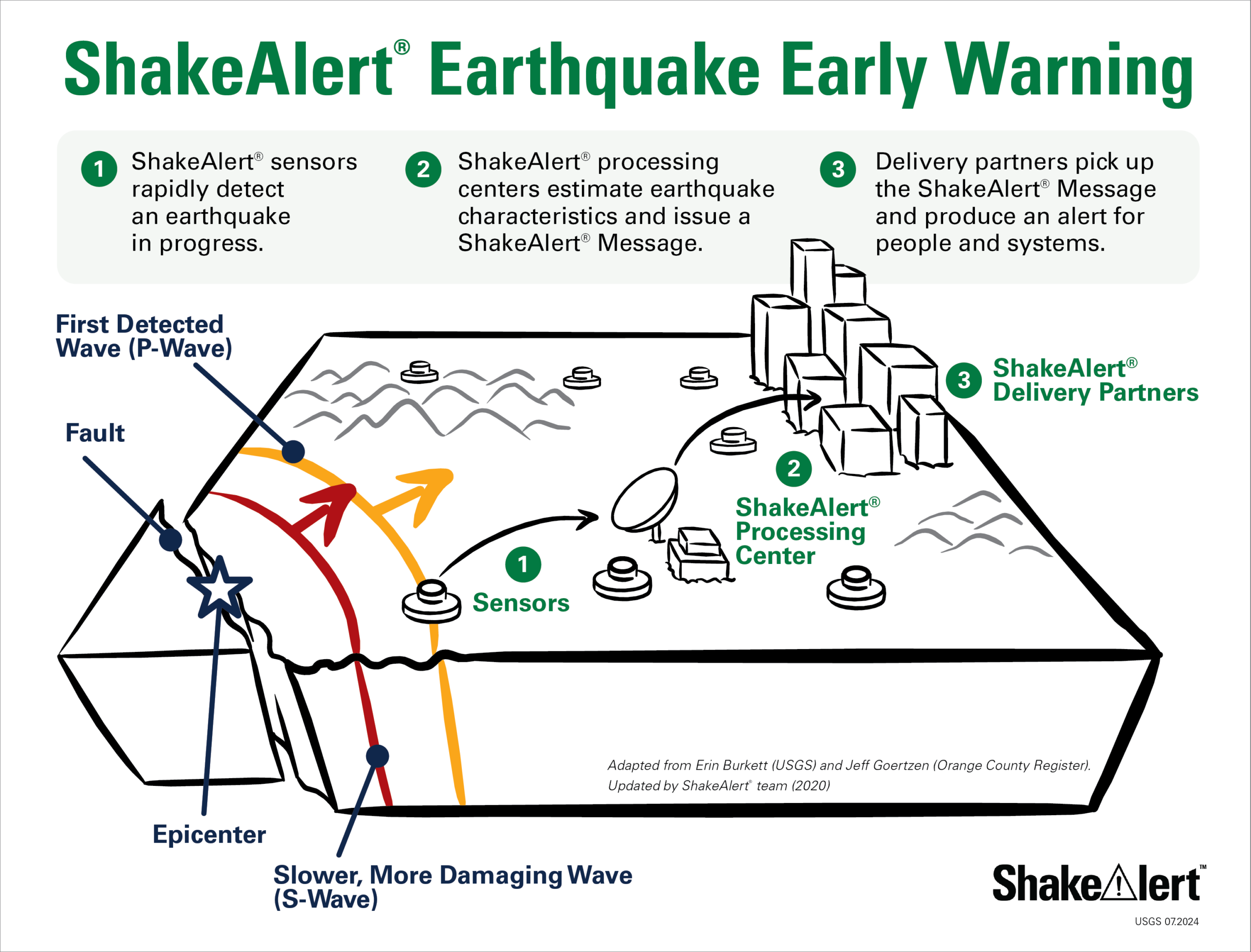
Earthquake early warning depends on a useful physical difference. The first waves to leave the rupture are primary waves, usually called P waves. They move quickly through the Earth and are often less damaging than the waves that follow. Secondary waves, or S waves, travel more slowly but usually produce stronger side-to-side motion. Surface waves can arrive later and may also cause damaging shaking.
The U.S. Geological Survey explains that P waves can travel about 3.7 miles per second, while the more damaging S waves and surface waves travel about 2.5 miles per second. That difference creates a narrow window. If instruments near the earthquake detect the first motion and send data faster than the shaking spreads, people farther away may receive an alert before the strongest motion arrives.
The warning is therefore not really early in the life of the earthquake. The earthquake has already begun. What is early is the arrival of the message at a particular location. Someone close to the epicenter may feel shaking before any alert can reach them, while someone farther away may have more time because the damaging waves still need to cross more ground.
How sensors turn shaking into an alert
On the U.S. West Coast, the public earthquake early warning system is ShakeAlert, operated by the U.S. Geological Survey with university, state, and technology partners. It uses a network of ground-motion sensors spread across earthquake-prone areas. These instruments do not wait for a human observer to confirm an earthquake. They continuously measure ground motion and send data to processing centers.
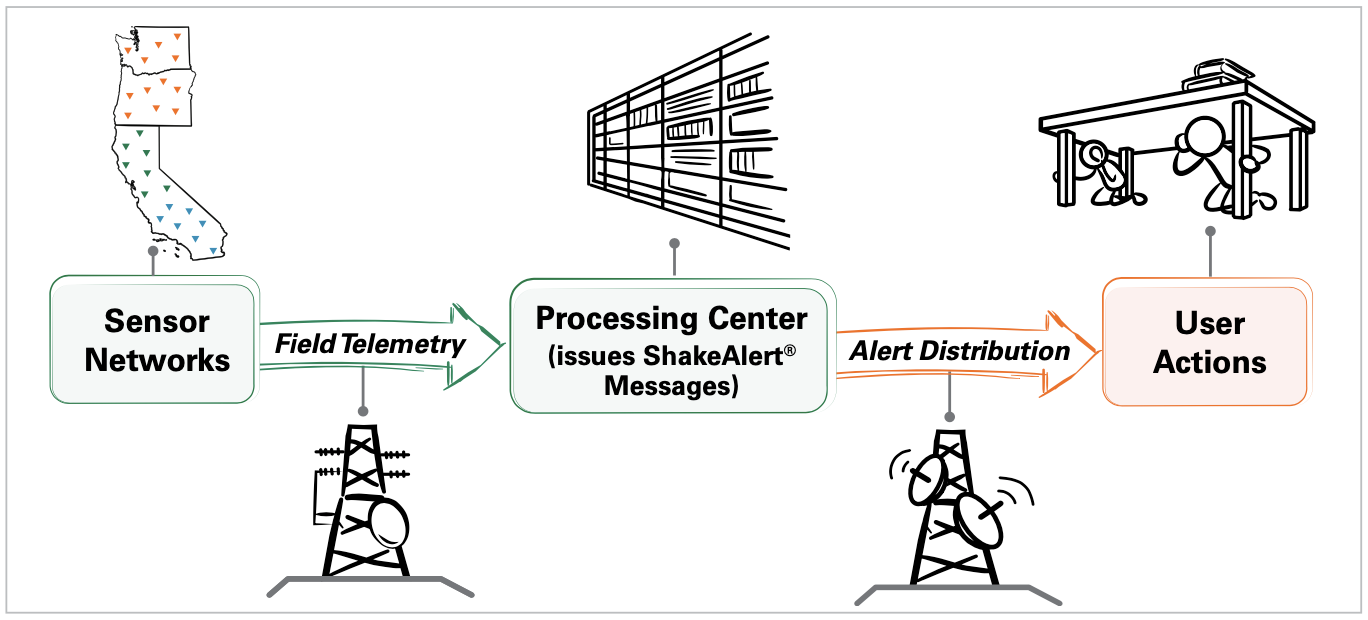
When enough sensors detect the pattern of an earthquake, computers estimate its location, size, and expected shaking intensity. If the event meets alert thresholds, a ShakeAlert Message is issued. Delivery partners then turn that message into public alerts or automated actions. The alert that appears on a phone is only the visible end of a longer chain: sensor network, data transmission, processing center, alert distributor, and user action.
Accuracy matters as much as speed. A system that alerts too slowly loses its advantage, but a system that alerts too easily can train people to ignore it. That is why earthquake early warning uses thresholds. It is designed for earthquakes likely to be felt or cause damage, not for every tiny tremor recorded by instruments.
The network has also become more sophisticated over time. In 2026, University of Washington researchers reported that planned ShakeAlert installations in Washington and Oregon had been completed, bringing the two-state Pacific Northwest network to hundreds of monitoring stations. Researchers are also studying offshore expansion because a major Cascadia subduction zone earthquake would begin under the ocean, where land-based sensors may lose valuable seconds.
Why warning time is uneven
The most important limit is distance. People near the rupture may be inside the blind zone, the area where strong shaking arrives before an alert can be delivered. This does not mean the system failed. It means the physics gave the warning system almost no time to work.
People farther away usually have a better chance of receiving a warning, but even there the timing is not guaranteed. The system must detect the earthquake, confirm that it is large enough, estimate shaking, send the message, and deliver it through phones, apps, public alert channels, or connected systems. Each step takes time. Good engineering reduces delay, but it cannot make the process instantaneous.
Earthquake size also complicates the calculation. Small and moderate earthquakes can be estimated quickly, but very large earthquakes may keep rupturing along a fault for a longer time. Early data may show that an earthquake is serious before it reveals its full size. That is one reason researchers study additional tools, including high-precision ground-position measurements, to improve estimates for the largest events.
Local ground conditions matter too. Soft sediments can amplify shaking, tall buildings may respond differently than short buildings, and intensity can vary across a city. A warning system has to simplify a messy reality into a fast public message. It is a warning of likely shaking, not a perfect forecast for every room, bridge, or hillside.
What an alert can and cannot tell you
An earthquake early warning is not a prediction that an earthquake might happen someday. It means an earthquake has started and shaking may be on the way. The message may include a magnitude, an estimated distance, or a level of expected shaking, depending on the delivery method. Those details are helpful, but the safest response should be immediate.
For most people indoors, the standard protective action is drop, cover, and hold on. Dropping lowers the chance of being knocked down. Taking cover helps protect the head and neck from falling objects. Holding on keeps the cover from moving away during shaking. Running outside after an alert can be more dangerous if glass, bricks, signs, or power lines may fall.
Alerts can also protect systems that move faster than people can. A train can begin slowing. A school announcement system can activate. A hospital or laboratory can protect sensitive equipment. A water or gas utility may be able to reduce risk from broken lines. These actions are not dramatic on their own, but they can reduce injuries, damage, and confusion during the first moments of a disaster.
Because alert thresholds are selective, a person may feel a small earthquake without receiving a warning. The reverse can also happen: an alert may arrive and the shaking may be lighter than expected at that person’s exact location. The right way to judge the system is not whether every alert feels severe, but whether it gives timely, useful guidance during earthquakes that matter.
Why the warning is still worth building
Earthquake early warning is easy to misunderstand because it sounds like prediction. Its real value is narrower and more practical. It cannot say that an earthquake will strike next week, and it cannot stop the ground from moving. It can only use the first evidence of a rupture to warn places that the stronger waves have not reached yet.
That limitation still leaves room for real public benefit. Seconds can help a teacher give a clear instruction, a commuter step away from a platform edge, a surgeon pause a delicate action, or a family move away from heavy furniture. In emergency planning, not every useful tool has to solve the whole problem. Some tools simply give people a better first move.
The strongest lesson is that warning systems and personal preparedness belong together. Alerts work best when people already know what to do. A phone vibration is not the moment to debate whether a doorway is safe or whether to run outside. The message should trigger a practiced response: drop, cover, and hold on, then check for hazards after the shaking stops.
Earthquake early warning turns geology into a few extra seconds of decision time. That may sound small until the floor starts moving. Then the value of those seconds becomes clear: they are not a prediction of the future, but a head start against shaking that has already begun.





Add comment