

 Akshay Dinesh
Ranked-choice voting can look strange the first time someone sees the ballot. Instead of choosing one candidate and stopping, the voter may mark a first choice, second choice, third choice, and sometimes several more. That does not mean the voter gets extra votes. It means the ballot can keep speaking if the first-choice candidate cannot win.
The idea has become more visible in American elections because several places now use it for statewide, city, primary, special, or local contests. The National Conference of State Legislatures reported in March 2026 that Alaska and Maine use ranked-choice voting for statewide elections, while a number of cities use it for local elections. Washington, D.C. also brought ranked-choice voting into public attention during its 2026 primary cycle. For students, voters, and anyone trying to read election results, the useful question is not whether the system sounds simple or complicated. The useful question is how the counting actually works.
A ballot with backup choices
On a ranked-choice ballot, voters list candidates in order of preference. A voter might mark Candidate A as first choice, Candidate B as second choice, Candidate C as third choice, and leave the rest blank. Another voter might rank only one candidate. A third voter might rank every candidate available. The rules can differ by place, but the basic voting action is the same: the voter is creating an ordered list rather than making a single mark.
The first important point is that only one ranking counts at a time. If a voter’s first-choice candidate is still active in the count, that ballot counts for the first-choice candidate. The second choice sits in reserve. It does not weaken the first choice, and it does not count at the same time as the first choice. Backup choices matter only if the higher-ranked candidate is eliminated from the contest.
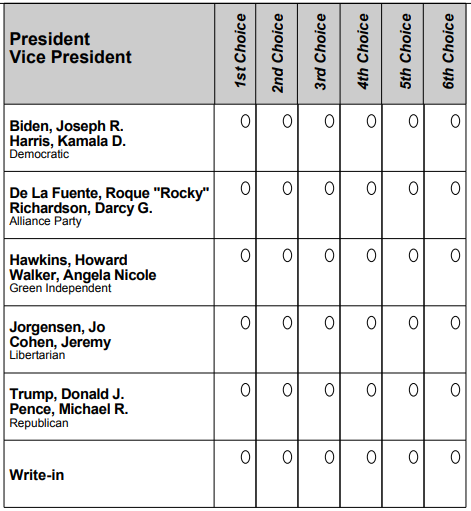
This is why ranked-choice voting is sometimes described as instant-runoff voting in single-winner races. A traditional runoff asks voters to return for another election after the weakest candidates are removed. Ranked-choice voting tries to collect those backup preferences on the first ballot, then uses them later if no candidate starts with enough support to win.
What happens in the first round
The first round is familiar. Election officials count every voter’s first choice. If one candidate has more than half of the votes under the local rule, the race is over. That candidate has enough first-choice support to win without using backup rankings.
Many ranked-choice races do not end that quickly, especially when several candidates split the vote. Imagine a city council race with four candidates and 10,000 ballots. Candidate A has 3,900 first-choice votes, Candidate B has 3,100, Candidate C has 2,000, and Candidate D has 1,000. No one has a majority. Under a single-winner ranked-choice count, Candidate D, the lowest candidate, is eliminated first.
The word eliminated can make the process sound harsher than it is. It does not erase voters. It removes a candidate from the active count because that candidate has the least support in that round. The ballots that counted for Candidate D are then checked for each voter’s next ranked active candidate. If a D voter ranked Candidate B second, that ballot moves to Candidate B. If another D voter ranked Candidate C second, that ballot moves to Candidate C. If a D voter did not rank anyone else, that ballot has nowhere else to go.
How votes transfer between rounds
The transfer step is the part that makes ranked-choice voting different from a normal plurality election. In a plurality election, the candidate with the most votes wins, even if most voters chose someone else. In ranked-choice voting, the count keeps asking whether the remaining candidates can build broader support from voters whose earlier choices are no longer active.
Continue the example. Candidate D’s 1,000 ballots are reviewed. Suppose 500 move to Candidate B, 300 move to Candidate C, 100 move to Candidate A, and 100 have no next active ranking. The new count would put Candidate A at 4,000, Candidate B at 3,600, and Candidate C at 2,300, with 100 ballots no longer active. If no remaining candidate has crossed the winning threshold, the lowest candidate is eliminated again. Candidate C would be removed, and C’s ballots would move to each voter’s next active choice if one is available.
New York City’s voter education materials describe the same basic movement: if a voter’s highest-ranked candidate is eliminated, the vote goes to the next highest-ranked candidate still in the race. That single sentence is the heart of the system. A ballot follows the voter preference list until it lands on a candidate who is still active, or until it runs out of ranked candidates.
That last possibility is called ballot exhaustion. A ballot becomes exhausted when all the candidates ranked on it have been eliminated and there is no next choice to count. This often happens when a voter ranks only one candidate in a crowded race. The ballot counted in the early round, but it cannot transfer later because the voter did not name any backup options.
Why ranking more candidates can matter
One common misunderstanding is that ranking a second or third candidate can hurt a voter’s first choice. In the usual single-winner ranked-choice count, it cannot. The backup ranking is not used while the first-choice candidate remains active. A second choice matters only if the first choice has already been eliminated. At that point, the voter is no longer choosing between the first and second choice. The first choice is out of the count.
Another misunderstanding is that ranking five candidates means casting five votes. It does not. The ballot has one vote in each round, assigned to the highest-ranked active candidate on that ballot. The ranked list tells officials where that vote should go if the current candidate drops out of the running.
Voters still have choices about how much of the ballot to fill out. Ranking only one candidate is usually allowed in many ranked-choice systems, though local rules matter. The tradeoff is practical: if that candidate is eliminated, the ballot may stop counting in later rounds. Ranking more candidates gives the ballot more chances to remain active, as long as the voter has genuine preferences among those candidates.
What the system tries to solve
Ranked-choice voting is often used to address a problem in crowded races. When three, four, or more candidates compete, a traditional plurality winner can finish first with far less than majority support. That may be legally valid, but it can leave voters wondering whether the winner was broadly acceptable or simply benefited from a split field.
Ranked-choice voting tries to answer that concern by simulating a series of runoff rounds. Instead of asking voters to return weeks later for a separate runoff, the ballot already contains their backup choices. The system can also reduce the fear that voting for a less popular favorite will simply spoil the race for a voter’s second-best option. A voter can rank the favorite first and still leave instructions for what should happen if that favorite is eliminated.
The system does not remove every election problem. It depends on clear ballot design, voter education, reliable counting procedures, and transparent reporting. Some critics argue that the method can confuse voters, especially when voters do not understand how backup rankings work. Others worry about exhausted ballots or about whether late-round results feel harder to follow than a simple first-place tally. Those concerns are part of why ranked-choice voting is expanding in some places while being restricted or debated in others.
Reading ranked-choice results with care
Ranked-choice results should be read as a sequence, not just a final score. The first round shows which candidates had the strongest first-choice support. Later rounds show where voters went when weaker candidates were removed. A candidate who starts in first place can still lose if that candidate does not attract enough backup support from voters whose candidates are eliminated. A candidate who starts behind can win by being a common second or third choice.
That does not make the later winner fake or the early leader irrelevant. It shows different kinds of support. First-choice votes reveal enthusiasm or initial preference. Transfer votes reveal acceptability among voters who preferred someone else first. Both are part of the final outcome under ranked-choice rules.
The cleanest way to understand the system is to follow one ballot through the count. First, it goes to the voter’s top active candidate. If that candidate stays in, the ballot stays there. If that candidate is eliminated, the ballot moves to the next ranked candidate who is still active. If there is no such candidate, the ballot stops moving. Once that motion makes sense, ranked-choice voting becomes less mysterious. It is not five votes, and it is not a guessing game. It is one vote with a ranked set of backup instructions.





Add comment