
 Akshay Dinesh
Every July, Earth reaches a point in its orbit that sounds as if it should belong to winter. The planet is farthest from the Sun, yet people across much of the Northern Hemisphere are dealing with long days, high Sun angles, and summer heat. That apparent contradiction makes aphelion one of the best ways to untangle a common misconception about seasons: distance from the Sun changes during the year, but it is not the main reason summer and winter happen.
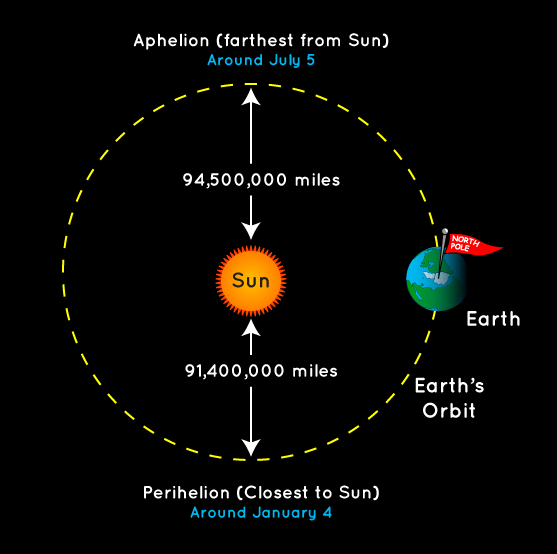
In 2026, Earth reaches aphelion on July 6. At that point, it is about 94.5 million miles, or roughly 152 million kilometers, from the Sun. Six months earlier, at perihelion, Earth was about 91.4 million miles, or about 147 million kilometers, from the Sun. The difference is real, measurable, and important to astronomy. It is also small compared with the average Earth-Sun distance, and its effect on daily weather is much weaker than the effect of Earth’s tilted axis.
What aphelion actually means
Aphelion is the point in a planet’s orbit when it is farthest from the Sun. Perihelion is the opposite point, when the planet is closest. These words come from Greek roots connected to distance and the Sun, and they apply because Earth’s path is not a perfect circle. It is an ellipse, a slightly stretched shape, with the Sun a little off center.
Earth’s orbit, however, is only mildly elliptical. If it were drawn to scale on a page, most people would have trouble seeing the difference between the orbit and a circle. That is why the distance change can sound larger than it feels. A difference of more than 3 million miles is enormous by everyday standards, but it is only a small fraction of the full distance between Earth and the Sun.
NASA Space Place and NOAA educational materials both use the same basic figures: about 91.4 million miles at perihelion and about 94.5 million miles at aphelion. Those numbers help explain why distance alone cannot be the seasonal switch. If closeness to the Sun caused summer, the Northern Hemisphere would have its warmest season around January, when Earth is closest. Instead, northern summer begins near the June solstice and continues through the weeks surrounding July aphelion.
Why the distance explanation feels tempting
The distance idea feels reasonable because people connect nearby heat sources with stronger warmth. Stand close to a campfire, lamp, or stove, and the effect is obvious. Move farther away, and the heat weakens. It seems natural to imagine Earth working the same way with the Sun.
The problem is scale. A person can move from one foot to several feet away from a small heat source, greatly changing the fraction of energy that reaches the body. Earth’s yearly distance change is much smaller in proportion. The Sun is so far away that the difference between January and July is not enough to overpower the geometry of sunlight caused by the planet’s tilt.
There is another reason the misconception survives: most simple drawings exaggerate Earth’s orbit. Textbook diagrams often stretch the ellipse so students can see that it is not circular. That makes the shape easier to notice, but it can also make the distance change look far more dramatic than it is. A good diagram teaches the idea; a scale-aware explanation keeps the diagram from misleading the reader.
Tilt changes sunlight more than distance does
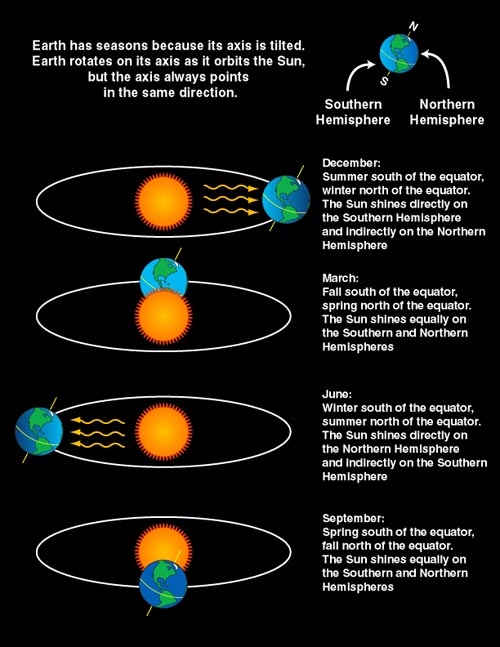
Earth’s axis is tilted by about 23.5 degrees compared with the plane of its orbit. As Earth travels around the Sun, that axis keeps pointing in nearly the same direction in space. During June and July, the Northern Hemisphere leans toward the Sun. During December and January, it leans away. The Southern Hemisphere experiences the opposite pattern.
That tilt changes two things at once: the angle of sunlight and the length of daylight. In northern summer, sunlight arrives more directly. The same amount of solar energy is concentrated over a smaller surface area, so it warms the ground more effectively. The Sun also stays above the horizon longer, giving the surface more time to absorb energy during the day.
In northern winter, sunlight comes in at a lower angle and spreads across a wider area. Days are shorter, so there are fewer hours for warming. This is why a cold January afternoon can happen even when Earth is closer to the Sun than it will be in July. The hemisphere is receiving sunlight less directly and for less time.
Why aphelion still matters
Aphelion does not cause summer, but it is not meaningless. It is part of the larger shape and rhythm of Earth’s orbit. Johannes Kepler’s work on planetary motion showed that planets travel in ellipses and move at different speeds along their orbits. A planet moves slightly faster when it is closer to the Sun and slightly slower when it is farther away.
For Earth, that means the planet moves a bit more slowly near aphelion than near perihelion. This affects the lengths of the seasons by a small amount. Northern Hemisphere summer is slightly longer than northern winter because Earth is moving more slowly along its orbit during that part of the year. The difference is not something most people notice day to day, but it is a real consequence of orbital motion.
Aphelion also helps students separate astronomy from weather in a useful way. Weather is local and immediate: clouds, wind, humidity, oceans, land surfaces, and pressure systems all matter. Seasons come from a planet-scale pattern of sunlight. Orbit shape belongs to an even larger celestial pattern. The three are connected, but they are not interchangeable.
What aphelion teaches about seasons
Aphelion is a useful reminder that the obvious answer is not always the correct one. July feels hot in much of the Northern Hemisphere not because Earth is closer to the Sun, but because the northern half of the planet is tilted toward stronger, longer-lasting sunlight. At the same time, the Southern Hemisphere is tilted away, even though both hemispheres share the same planet-Sun distance.
This is why people in Australia, South Africa, Argentina, and New Zealand experience winter when people in the United States, Canada, Europe, and much of Asia experience summer. Everyone is riding the same orbit, but each hemisphere receives sunlight from a different angle. The difference is not where Earth is in distance alone. It is how Earth is positioned.
The U.S. Naval Observatory describes the seasons through the angle between Earth’s rotation axis and its orbital plane. NASA and NOAA make the same point for younger learners: the tilt determines where sunlight is most direct. Aphelion adds a memorable twist to that explanation because it happens when the Northern Hemisphere is warmest, not coldest.
A small distance change, a big lesson
When Earth reaches aphelion on July 6, 2026, it will be at its farthest point from the Sun for the year. That fact is worth noticing, especially because it challenges a simple but mistaken idea about the seasons. Earth’s orbit is slightly stretched, and its distance from the Sun does change. But the cycle of summer and winter depends mostly on axial tilt, daylight length, and the angle at which sunlight reaches the ground.
The lesson is larger than one date on the astronomy calendar. Many natural patterns make sense only when scale is handled carefully. A few million miles can be both huge in human terms and modest in planetary terms. A tilted axis can matter more than a change in distance. The sky often teaches through details like that: the truth is not always harder than the simple explanation, but it is usually more interesting.





Add comment