
 Akshay Dinesh
A flash of lightning can make a whole sky seem to split open, but the sound often arrives a few seconds later. That delay is not a trick of the storm. Lightning and thunder are born from the same event, but they travel through the air in very different ways. Light moves so quickly that it reaches your eyes almost instantly, while sound takes time to cross the distance between the storm and your ears.
That simple delay opens the door to a much richer question: how does a storm build enough electric charge to make lightning, and why does that flash create thunder at all? The answer brings together moving air, ice particles, electric fields, heat, pressure, and sound waves. It is one of the clearest everyday examples of physics happening in the open sky.
A Thunderstorm Is an Electric Machine
Thunderstorms begin with rising air. Warm, moist air near the ground lifts upward, cools, and forms clouds. Inside a growing storm cloud, strong updrafts and downdrafts move water droplets, ice crystals, and small hail-like particles called graupel through different layers of temperature. Those collisions help separate electric charge inside the cloud.
The National Severe Storms Laboratory describes lightning as a giant spark of electricity that can happen within a cloud, between clouds, or between a cloud and the ground. In many storms, the upper part of the cloud tends to become more positively charged, while lower regions often become more negatively charged. The exact pattern can vary, but the important idea is that the storm is building an electric imbalance. Nature keeps trying to even that imbalance out.
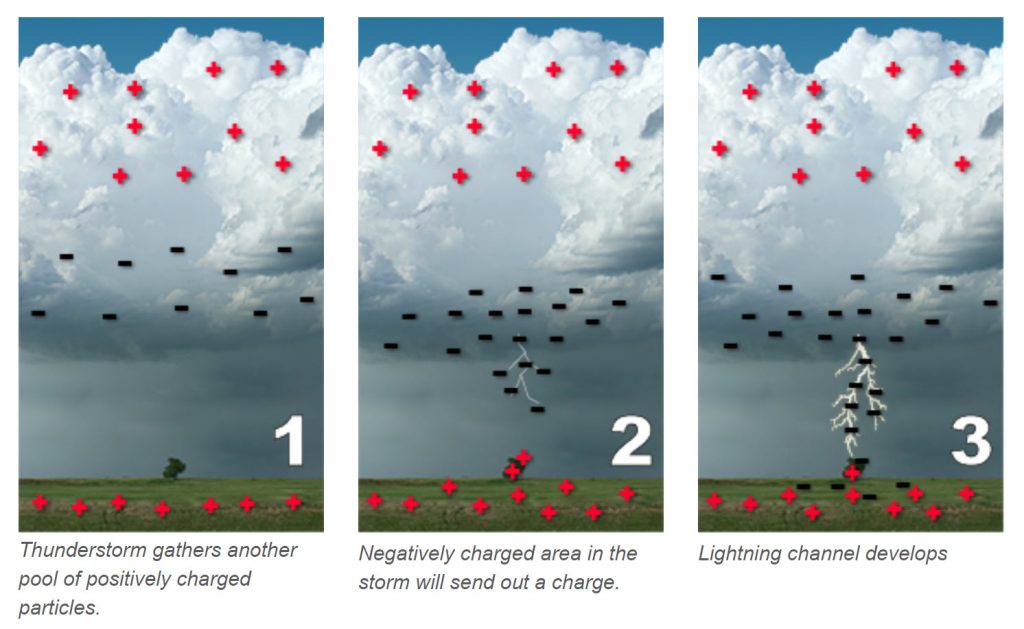
Air normally acts as an insulator, meaning electric charge does not flow through it easily. But if the electric field becomes strong enough, the air begins to break down. A thin channel of ionized air forms, creating a path where electric current can move. That path may stay inside the cloud, jump to another cloud, or connect with the ground.
What Happens During a Lightning Flash
A cloud-to-ground lightning flash does not usually happen as one smooth line from sky to earth. It begins in stages. A faint, branching path called a stepped leader moves downward from the cloud in short jumps. At the same time, objects on the ground can send small upward streamers toward the descending charge.
When one of those upward streamers connects with the leader, a powerful return stroke races back up the channel. That return stroke is the bright flash people usually see. The whole process happens extremely fast, often too fast for the eye to separate into steps. What looks like a single bolt may actually include several pulses along the same path.
Most lightning does not strike the ground. NSSL notes that many more flashes remain inside clouds than travel from cloud to ground. Cloud flashes can light up the sky without a visible bolt reaching the surface, which is why a storm can flicker from within like a lantern behind a curtain. Ground strikes are less common, but they matter most for people, trees, buildings, power lines, and wildfires.
Why Thunder Is the Sound of Sudden Expansion
Thunder is not produced because clouds crash together. It is the sound made when lightning heats the air around its channel with astonishing speed. NOAA’s severe weather education materials explain that air in the lightning channel can heat to above 50,000 degrees Fahrenheit in only a few millionths of a second. That is hotter than the surface of the Sun, though the heated path is narrow and brief.
When air is heated that suddenly, it expands violently. The surrounding air is pushed outward, creating a pressure wave. That pressure wave travels as sound. Close to the strike, the sound may arrive as a sharp crack or explosive bang because the pressure wave is strong and nearby.
Farther away, thunder often becomes a low rumble. A lightning channel can stretch for miles and branch in many directions, so sound from different parts of the channel reaches you at slightly different times. Hills, buildings, temperature layers, and wind can also bend or scatter the sound. That is why thunder can roll, fade, return, and seem to move across the sky.
Light Wins the Race Against Sound
Lightning and thunder happen at nearly the same moment, but they do not travel at the same speed. Light moves through air so fast that, for ordinary storm distances, the delay is too small to notice. Sound is much slower. Near the ground, sound travels roughly one fifth of a mile per second, though the exact speed changes with temperature and humidity.
This difference gives people a simple way to estimate distance. Count the seconds between the lightning flash and the thunder. Divide by five to estimate the distance in miles. If the thunder arrives ten seconds after the flash, the lightning was about two miles away. If it arrives in five seconds, the strike was about one mile away.
The method is only an estimate, but it is useful because it connects a dramatic sky event to a measurable physical pattern. A longer delay means the lightning was farther away. A shorter delay means it was closer. If the flash and sound arrive almost together, the strike was very near.

Why Some Lightning Seems Silent
Sometimes lightning appears on the horizon without thunder. People often call this heat lightning, especially on warm summer nights, but it is usually ordinary lightning from a storm too far away for the thunder to reach clearly. The flash can be seen over long distances, especially at night, while the sound weakens as it spreads through the air.
Sound also has to travel through a complicated atmosphere. Wind, terrain, buildings, and layers of warmer or cooler air can reduce, redirect, or blur thunder before it reaches a listener. A distant flash may light up the clouds beautifully while its sound is absorbed or bent away. The lightning is real, but the thunder is too faint or distorted to notice.
The opposite can happen as well. A storm may produce thunder that seems louder than expected because the lightning channel is close, long, or shaped in a way that directs sound toward you. The sky is not a flat screen. It is a deep, moving space, and the sound of thunder carries information about distance, direction, and the shape of the flash that produced it.
Reading the Storm With Physics
Lightning is one of the few natural events where electric charge, heat, light, and sound become visible in a single moment. A storm separates charge as ice and water particles move through turbulent air. When the imbalance becomes strong enough, electricity forces a path through the atmosphere. The flash races outward as light, while the heated air expands into thunder.
The delay between the flash and the sound turns that physics into something anyone can observe. Counting the seconds after a flash is not just a safety habit; it is also a measurement of how sound moves through air. It shows why the same storm can seem distant and beautiful one minute, then suddenly close and forceful the next.
The safest interpretation is simple: if thunder can be heard, lightning is close enough to matter. The National Weather Service teaches that no outdoor place is safe near a thunderstorm, because lightning can strike outside the heaviest rain and sometimes before the storm seems directly overhead. The science is fascinating, but it is also practical. The flash tells you energy has moved through the sky; the thunder tells you the storm is within hearing range; together, they remind you that the atmosphere is alive with forces much larger than they appear from the ground.





Add comment