

 Akshay Dinesh
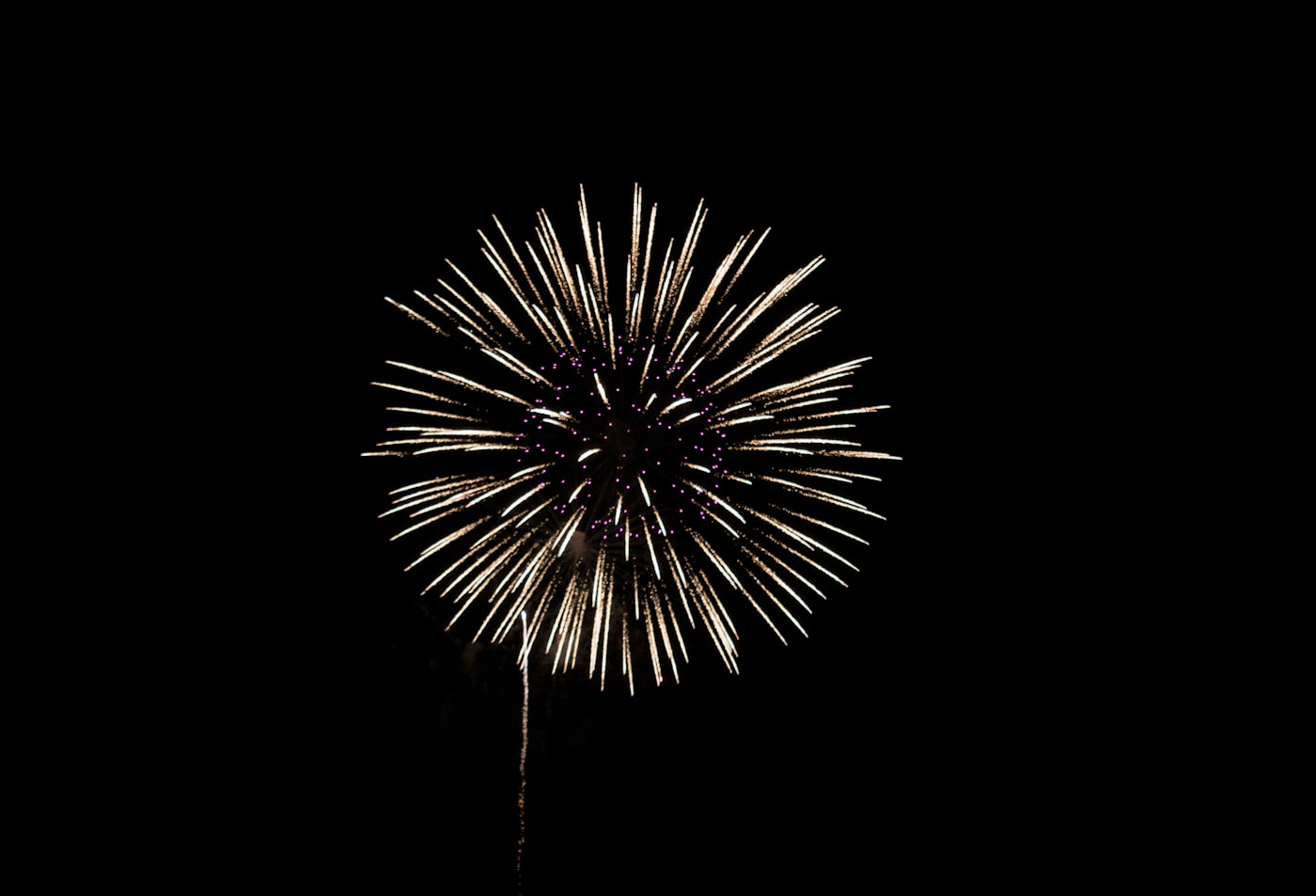
A fireworks show is not only a light show. It is also a carefully timed soundscape: the deep boom that arrives after a shell opens, the sharp crackle that scatters across the sky, the rising whistle that makes people look up before the burst. Those sounds may feel random from the ground, but they come from design choices inside the firework. Chemistry provides hot gas and fast reactions. Physics turns those reactions into pressure waves, vibration, pitch, and loudness.
The delay between flash and sound gives away one basic fact right away. Light reaches your eyes almost instantly at ordinary viewing distances, while sound travels much more slowly through air. That is why a distant aerial shell can appear to bloom silently for a moment before the boom rolls across the crowd. The sound is the slower messenger, carrying the violence of a sudden pressure change after the color has already arrived.
The Boom Starts With a Sudden Pressure Wave
The simplest fireworks sound is the boom. Aerial shells contain a bursting charge that opens the shell and throws glowing stars outward. When that charge burns extremely quickly, it produces hot expanding gases. Those gases shove nearby air outward, and that moving disturbance travels as a pressure wave. Your ear detects the rapid pressure change as sound.
A louder boom usually means the pressure change is stronger, the shell is larger, the burst is closer, or the surrounding air and landscape are carrying the sound efficiently. The American Institute of Physics describes pyrotechnics as the science of combining materials that release heat, light, gas, smoke, and sometimes sound. In a boom, the gas part matters most. The firework does not need to push air for very long; it needs to push it suddenly.
That suddenness is why the sound feels different from a steady musical note. A violin string, a flute, or a speaker can vibrate in repeated patterns. A firework burst is closer to an impulse: a short, forceful event that spreads through the air in every direction. The first pressure jump gives the bang its edge, and reflections from buildings, hills, water, or clouds can stretch the sound into a rolling echo.
Why Whistles Need Tubes, Gas, and Vibration
A whistle is more controlled than a boom. Instead of one quick burst, a whistling firework uses a small tube or chamber where burning material produces gas in a narrow space. As gas escapes, the air inside and around the tube vibrates. If the design supports a steady pattern of vibration, the result is a clear rising or falling tone rather than a blunt bang.
Inside Science, a science news service of the American Institute of Physics, explains that whistling fireworks use a narrow tube with a tightly packed chemical mixture and an empty space that vibrates when the device burns. That is the same broad idea behind many whistles outside fireworks: moving air becomes organized into repeated pressure changes. The exact pitch depends on the firework’s composition, tube shape, gas flow, and motion through the air.
Some fireworks seem to scream upward because the sound source is moving as it burns. Motion can change how the pitch reaches the listener, and a changing burn rate can change the gas flow inside the tube. The ear hears that as a sound that climbs, bends, or wavers. A whistle, then, is not just a small explosion. It is a tiny acoustic instrument powered by a chemical reaction.
Crackles Come From Many Tiny Bursts
Crackling fireworks work differently. The sound is broken into many small snaps instead of one large boom or one smooth whistle. Pyrotechnicians can create that effect with small pellets often called crackling stars or microstars. These tiny units burn, heat up, and then pop, scattering many little pressure waves close together in time.
The chemistry is part of the character of the sound. Inside Science describes crackling microstars as pellets that contain metal powders mixed with other chemicals; they burn brightly and then burst with a sharp crackle. Because many pellets ignite and pop at slightly different moments, the ear receives a cluster of small attacks. That is why crackle sounds textured, almost like dry twigs snapping or static breaking apart.
Particle size, mixture, packing, and timing all matter. A fine powder may burn smoothly, while larger particles or layered mixtures can create delayed popping. The same general firework shell can therefore produce different sounds depending on what is packed inside it. Color tells you what atoms and compounds are emitting light; sound tells you how the burning material is moving gas, vibrating air, and breaking apart.
Distance Changes What the Audience Hears
People watching the same display from different places may not hear exactly the same show. Close to the launch site, the first bang can be sharp and percussive. Farther away, higher-pitched details may fade faster than low rumbles, and echoes can blur separate bursts together. Humid air, wind direction, buildings, trees, and open water all affect how sound travels.
This is one reason a large professional display can feel huge even when the shells are far away. Low-frequency sound travels well and can be felt in the chest, while bright crackles and whistles add detail above it. The audience experiences a layered mix: flash first, then pressure, then echo. A good display uses timing so the sounds do not merely follow the light but help shape the rhythm of the whole scene.

There is also a simple observation anyone can make from a safe viewing area: count the seconds between a bright burst and its boom. Sound travels through air at roughly a few hundred meters per second, so the longer the pause, the farther away the burst is. The exact distance depends on air temperature and other conditions, but the delay still turns a fireworks show into a live demonstration of wave speed.
Loudness Is Part of the Design and Part of the Risk
Fireworks sound impressive because it is intense. That intensity deserves respect. The National Institute on Deafness and Other Communication Disorders explains that long or repeated exposure to sounds at or above 85 decibels can contribute to noise-induced hearing loss, and louder sounds need far less time to cause harm. Fireworks are brief, but they can be very loud, especially at close range.
The U.S. Consumer Product Safety Commission also tracks fireworks injuries each year, reminding the public that fireworks are not ordinary toys or decorations. For an educational look at sound, the lesson is straightforward: the same pressure waves that make a display exciting are physical energy reaching the ear. Distance, barriers, and hearing protection reduce exposure because they reduce how much of that energy reaches the listener.
This does not make the science less beautiful. It makes it more complete. The boom is not magic; it is expanding gas pushing air. The whistle is not a mystery; it is vibration shaped by a tube and a burning mixture. The crackle is not random noise; it is many tiny bursts arriving in quick succession. Fireworks sound dramatic because chemistry releases energy quickly and physics gives that energy a way to travel.
The Sky Show Is a Lesson in Waves
Fireworks are often remembered for color, but their sounds are just as carefully built. A shell designer can choose materials that glow, burn, whistle, pop, or explode. A display designer can arrange those effects so one burst answers another, a quiet sequence builds into a loud finale, or a rising whistle sets up a sudden bloom of light. The audience hears design through the movement of air.
That is what makes the snap, crackle, whistle, and boom worth noticing. Each one is a small lesson in how matter stores energy, how reactions release gas, how vibration creates pitch, and how pressure waves carry information across open space. A fireworks show may last only a few minutes, but inside those few minutes is a compact demonstration of chemistry, acoustics, motion, and human perception working together in the night sky.




Add comment