

 Akshay Dinesh
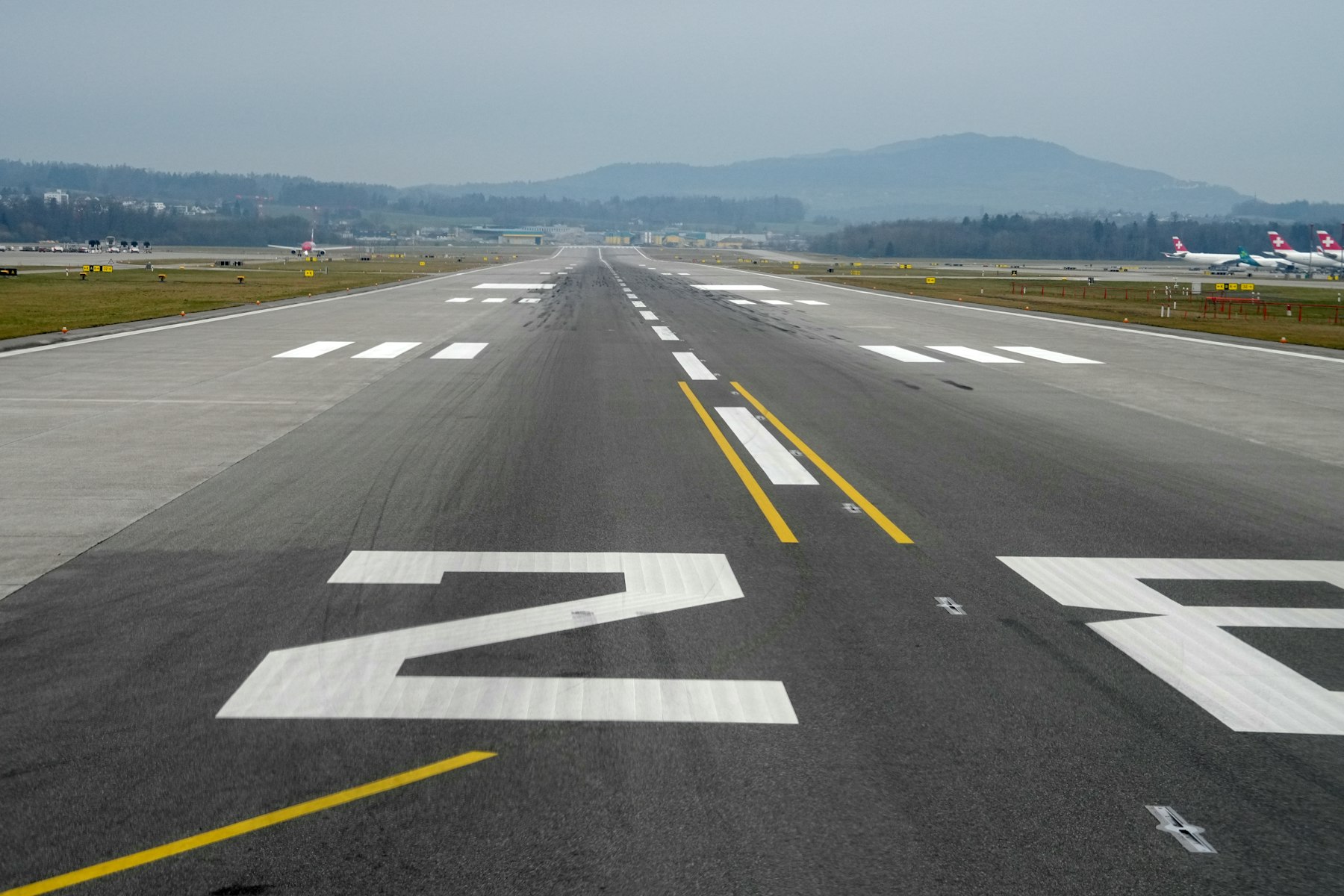
The giant numbers painted at the end of an airport runway are not random labels. They are short compass clues. When a pilot sees Runway 27, the number is pointing toward a direction close to 270 degrees, or west. When a pilot hears Runway 09, the aircraft is lined up roughly east. A runway number turns a long strip of pavement into a clear direction that pilots, air traffic controllers, airport signs, and charts can all share quickly.
That simple idea hides a neat piece of physics and geography. Runway numbers are tied to magnetic direction, not ordinary street-style numbering. They depend on compass headings, Earth’s magnetic field, and the approach direction of the aircraft. They can even change over time because magnetic north slowly moves. Once the system makes sense, a runway sign starts looking less like a code and more like a practical language for motion.
The Number Is a Rounded Compass Heading
A compass circle has 360 degrees. North is 360 degrees, east is 90 degrees, south is 180 degrees, and west is 270 degrees. Airports do not paint all three digits on the runway because pilots need something quick and readable from a moving aircraft. Instead, the heading is rounded to the nearest 10 degrees and the final zero is dropped.
The Federal Aviation Administration explains runway designators this way in its Aeronautical Information Manual: the runway number is the whole number nearest one-tenth of the runway centerline’s magnetic azimuth, measured clockwise from magnetic north. In everyday terms, take the compass direction, round it, and shorten it. A runway aligned close to 183 degrees becomes Runway 18. A runway aligned close to 87 degrees becomes Runway 09.
That is why runway numbers range from 01 through 36. There is no Runway 00 because a north-facing runway is labeled 36, matching 360 degrees. The leading zero on numbers such as 04 or 09 helps keep the format clear, especially in speech and on signs. Pilots usually say each digit separately, so Runway 09 becomes “runway zero niner” in aviation radio language.
One Runway Usually Has Two Numbers
A runway is used from either end, so the same pavement normally has two designators. The two numbers are always about 180 degrees apart. Since runway numbers are compass headings divided by 10, opposite ends usually differ by 18. A runway labeled 09 from one direction is labeled 27 from the other. A runway labeled 18 from one end is labeled 36 from the other.
Imagine standing on one end of a straight road and facing east. Your compass heading is about 90 degrees, so that end would be 09. Turn around and face the other way. Now you are looking west, around 270 degrees, so the opposite end is 27. Nothing about the pavement changed. Only your direction changed.
This matters because aircraft take off and land into the wind when possible. If the wind shifts, the airport may use the same physical runway in the opposite direction. A traveler might hear that flights are landing on Runway 27 in the morning and Runway 09 later in the day. That does not necessarily mean planes moved to a different strip of pavement. It may mean the traffic flow reversed to match the wind.
Letters Solve the Parallel Runway Problem
Large airports often have two or three runways pointing in nearly the same direction. If two parallel runways both point around 270 degrees, giving both of them the same number would be confusing. The numbering system adds letters: L for left, R for right, and C for center.
The left and right labels depend on the pilot’s approach direction. If an aircraft is lined up with parallel runways and approaching from the east toward the west, the runway on the pilot’s left may be 27L and the one on the right may be 27R. From the opposite direction, those same strips receive the opposite-end numbers, and the left-right relationship is judged from that new approach direction.
At very large airports with more than three parallel runways, the system may adjust one pair of numbers slightly so the labels remain distinct. The point is not mathematical perfection for its own sake. The point is to keep radio calls, signs, charts, and cockpit decisions unambiguous. At runway speeds, a clear label is a safety tool.
Magnetic North Is Not Fixed in Place
The reason runway numbers can change is that they are based on magnetic north. A compass needle points toward Earth’s magnetic field, not exactly toward the geographic North Pole. The angle between true north and magnetic north is called magnetic declination, and it varies from place to place. It also changes over time as Earth’s outer core keeps moving and reshaping the magnetic field.
NOAA’s National Centers for Environmental Information has noted that airport runway names can shift with the magnetic field. If the magnetic heading of a runway drifts far enough, the rounded runway number may no longer match the best compass label. At that point, airports may need to repaint runway numbers, update signs, revise charts, and coordinate the change across many systems.
Denver International Airport offers a useful example. NOAA has described how one Denver runway labeled 17L-35R had a magnetic orientation near 172.5 degrees. If magnetic change eventually pushes the rounded heading far enough, that runway could become 18L-36R. The concrete would stay in the same place, but the compass-based name would catch up with the new magnetic reading.

The Markings Work With Signs, Charts, and Radio Calls
The runway number is only one part of the airport’s visual language. White centerline markings help pilots stay aligned. Threshold markings show the beginning of the usable landing area. Aiming point markings help pilots judge where the aircraft should touch down. Taxiway markings and runway holding position markings help keep aircraft from entering active runway areas without clearance.
The FAA’s marking standards emphasize uniformity because pilots move between airports constantly. A pilot who learned the markings at a small regional airport needs to recognize the same basic patterns at a major international airport. Consistent paint and signs reduce the mental load in moments when timing, speed, weather, and communication all matter.
The number also connects to air traffic control instructions. A controller can clear an aircraft to land on Runway 24, and the pilot can match that instruction to the painted number, the airport diagram, the compass heading, and the approach path. The label gives everyone the same directional reference. It is short because aviation communication rewards clarity.
A Small Number Carries a Lot of Information
Runway numbers are a good reminder that practical systems often compress a large idea into a small mark. Two painted digits can tell a pilot which way the aircraft is facing, which end of the runway is in use, how the runway relates to the wind, and how to match the pavement with charts and radio instructions. Add a letter, and the label can distinguish parallel runways at busy airports.
The system also shows why navigation is never completely separate from the planet beneath it. Airports may look like fixed infrastructure, but their labels depend on a magnetic field that slowly changes. A runway can keep the same pavement, the same city, and the same airport code while its number eventually needs to shift. The paint follows the compass.
So the next time an aircraft lines up with a giant 18, 27, or 36 at the end of the runway, the number is doing more than decorating the pavement. It is translating direction into a form that pilots can see, say, and act on quickly. In a place where motion has to be carefully organized, that simple code earns its space in big white paint.





Add comment