

 Akshay Dinesh
An ambulance siren does not actually change its own note every time it passes a sidewalk. The sound seems to slide from higher to lower because the ambulance is moving while the sound waves are spreading through the air. That change is called the Doppler effect, and it appears whenever a wave source, an observer, or both are moving relative to each other. It is easiest to notice with sound, but the same idea helps scientists read weather radar, measure moving stars, and understand why light from distant objects can shift toward red or blue.
The key is not that waves speed up or slow down on their way to you. In ordinary air, sound still travels through the air at roughly the speed set by the air’s temperature and conditions. What changes is the spacing between the wavefronts that reach your ear. Shorter spacing means a higher frequency and a higher pitch; wider spacing means a lower frequency and a lower pitch.
Why a Moving Siren Sounds Higher, Then Lower
Picture a siren making regular pulses of sound. If the ambulance is parked, each pulse spreads outward in a roughly circular wavefront, and the spacing between one wavefront and the next stays even in every direction. A listener in front, behind, or beside the ambulance hears the same siren frequency, aside from ordinary changes in loudness.
Now let the ambulance move toward you. By the time it sends out the next pulse, it has moved a little closer to where you are standing. Each new wavefront starts from a position closer than the last one, so the wavefronts get crowded together in front of the ambulance. More wave cycles reach your ear each second, so the siren sounds higher than it would if the vehicle were still.
After the ambulance passes, the opposite happens. Each new pulse starts from a point farther away, stretching the spacing between the wavefronts that trail behind the vehicle. Fewer cycles reach your ear each second, so the pitch drops. NASA’s Imagine the Universe materials use the passing emergency vehicle as a classic example because the change is familiar enough to hear without instruments.

Frequency, Wavelength, and the Direction of Motion
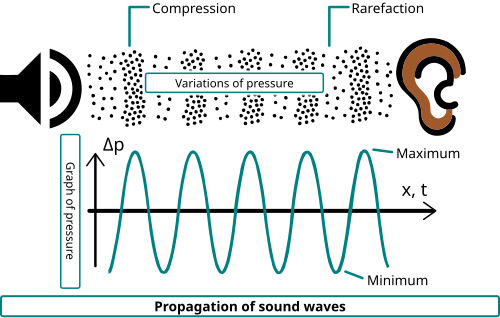
The Doppler effect is really a story about frequency and wavelength. Frequency counts how many wave cycles arrive each second. Wavelength measures the distance from one matching part of a wave to the next, such as crest to crest or compression to compression. For sound, higher frequency usually means higher pitch. For light, higher frequency moves toward the blue-violet side of the visible spectrum, while lower frequency moves toward the red side.
Direction matters. Only the part of motion toward or away from the listener changes the observed frequency in this way. If a vehicle moves straight toward you, the effect is strong. If it moves across your field of view, the pitch changes less because the distance between you and the siren is not shrinking or growing as quickly. That is why the pitch change often feels sharpest right as the vehicle passes close by: the motion changes from mostly approaching to mostly receding in a short time.
A common mistake is to think the siren “throws” sound forward faster, as if the vehicle’s speed gets added to the sound’s speed. That is not what your ear is noticing. The sound wave still travels through the air according to the medium. The moving source changes where each new wavefront begins, which changes the spacing you receive.
Why the Effect Is Bigger at Higher Speeds
A walking person carrying a small speaker can create a Doppler shift, but the change is usually too small to notice. A fast car, train, motorcycle, or ambulance makes the shift much easier to hear because the source moves a meaningful distance between one wavefront and the next. The faster the source moves toward you, the more tightly the wavefronts are packed in front. The faster it moves away, the more stretched the wavefronts become behind it.
The effect becomes dramatic when an object moves near the speed of sound. At that point, wavefronts pile up strongly because the source is nearly keeping up with the waves it sends forward. If an aircraft travels faster than sound, it outruns its own pressure waves and forms a shock wave. The sharp pressure change reaches listeners as a sonic boom, which is related to the same wavefront crowding idea but much more extreme than the pitch change from a passing siren.
For ordinary classroom examples, though, the siren remains the best starting point because it connects the math to a real sensation. You do not need to see the wavefronts to hear their spacing change. Your ear turns the arrival rate of pressure waves into pitch, and the moving source changes that arrival rate.
How Doppler Radar Reads Motion in Storms
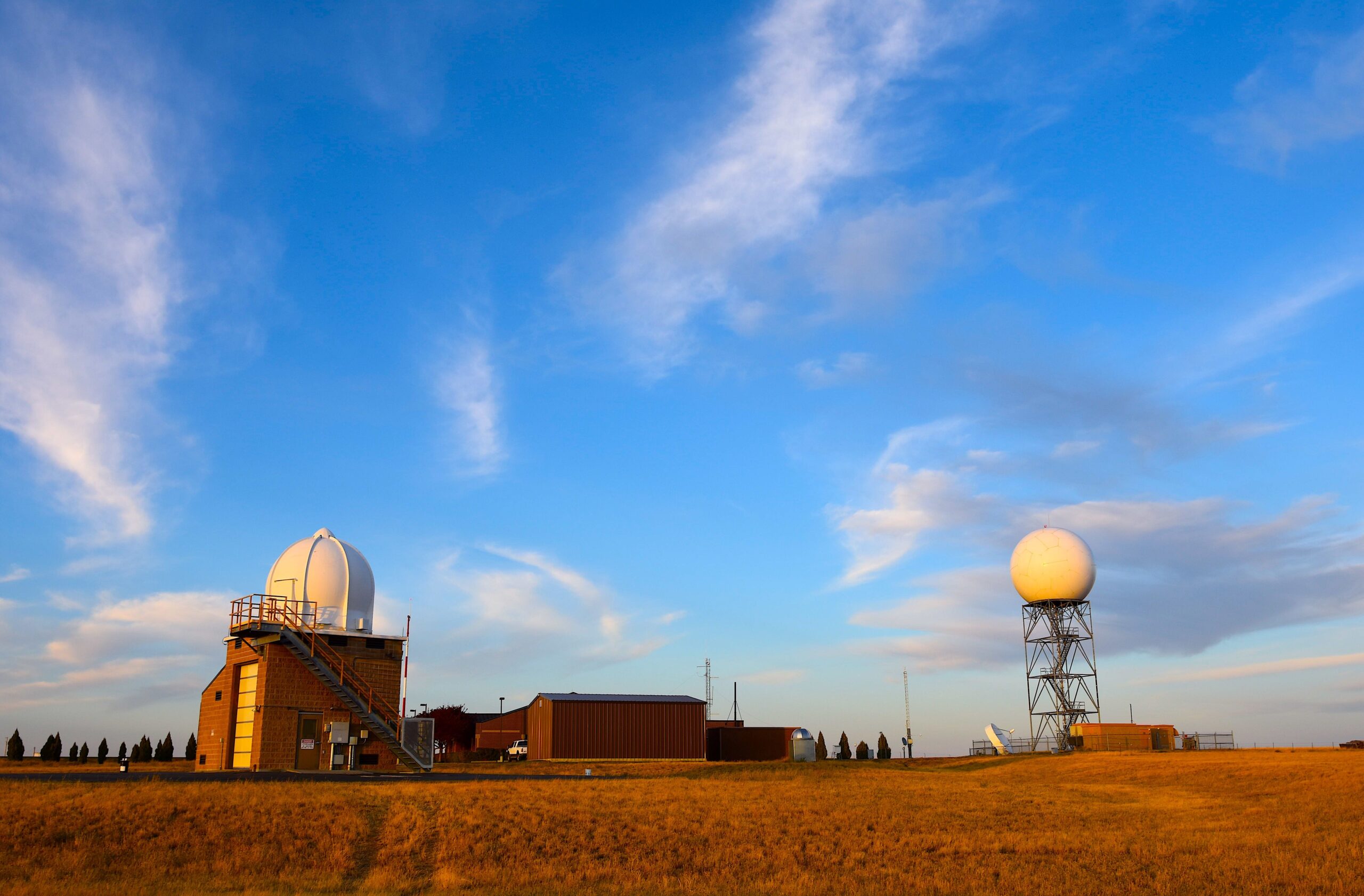
Weather radar uses the same broad idea with radio waves instead of sound. A radar sends out pulses of electromagnetic waves and listens for echoes that bounce back from raindrops, snowflakes, hail, or other targets. The National Weather Service explains that Doppler radar can measure motion toward or away from the radar by tracking changes in the returning signal. This toward-or-away component is called radial velocity.
That detail is important because radar does not see every part of the wind equally. Motion straight toward the radar or straight away from it produces the clearest Doppler signal. Motion mostly across the radar beam is harder to read from velocity alone. Meteorologists use this information with reflectivity, storm structure, nearby radars, and the larger weather pattern to understand what a storm is doing.
Velocity data can show rotation inside storms, wind shifts along boundaries, and areas where air is moving quickly toward or away from the radar site. That does not make radar a magic storm camera, but it gives forecasters a powerful way to read motion inside clouds that people on the ground cannot see directly. The same wave principle that makes a siren dip in pitch helps a radar screen reveal moving air and precipitation.
Why Astronomers Use Redshift and Blueshift
The Doppler effect also works with light, although people do not hear light as pitch. When a light source moves toward an observer, its wavelengths can be compressed toward shorter wavelengths, a shift often called blueshift. When a light source moves away, its wavelengths can stretch toward longer wavelengths, called redshift. NASA’s astronomy education materials use spectral lines to explain this: patterns in a star’s spectrum can shift from their expected positions when the star is moving toward or away from us.
This does not usually mean a star visibly turns blue or red to the naked eye. The shifts are often small and measured with instruments. Astronomers compare observed spectral lines with known lines measured in laboratories. If the whole pattern has shifted, the difference can reveal motion along the line of sight. That is how scientists can study the wobble of some stars, the motion of galaxies, and other movements far beyond direct human experience.
Redshift in cosmology can involve more than ordinary motion through space, especially when the expansion of the universe stretches light from very distant galaxies. Still, the everyday siren example gives a useful doorway into the larger idea: waves carry information about motion. When their spacing changes in a consistent way, careful observers can work backward from the received wave to the movement that shaped it.
What the Doppler Effect Teaches About Waves
The Doppler effect matters because it turns motion into a readable change in waves. A listener hears it as a changing siren pitch. A meteorologist sees it as radar velocity. An astronomer measures it as a shift in spectral lines. In each case, the wave carries more than energy from one place to another; it carries clues about how the source and observer are moving relative to each other.
Once that idea clicks, the passing siren stops being just a city sound. It becomes a small demonstration of a principle that links streets, storms, and stars. The same pattern of compressed and stretched waves helps explain why motion changes what we hear, what instruments detect, and what scientists can infer from signals that began far beyond reach.





Add comment