
 Akshay Dinesh
A quiet room, a busy road, a school band rehearsal, and a fireworks show do not feel like points on a simple ruler. Sound grows too quickly for that. A small increase in a loudness number can represent a much larger change in the physical energy moving through the air, which is why ordinary arithmetic can make noise levels surprisingly easy to misread.
The decibel scale solves that problem by compressing a huge range of sound into numbers people can actually use. Instead of measuring sound with a long string of pressure values, decibels compare one sound to a reference level and report the ratio on a logarithmic scale. That sounds technical, but the idea is practical: a logarithmic scale lets one number cover whisper-quiet rooms, normal conversation, traffic, concerts, power tools, and jet engines without becoming absurdly large.
Once the scale makes sense, common sound labels start to look different. A 90 dB sound is not just a little more intense than an 80 dB sound. Two machines at 80 dB do not simply make 160 dB together. And a sound meter reading does not always match exactly how loud something feels to a listener, because the ear and brain respond to pitch, duration, distance, and expectation as well as raw pressure.
Why Sound Needs a Ratio, Not Just a Ruler
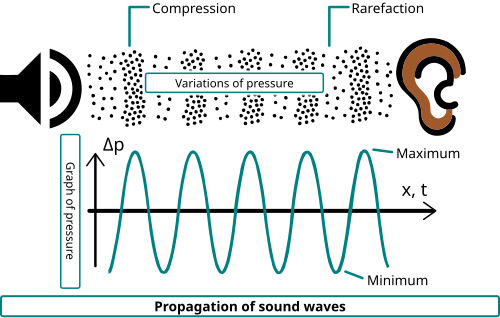
Sound begins as vibration. A speaker cone, guitar string, engine part, clapping hand, or vocal cord pushes and pulls nearby air molecules, creating pressure changes that travel outward as waves. When those pressure changes reach the ear, the eardrum and inner ear turn them into signals the brain can interpret as sound.
The pressure changes in ordinary sound are tiny compared with everyday air pressure. Air pressure around us is roughly 101,000 pascals at sea level, while the faintest sound a young healthy ear can detect near 1,000 hertz is often represented by a reference sound pressure of 20 micropascals, or 0.000020 pascals. At the other end, loud sounds can create pressure changes millions of times larger than that reference. A plain linear scale would have to stretch across an enormous range before it became useful.
That is where ratios help. A decibel reading does not tell you the pressure by itself. It tells you how a measured sound compares with a reference value. For sound intensity, the simplified relationship is:
dB = 10 log10(I / I0)
In that expression, I is the sound intensity being measured, and I0 is the reference intensity. The logarithm turns repeated multiplication into steady steps. If the intensity becomes 10 times larger, the level rises by 10 dB. If the intensity becomes 100 times larger, the level rises by 20 dB. If it becomes 1,000 times larger, the level rises by 30 dB.
Sound pressure level is often written a little differently because intensity is related to pressure squared. For airborne sound pressure, a common form is:
dB SPL = 20 log10(p / p0)
Here p0 is the reference sound pressure, usually 20 micropascals in air. The details matter for acoustics, but the reader-friendly takeaway is simpler: decibels are built for comparison. They are not ordinary units like meters or seconds. They are a compact way to say how many times stronger one sound-related quantity is than a reference.
What a Few Decibels Really Mean
The most useful decibel habit is to stop treating dB differences like ordinary subtraction. A difference of 3 dB is small on paper, but it is close to a doubling of sound intensity. A difference of 10 dB represents 10 times the intensity. A difference of 20 dB represents 100 times the intensity. The numbers climb gently while the physical sound energy grows in jumps.
That does not mean a 10 dB increase always feels exactly 10 times as loud. Human loudness perception is not a simple meter. Many listeners experience a 10 dB increase as roughly a doubling in perceived loudness, but perception depends on frequency, background noise, attention, and the kind of sound. A steady fan, a violin note, a barking dog, and a siren can have different emotional and sensory effects even if a meter shows similar readings.
The logarithmic scale also explains why combining sound sources is less obvious than it looks. If one vacuum cleaner measures 70 dB at a certain spot, adding another identical vacuum nearby does not make 140 dB. Because the sound intensities add before the logarithm is taken, two equal independent sources raise the level by about 3 dB, making the combined level about 73 dB under ideal conditions. Ten equal sources would raise it by about 10 dB.
This is why noise problems can build quietly. A room full of conversations, moving chairs, music, ventilation, and hallway noise may not contain one dramatic source, but the combined energy can still become tiring. The decibel scale helps reveal that accumulation. It turns a messy mix of vibrations into a number that can be compared, tracked, and managed.
Why dBA Is Not the Same as Raw Sound Pressure
Many noise readings are reported as dBA rather than just dB. The A means the measurement has been adjusted with A-weighting, a filter that roughly follows how human hearing responds to different frequencies at moderate sound levels. Human ears are not equally sensitive to every pitch. Very low rumbles and very high tones often need more physical energy to seem as loud as midrange sounds where speech carries much of its meaning.
A-weighting is especially common in environmental and workplace noise measurements because it gives a single number closer to how many everyday sounds affect human hearing. It is not perfect. A low-frequency bass thump may be felt in the body even when its A-weighted level seems less dramatic. A high-pitched whine can be irritating even when it does not dominate the total sound energy. Still, dBA gives a practical shared language for many real-world settings.
Time matters too. A short burst and a full workday exposure are different questions. Fireworks, dropped metal, and a balloon pop may spike briefly. A factory line, landscaping tool, or loud music practice can last much longer. Sound meters and safety standards often average levels over time because the risk from noise depends on both level and duration.
NIOSH, the National Institute for Occupational Safety and Health, uses 85 A-weighted decibels averaged over an eight-hour workday as its recommended exposure limit for occupational noise. NIOSH also uses a 3 dB exchange rate: when the sound level rises by 3 dBA, the recommended exposure time is cut in half because the sound energy roughly doubles. OSHA rules use their own regulatory framework, including a hearing conservation action level at an 85 dBA eight-hour time-weighted average. These thresholds are workplace standards, not a personal diagnosis, but they show why a few decibels can matter.

How Decibels Help People Make Sense of Everyday Sound
Decibels are useful because they connect physics to practical decisions. Audio engineers use them to balance recordings without overloading equipment. City planners use noise measurements when thinking about roads, airports, construction, and neighborhoods. Scientists use sound levels to study animal communication, ocean noise, and the effects of human activity. Workers and safety professionals use dBA readings to decide when hearing conservation steps are needed.
The same scale can also help students make better sense of everyday claims. If headphones, appliances, or tools list noise ratings, the difference between 50 dB and 60 dB is not a tiny nudge. If a classroom, cafeteria, or gym feels overwhelming, part of the reason may be the way many sound sources add together. If a phone app gives a rough noise reading, the number can be informative, but it is not the same as a calibrated professional sound meter. Microphone quality, placement, reflections from walls, and the type of weighting can all change the result.
Distance matters as well. In an open area, sound from a small source usually spreads outward, so the intensity drops as distance increases. Doubling the distance from a point-like source can reduce the sound level by about 6 dB in ideal free-field conditions. Real rooms are more complicated because walls, ceilings, floors, and furniture reflect and absorb sound. That is why a loud cafeteria, concert hall, or tiled hallway can feel different from an open field even when the source is similar.
Decibels also appear outside sound. Electronics, radio signals, antennas, audio gain, and communication systems use decibels because engineers often need to compare ratios across huge ranges. The same mathematical convenience that helps describe a whisper and a jet engine also helps describe signal strength and power changes. Once the logarithmic idea clicks, the scale stops being a mysterious noise label and becomes a general tool for comparing big differences clearly.
The Simple Idea Behind a Complicated-Looking Scale
The decibel scale can look intimidating because it brings together physics, logarithms, measurement equipment, and human hearing. Its central idea is friendly, though: sound varies across such a wide range that multiplication is more useful than ordinary counting. Decibels turn those multiplications into manageable steps.
That is why a 3 dB change can matter, why 10 dB is a large jump, and why sound levels do not add the way simple numbers do. A decibel reading is a comparison, not a direct pile of sound. It depends on reference values, weighting, distance, duration, and the kind of sound being measured.
Read with that in mind, decibels become less like a secret code and more like a map. They show how tiny pressure changes can become music, speech, warning signals, or unwanted noise. They also show why a small-looking number can carry a much larger physical change, which is exactly what a good scale is supposed to reveal.





Add comment