

 Akshay Dinesh
A river can flood in winter even when there has been little recent rain. One reason is an ice jam: a pileup of river ice that restricts the channel and forces water to rise behind it. The danger can extend downstream too, because a jam that suddenly gives way may release water and moving ice into communities below.
Ice jams are especially difficult to predict because the ice can shift, break apart, and lodge again somewhere else. Understanding the difference between a frozen river and a blocked one helps explain why a stretch that looked quiet in the morning can become a flood concern later in the day.
How an ice jam forms
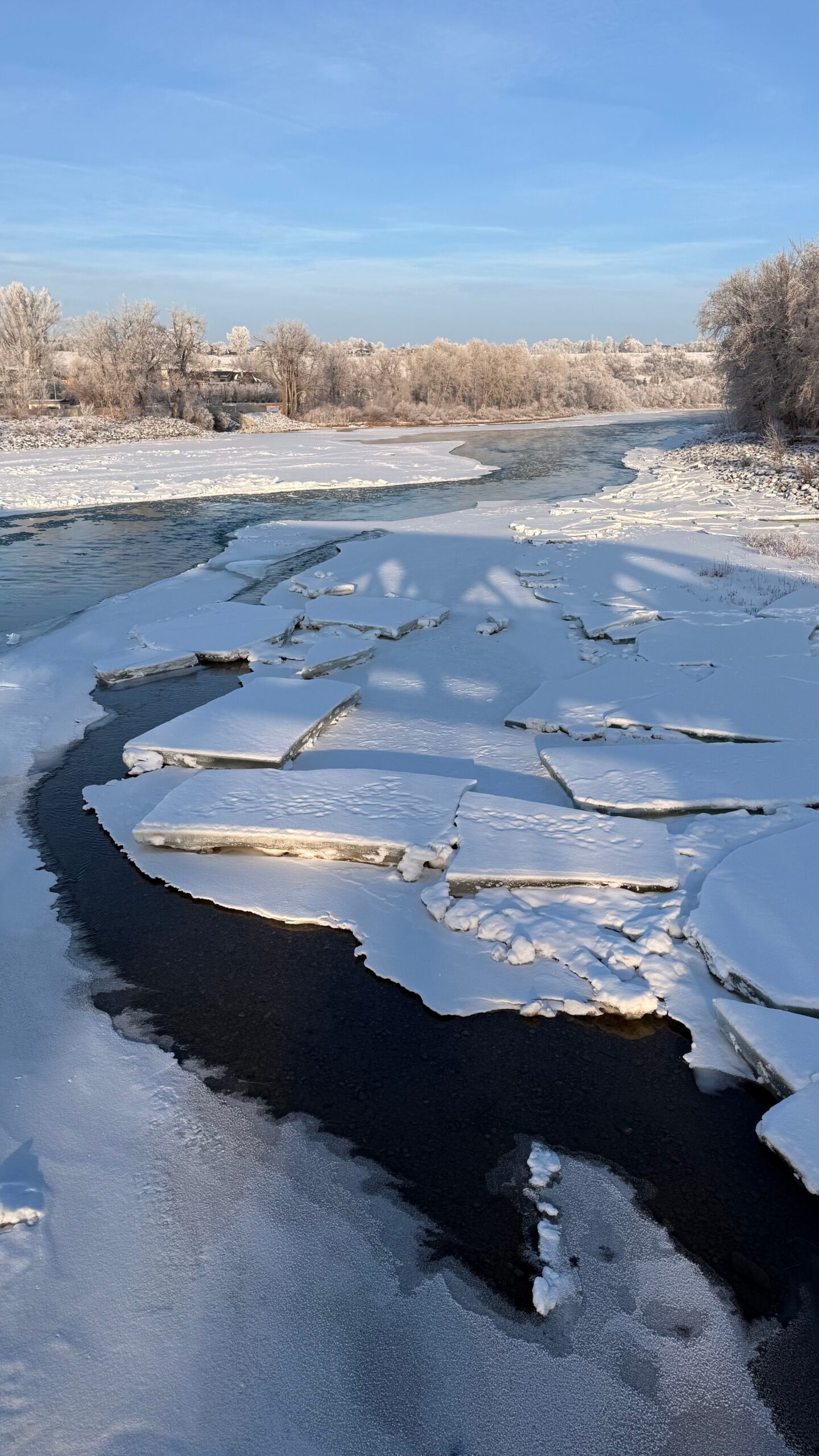
River ice does not always form as one smooth, stationary sheet. During a cold spell, ice can grow along the banks and across the surface while water continues moving underneath. Pieces of ice and slushy accumulations may collect where the channel slows or narrows, restricting the space available for flowing water. A jam that develops as ice forms is called a freeze-up jam.
Another kind develops when an existing ice cover breaks apart. Rising water, warmer weather, rain, or snowmelt can loosen and lift the ice, sending pieces downstream. Those pieces can catch on a bridge pier, island, bend, shallow stretch, or another section of intact ice. More ice may pile against the obstruction, producing a breakup jam.
A thaw does not automatically cause a jam, and a jam can form at more than one point along a river. The National Weather Service notes that breakup jams can move and form again downstream. The location and timing depend on the ice, the river channel, and the changing flow, which is why a forecast cannot simply name the day when a river will break up.
Why water rises upstream
Think of a river channel as a passage carrying water downhill. A jam occupies some of that passage and adds resistance to the flow. Water does not need to stop completely for the level upstream to rise: if water cannot move through and under the jam as readily as it arrives, it backs up. Hydrologists call the resulting elevated water level backwater.
The effect can be striking even when the river’s overall flow is not exceptionally high. The U.S. Geological Survey documented a jam on the Connecticut River in New Hampshire in February 2022 that produced about 12 feet of backwater. That figure describes the rise associated with that particular jam, not a rule for other rivers. Local channel shape, ice thickness, and flow all affect the outcome.
Backwater can spread onto roads and into buildings above the obstruction. A water-level reading at a single gauge may not describe conditions along the whole river, particularly if the jam lies between the gauge and a nearby neighborhood. A falling reading at one point is not, by itself, proof that every downstream area is safe.
What happens when a jam breaks
When a jam releases suddenly, water that had been held back can move downstream in a surge. Large pieces of ice may travel with it, striking banks, bridges, and other structures. The moving ice can then catch again, creating a new blockage and a new area of rising water. The hazards above and below a jam are therefore different, but they can occur during the same event.
In January 2024, a series of ice jams affected rivers in northern Illinois. The National Weather Service reported that the breakup of a jam on the Kankakee River led to rapid flooding near Wilmington, while other jams and high water affected additional locations. The episode shows why a temporary release does not necessarily mean the danger is over.
Why ice-jam floods are hard to forecast
Forecasters can monitor temperatures, precipitation, snowpack, river levels, and reports of ice movement. Those observations help identify conditions that favor a jam, but they do not reveal every underwater pileup or predict exactly when ice will shift. The National Weather Service works with river observers and emergency managers to track changing conditions and issue flood or flash flood warnings when warranted.
Ice also complicates the usual relationship between a river’s water level and its flow. At the same flow, an obstruction can produce a higher level upstream than an open channel would. A familiar river height from a previous open-water flood may therefore be a poor guide to precisely where ice-jam water will reach. Local warnings and official observations provide more useful context than trying to infer the risk from temperature alone.
What to do when flooding is possible
Follow forecasts and alerts from the local weather service and emergency officials, especially during a thaw or a period of rising river levels. Know more than one way out of a flood-prone area, and act promptly if officials advise evacuation. Never drive or walk through floodwater: its depth, current, and damage beneath the surface can be difficult to judge.
Keep away from river ice and do not approach a jam to inspect it. Ice can move without warning, and a bank or ice surface that looks solid may not be safe. Report observed flooding or ice movement to local authorities from a safe place, following local guidance.
Ice jams are a reminder that winter flooding is not simply summer flooding in colder weather. The position and movement of the ice can redirect the danger from one stretch of river to another. Paying attention to changing local information gives communities a better chance to respond before a blocked channel becomes an emergency.
Sources: National Weather Service, Ice Jams and Their Dangers and Mid-Late January 2024: Ice Jams and River Flooding; U.S. Geological Survey, Ice Jam on a River.



Add comment