

 Akshay Dinesh
A cell is the smallest unit of life. Some organisms consist of a single cell; others, including humans, contain many cells that work together in tissues and organs. All cells have a membrane, cytoplasm, genetic material, and ribosomes, but their internal structures differ. Comparing these structures helps explain how cells grow, make proteins, and obtain usable energy.
Cell Theory
Robert Hooke described and named cells after observing cork in 1665. Later observations by many researchers helped establish cell theory, which provides a foundation for understanding living organisms. Its central principles are:
- All living organisms are made up of one or more cells
- New cells arise from pre-existing cells through cell division
- The cell is the basic unit of structure and function in living things
Eukaryotes vs Prokaryotes
Cells are generally classified as prokaryotic or eukaryotic. Bacteria and archaea are prokaryotes: their cells lack a membrane-bound nucleus. Eukaryotic cells have a nucleus and other membrane-bound compartments; animals, plants, fungi, and many single-celled organisms are eukaryotes. Eukaryotic cells are often larger than prokaryotic cells, although sizes vary.
In a prokaryotic cell, the main DNA is usually concentrated in a region called the nucleoid, which is not enclosed by a membrane. Some prokaryotes also carry small DNA molecules called plasmids. In eukaryotic cells, most DNA is organised into chromosomes inside the nucleus; the nucleolus is a region within the nucleus involved in making ribosomes, not the storage site for all the cell’s DNA.
Eukaryotes
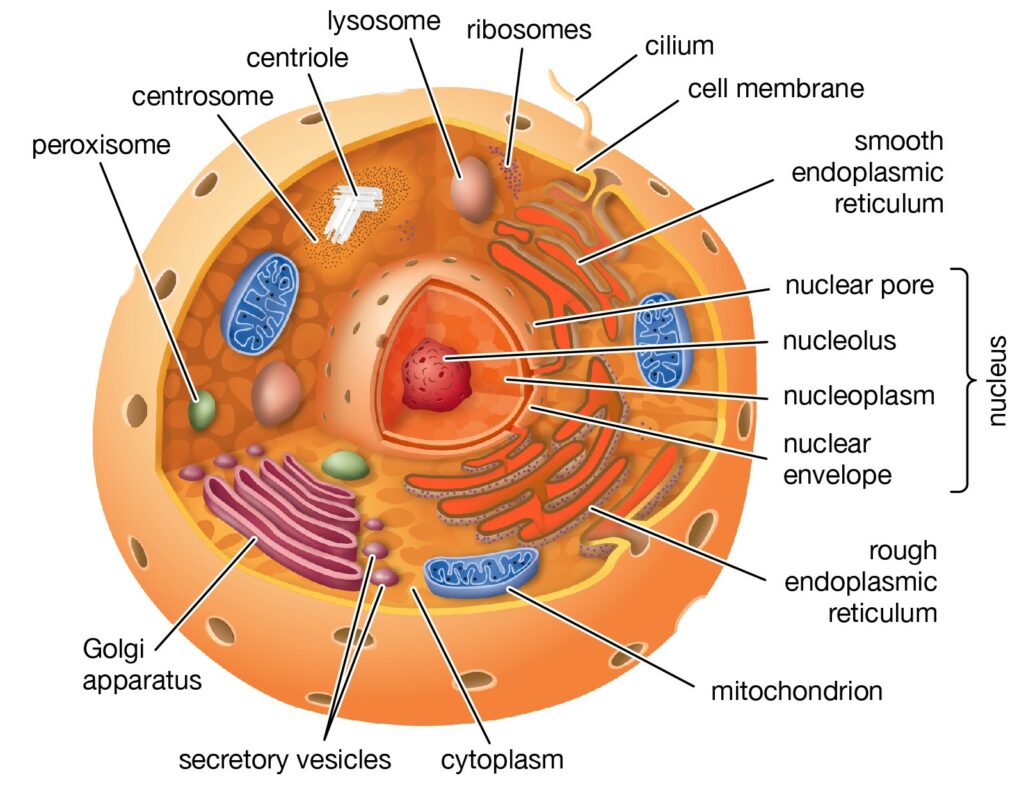
A typical eukaryotic cell has a cell membrane surrounding the cytoplasm and a membrane-bound nucleus. The cytoplasm contains cytosol, the cytoskeleton, and organelles. Cell structures vary: for example, plant cells have chloroplasts and a cell wall, whereas animal cells do not.
Cell Surface Membrane
The plasma membrane is mainly a phospholipid bilayer with embedded proteins. Some membrane lipids and proteins have carbohydrate chains attached. The fluid mosaic model describes a flexible membrane whose components can move within the layer; the membrane also regulates what enters and leaves the cell.
Nucleus
The largest organelle within the eukaryotic cell, the nucleus is an ovoid organelle bound by the nucleus envelope, a double membrane. The nucleus envelope has an outer membrane that is continuous with the endoplasmic reticulum, with nuclear pores that act as channels. These nuclear pores regulate the movement of substances in and out of the nucleus. The nucleus is filled with nucleoplasm.
The nucleus stores genetic materials that are necessary for the passing down of genetic information to the cell’s offspring. The genes in the nucleus are used as templates for the synthesis of proteins. On top of that, the nucleus is responsible for the activities within the cell through the expression of genes and the synthesis of proteins.
Nucleolus
The nucleolus is a dense region inside the nucleus where ribosomal RNA is produced and combined with proteins to assemble ribosomal subunits. These subunits leave the nucleus and join to form functional ribosomes. The nucleus also contains chromatin, DNA associated with proteins, distributed beyond the nucleolus.
Golgi apparatus
The Golgi apparatus is made up of a series of membranous sacs and tubules – the cisternae. Transport vesicles from the ER lumen fuse with the cis face of the Golgi apparatus, and secretory vesicles bud from the trans face.
The Golgi apparatus is responsible for chemically modifying, sorting, and packing proteins or lipids synthesised in the rER and sER, respectively. This helps to make the proteins and lipids specific to their function.
Lysosomes
Vesicles from the Golgi apparatus form lysosomes, which are small, spherical vesicles. They fuse with vesicles formed by endocytosis, releasing hydrolytic enzymes to digest the materials within the vesicles. Lysosomes also carry out autophagy – engulfing and digesting old and worn-out organelles. They are also responsible for the autolysis of the cell after cell apoptosis, digesting the contents within the cell.
Rough Endoplasmic Reticulum (rER)
The rER comprises interconnected cisternae. The rER is continuous with the outer membrane of the nuclear envelope, with ribosomes attached to the cisternae.
Protein synthesis and transport occur at the rER. The ribosomes on the cisternae synthesise the proteins before being sent to the membranes of the organelles, out of the cells, or into the lysosomes. These proteins are folded in the ER lumen before being packed into transport vesicles that bud off the surface of the rER.
Smooth Endoplasmic Reticulum (sER)
Similar to the rER, the sER is made up of cisternae, but without ribosomes attached. Lipids, such as hormones, are synthesised at the sER. On top of that, the sER is also responsible for detoxifying drugs and poisons and storing calcium ions needed for signal transduction and muscle contraction.
Chloroplast
Chloroplasts are large organelles bound by a double membrane found in plant cells. However, it has a third membrane, the thylakoid membrane, which forms a network of thylakoids. These thylakoids enclose the thylakoid space that is filled with fluids. That said, grana are formed when thylakoids are stacked and joined by intergranal lamellae.
Photosynthetic pigments like chlorophyll can be found in both the grana and the intergranal lamellae. Inside the chloroplast, the gel-like stroma contains circular DNA and several 70S ribosomes. Thus, chloroplasts are responsible for carrying out photosynthesis. Photosynthesis occurs on the thylakoid membrane, whereas the Calvin cycle occurs within the stroma.
Mitochondrion
Mitochondria are cylindrical organelles bound by a double membrane separated by an intermembrane space. The outer membrane is smooth and continuous, whereas the inner membrane folds extensively to form cristae projecting into the matrix.
The matrix is made up of circular DNA and several 70S ribosomes, like those seen in prokaryotes. The circular DNA and ribosomes allow proteins to be synthesised within the mitochondrion. Cellular respiration occurs in the mitochondria to produce ATP.
Centrioles
Centrioles are a pair of rod-like structures perpendicular to each other. They can be found at the centrosome, which is next to the nucleus. Centrioles are made up of nine triplets of microtubules, that are made up of tubulins. Animal cells have centrioles but not plant cells.
In many animal cells, a pair of centrioles sits within the centrosome, a major microtubule-organising centre. During cell division, centrosomes help organise the spindle that separates chromosomes. Most flowering plants lack centrioles but can organise a spindle using other structures.
Ribosomes
Ribosomes are comprised of proteins and rRNA that are attached to the rER or are free in the cytosol. Eukaryotic ribosomes (80S) have two subunits – the large subunit of 60S and the small subunit of 40S. They are the site of protein synthesis and are often seen in clusters of polyribosomes. As such, simultaneous synthesis of multiple polypeptide chains from one mRNA can occur.
Cytoplasm
The cytoplasm refers to the space bounded by the plasma membrane of the cell. It contains the cytosol, cytoskeleton, and other organelles.
Cytosol
The cytosol is a fluid found in the cytoplasm. It contains ions, biomolecules and other organic compounds.
Cytoskeleton
The cytoskeleton is a framework of protein filaments that gives eukaryotes their shape. They also play a part in other cellular functions, such as the movement of vesicles around the cell.
Prokaryotes
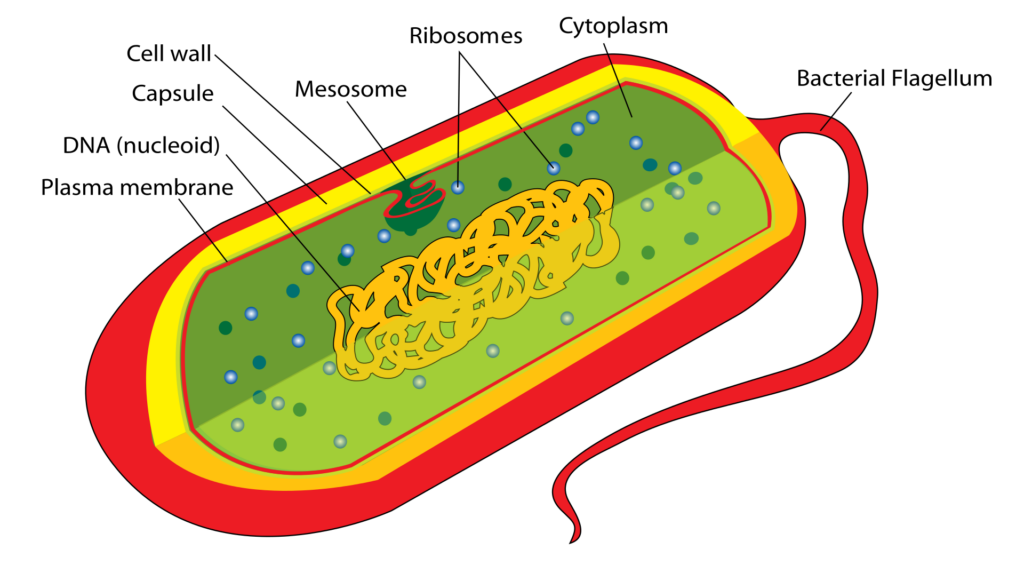
Prokaryotes share features such as a plasma membrane, cytoplasm, and ribosomes with eukaryotes, but lack a membrane-bound nucleus and most other membrane-bound organelles. Bacteria and archaea also differ from each other, and not every structure described below occurs in every prokaryote.
Peptidoglycan Cell Wall
Most bacteria have a cell wall containing peptidoglycan, a mesh of sugar chains linked by short peptides. The wall helps maintain shape and protects the cell against bursting when water enters. Some bacteria lack a cell wall, and archaeal cell walls do not contain peptidoglycan.
Flagellum
Some bacteria have flagella, long structures that rotate to propel the cell. Bacterial flagella differ in structure and movement from the flagella of eukaryotic cells.
Pili
Some bacteria use pili to attach to surfaces; certain pili also help bring cells together for conjugation, a process that can transfer DNA between cells.
Nucleoid Region
The nucleoid is the region where a prokaryotic cell’s chromosome or chromosomes are concentrated. Its DNA is not enclosed by a nuclear membrane. Many bacteria have a single circular chromosome, but chromosome number and shape vary, and DNA-associated proteins also vary between organisms.
Other cell parts
The plasma membrane controls movement into and out of the cell. In many prokaryotes it also hosts processes involved in energy conversion. Membrane composition varies among bacteria, archaea, and eukaryotes.
Prokaryotic cytoplasm contains 70S ribosomes, which have 50S and 30S subunits and make proteins. Eukaryotic cytoplasmic ribosomes are generally 80S, although mitochondria and chloroplasts contain smaller ribosomes. These shared protein-making structures are one reminder that very different cells still rely on many of the same basic processes.




Add comment