

 Akshay Dinesh
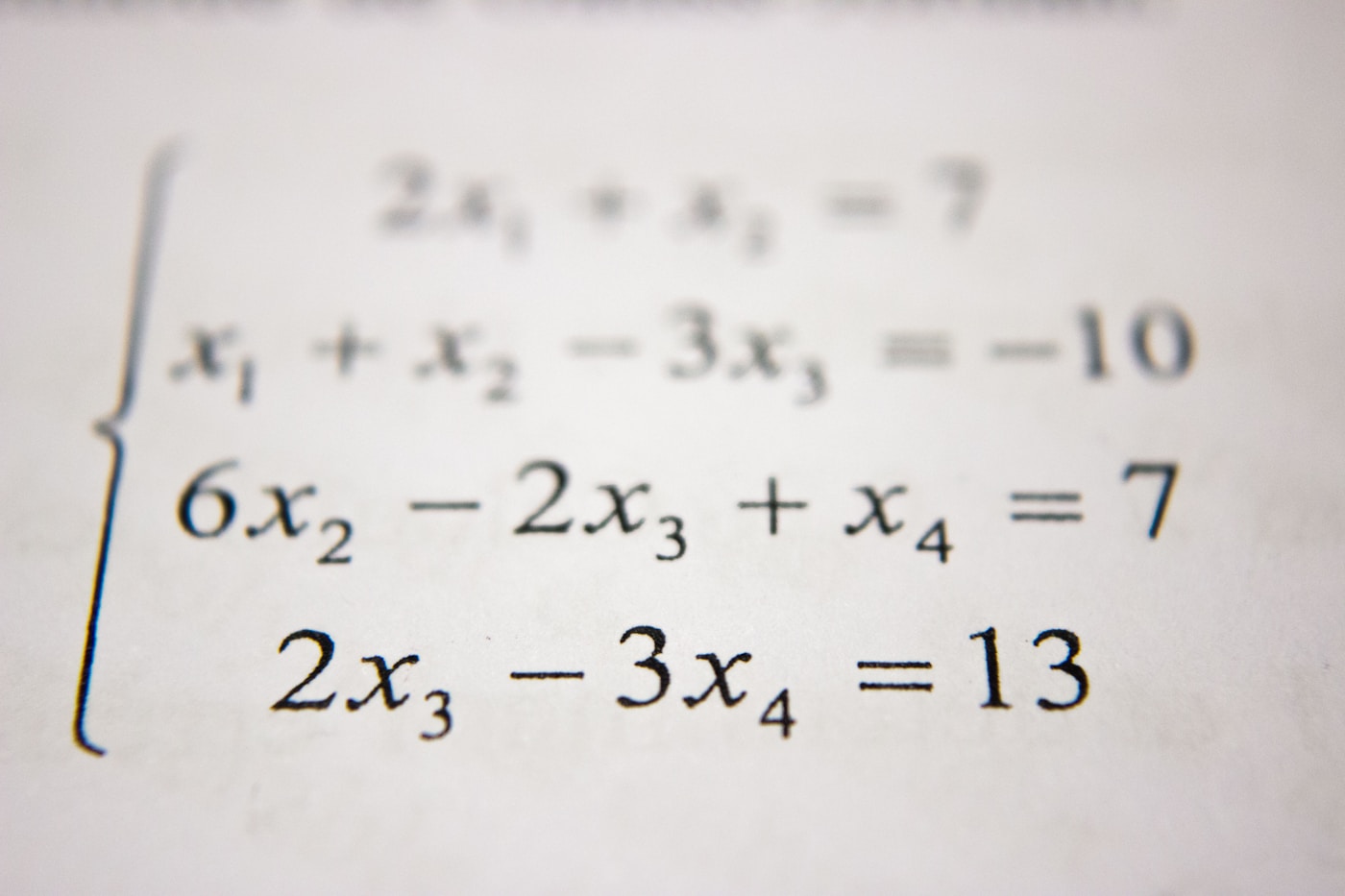
A system of equations can look messy even when the idea behind it is simple. Several equations are all making claims about the same unknowns, and the job is to find values that make every claim true at once. Row reduction gives that job a reliable structure. Instead of trying numbers, staring at graphs, or hoping that substitution will stay tidy, it rewrites the system step by step until the answer is easier to read.
The method sits at the heart of linear algebra because it treats equations as organized information. Once a system is written as a matrix, each row represents one equation and each column represents one variable. Row operations then act like careful edits that preserve the solution set. The numbers may change along the way, but the values that solve the original system stay the same.
Why Systems Become Easier When They Become Matrices
Consider a small system with two variables: \(2x + y = 7\) and \(x – y = 2\). One way to solve it is to add or substitute equations until one variable disappears. Row reduction does the same kind of thinking, but it strips away the repeated variable names and keeps only the coefficients and constants. The system becomes the augmented matrix \(\begin{bmatrix}2 & 1 & | & 7 \\ 1 & -1 & | & 2\end{bmatrix}\).
The vertical bar is only a divider. The numbers to the left describe the coefficients of \(x\) and \(y\), while the numbers to the right describe the constants. The matrix is not a new problem; it is the same problem in a cleaner format. That cleaner format matters because it makes patterns easier to see and gives every step a visible place on the page.
For larger systems, the advantage becomes much bigger. A three-variable system may already be awkward with substitution, and a four- or five-variable system can quickly turn into a tangle of copied expressions. A matrix keeps the work lined up. Each operation affects a whole row, so the arithmetic stays organized and the solver can focus on strategy instead of rewriting long equations again and again.

The Three Row Operations That Keep the Solution Safe
Row reduction is powerful because it allows only three kinds of moves. You may swap two rows, multiply a row by a nonzero number, or add a multiple of one row to another row. These moves are called elementary row operations. They are deliberately limited because each one creates an equivalent system, meaning the same values still solve the equations.
Swapping rows changes the order of the equations, not their meaning. Multiplying a row by a nonzero number is like multiplying both sides of an equation by the same number. Adding a multiple of one row to another is the matrix version of combining equations to eliminate a variable. None of these moves invents a new answer or throws away a valid one.
The nonzero detail is important. Multiplying a row by zero would erase information, turning a meaningful equation into \(0 = 0\) and losing a constraint that may have mattered. Row reduction works because it changes the appearance of the system without damaging its content. Good row work is not just arithmetic; it is arithmetic with a guarantee behind it.
The usual goal is to create zeros below leading entries, often called pivots. A pivot is a number used as an anchor for clearing out a column. If the first row has a useful number in the \(x\)-column, that row can help eliminate \(x\) from the rows below it. Then another pivot can clear the next column, and the matrix gradually becomes simpler.
A Worked Example From Messy to Readable
Take the system \(x + y + z = 6\), \(2x + y – z = 3\), and \(x – y + 2z = 7\). In augmented-matrix form, it is \(\begin{bmatrix}1 & 1 & 1 & | & 6 \\ 2 & 1 & -1 & | & 3 \\ 1 & -1 & 2 & | & 7\end{bmatrix}\). The first entry is already a convenient pivot because it is 1. That makes it easy to clear the first column below it.
Subtract twice the first row from the second row, and subtract the first row from the third row. The matrix becomes \(\begin{bmatrix}1 & 1 & 1 & | & 6 \\ 0 & -1 & -3 & | & -9 \\ 0 & -2 & 1 & | & 1\end{bmatrix}\). The first column is now clean below the pivot. The second row can become the next pivot row.
It is often helpful to multiply the second row by \(-1\), giving \(\begin{bmatrix}1 & 1 & 1 & | & 6 \\ 0 & 1 & 3 & | & 9 \\ 0 & -2 & 1 & | & 1\end{bmatrix}\). Now add twice the second row to the third row. That produces \(\begin{bmatrix}1 & 1 & 1 & | & 6 \\ 0 & 1 & 3 & | & 9 \\ 0 & 0 & 7 & | & 19\end{bmatrix}\).
The bottom row now says \(7z = 19\), so \(z = 19/7\). The second row says \(y + 3z = 9\), so \(y = 9 – 57/7 = 6/7\). The first row says \(x + y + z = 6\), so \(x = 6 – 6/7 – 19/7 = 17/7\). Row reduction has not hidden the algebra; it has arranged it so the answer can be read from the simplified structure.
What Row Echelon Form Is Really Showing
The triangular matrix in the example is in row echelon form. In this form, each nonzero row begins farther to the right than the row above it, and rows of all zeros, if any, sit at the bottom. The shape matters because it creates a clear path for back substitution. You solve the last useful row first, then work upward.
Reduced row echelon form goes one step further. Each pivot becomes 1, and every other entry in a pivot column becomes 0, including entries above the pivot. If the example were pushed all the way to reduced row echelon form, the left side would become the identity matrix, and the right side would display the values of \(x\), \(y\), and \(z\) directly. That is neat, but it is not always necessary.
For hand work, row echelon form is often enough. It avoids some extra fraction-heavy arithmetic while still revealing the solution. For calculators and computer algebra systems, reduced row echelon form is common because machines can do the extra operations quickly and consistently. Both forms are part of the same idea: transform the matrix until the hidden structure becomes visible.
The shape also reveals when a system has no solution or infinitely many solutions. A row like \(0x + 0y + 0z = 5\) means the system is inconsistent because it claims \(0 = 5\). A row of all zeros means one equation became redundant. If a variable column has no pivot, that variable may be free, which often leads to infinitely many solutions described with a parameter.
Common Mistakes That Make Row Reduction Harder
The most common mistake is changing only part of a row. A row operation must affect every entry in that row, including the number on the right side of the divider. If a student doubles the coefficients but forgets to double the constant, the matrix no longer represents an equivalent system. The arithmetic may look normal for several steps, but the final answer will not check.
Another mistake is choosing pivots without thinking ahead. A pivot of 1 is usually easier than a pivot of 6 because it reduces fractions. Swapping rows is allowed precisely so a better pivot can move into position. Row reduction is not a race to perform operations; it rewards small choices that keep the numbers manageable.
Sign errors also appear often because elimination usually involves subtraction. Writing the row operation beside the matrix can help. A note such as \(R_2 \leftarrow R_2 – 2R_1\) records exactly what changed. That notation makes the work easier to audit, especially if a later row seems suspicious.
Finally, some students treat row reduction as a memorized pattern rather than a logic tool. The point is not merely to create zeros. The point is to isolate variables while preserving the solution set. When a row operation feels arbitrary, it helps to translate it back into equation language: you are replacing one equation with a combination of equations that says the same thing in a more useful way.
Why Row Reduction Matters Beyond Homework
Row reduction is more than a classroom procedure for solving tidy systems. The same logic appears anywhere many linear relationships need to be organized at once. Engineers use systems of equations when analyzing circuits, forces, and structures. Economists and data scientists use matrix methods when modeling relationships among many variables. Computer graphics relies on matrices to move, scale, and rotate objects in space.
The deeper value is that row reduction teaches a way of thinking. A complicated problem can sometimes become manageable if its information is arranged well and changed only through valid moves. The method does not ask for a lucky insight at the start. It gives a path: choose a pivot, clear a column, move to the next pivot, and keep checking what each row means.
That is why row reduction often feels mechanical at first but becomes meaningful with practice. The steps are repetitive, yet the result is interpretation. A simplified matrix can tell whether there is one solution, no solution, or an entire family of solutions. It can show which variables are determined and which remain free. It turns a crowded system into a readable map of the relationships inside it.
For learners, the best sign of progress is not speed. It is being able to explain why each row operation is legal and what the simplified matrix is saying. Once that happens, row reduction stops being a collection of moves and becomes a dependable way to see through systems that once looked like guesswork.






Add comment