 Akshay Dinesh
An inverse function answers a simple question with surprisingly useful power: if a rule takes you from one value to another, what rule brings you back? Ordinary arithmetic already works this way. Adding 5 is undone by subtracting 5. Multiplying by 3 is undone by dividing by 3. Squaring, taking square roots, converting temperatures, and decoding formulas all rely on the same idea, though the details can become more careful once graphs and domains enter the picture.
In algebra, inverse functions help students see functions as reversible machines rather than one-way instructions. A function starts with an input, follows a rule, and produces an output. An inverse function starts with that output and, when possible, recovers the original input. That is why inverse notation looks like f^{-1}(x): it does not mean a reciprocal like 1/f(x). It means the function that reverses f.
The Basic Idea: Switch the Direction
Suppose a function is f(x) = 2x + 3. If the input is 4, the function doubles 4 and adds 3, producing 11. The inverse function has to undo those steps in the reverse order. Starting from 11, it first subtracts 3 to get 8, then divides by 2 to return to 4. Written as a rule, the inverse is f^{-1}(x) = (x – 3) / 2.
The order matters because undoing a process is like retracing a route. If you put on socks and then shoes, you remove the shoes before the socks. A function works the same way. The last operation performed by the original function is usually the first operation reversed by the inverse.

This is also why inverse functions feel connected to solving equations. When you solve 2x + 3 = 11, you subtract 3 and divide by 2. When you build the inverse of f(x) = 2x + 3, you use the same logic, except the process becomes a new function instead of a single solution.
How to Find an Inverse Function
A common algebra method begins by writing the function as y = f(x). For f(x) = 2x + 3, write y = 2x + 3. Then switch x and y, giving x = 2y + 3. This switch represents the inverse relationship: the old output becomes the new input, and the old input becomes the new output. Finally, solve for y.
For this example, x = 2y + 3 becomes x – 3 = 2y, so y = (x – 3) / 2. That final y is the inverse function, so f^{-1}(x) = (x – 3) / 2. The switch-and-solve method is not magic. It is a compact way to say that the pairs in the function are being reversed. If f sends 4 to 11, the inverse sends 11 to 4.
Try another example: g(x) = x^3 – 7. Write y = x^3 – 7. Switch x and y: x = y^3 – 7. Add 7 to both sides, then take the cube root: y = cube root of (x + 7). So g^{-1}(x) = cube root of (x + 7). The original function subtracts 7 after cubing; the inverse adds 7 before taking a cube root.
Why Some Functions Need Restrictions
Not every function has an inverse that is also a function on its full domain. The problem appears when one output can come from more than one input. Consider h(x) = x^2. Both 3 and -3 produce 9. If an inverse tried to send 9 back to the original input, it would have to choose between 3 and -3. A function is allowed to give only one output for each input, so the full squaring function does not have an inverse function unless its domain is restricted.
That restriction is not a trick. It is a way to state which half of the original function you want to reverse. If h(x) = x^2 is limited to x >= 0, then every output has exactly one nonnegative input, and the inverse is h^{-1}(x) = square root of x. If h(x) = x^2 is limited to x <= 0, then the inverse is h^{-1}(x) = - square root of x. The algebra changes because the promise about allowed inputs changes.
This is where domain and range become more than vocabulary. The domain of the original function becomes the range of the inverse. The range of the original function becomes the domain of the inverse. For h(x) = x^2 with x >= 0, the original inputs are nonnegative and the outputs are also nonnegative. The inverse square root function can accept only nonnegative inputs and returns nonnegative outputs.
The Graph Connection
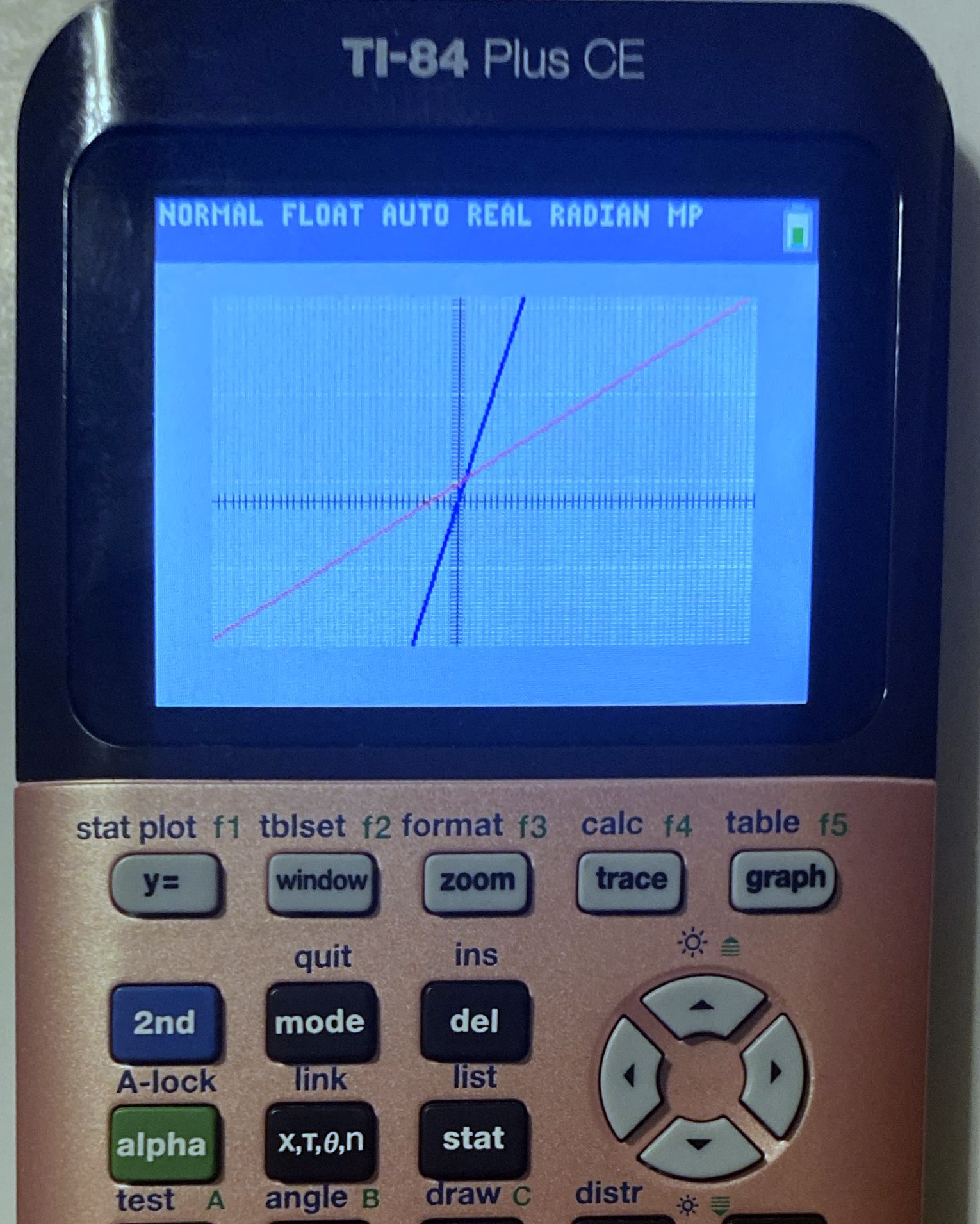
On a graph, inverse functions have a visual pattern: their points reflect across the line y = x. If the original function contains the point (4, 11), the inverse contains the point (11, 4). The x-coordinate and y-coordinate trade places. The line y = x is the mirror because every point on that line has equal coordinates, such as (2, 2) or (5, 5).
This reflection helps explain the horizontal line test. A graph has an inverse function only if every horizontal line crosses the graph at most once. If a horizontal line crosses twice, one output came from two different inputs, so reversing the relation would give one input two outputs. That would fail the definition of a function.
The horizontal line test is closely related to one-to-one functions. A one-to-one function never sends two different inputs to the same output. Linear functions with nonzero slope are one-to-one. The function f(x) = 2x + 3 passes the horizontal line test because every output comes from exactly one input. The full parabola y = x^2 fails because many horizontal lines above the x-axis cross it twice.
How to Check Your Answer
The best check for an inverse is composition. If two functions really undo each other, then doing one after the other should bring you back to where you started. In symbols, f(f^{-1}(x)) = x and f^{-1}(f(x)) = x, as long as the values used are inside the correct domains.
For f(x) = 2x + 3 and f^{-1}(x) = (x – 3) / 2, start with the inverse inside the original function: f((x – 3) / 2) = 2((x – 3) / 2) + 3. The 2 and the division by 2 cancel, leaving x – 3 + 3, which simplifies to x. Going the other way also works: f^{-1}(2x + 3) = ((2x + 3) – 3) / 2 = 2x / 2 = x.
That check catches many common mistakes. Students often reverse the operations but forget the order, or they treat f^{-1}(x) like a reciprocal. Others find a correct-looking formula but forget a domain restriction. Composition forces the answer to prove itself. If the two functions do not simplify back to x in both directions, something about the inverse, the algebra, or the allowed inputs needs another look.
Why Inverse Functions Matter
Inverse functions show up whenever a relationship can be read backward. A temperature formula that converts Celsius to Fahrenheit has an inverse that converts Fahrenheit to Celsius. A formula that calculates distance from speed and time can often be rearranged to find speed or time. Exponential functions and logarithms are inverse pairs, which is why logarithms are useful for solving equations where the unknown sits in an exponent.
The deeper value is not just getting another formula. Inverses train you to ask what information is preserved by a rule. If a function keeps enough information to recover the original input, it can have an inverse. If it collapses different inputs into the same output, some information has been lost, and a full inverse function is impossible without narrowing the domain.
That idea reaches beyond algebra homework. Password systems, unit conversions, coordinate transformations, and data encoding all depend on whether a process can be reversed and under what conditions. Algebra gives a clear starting point: follow the rule, reverse the steps, check the domains, and make sure the answer truly brings every allowed value back home.