
 Akshay Dinesh
A function is one of the first ideas in algebra that feels small at first and then quietly shows up everywhere. It can describe the cost of buying notebooks, the height of a thrown ball, the distance a car travels, or the way a phone battery drops over time. At its simplest, a function takes an input, follows a rule, and gives back an output. The power of the idea is that the same rule works consistently, so a changing situation becomes something you can organize, predict, and compare.
Many students first meet functions as tables, graphs, or equations, which can make them seem like several different topics. They are really several views of the same relationship. A table lists paired values, a graph turns those pairs into a picture, and an equation writes the rule in a compact form. Once those pieces connect, function notation stops looking like a strange code and starts acting like a useful label for a process.
A Function Is a Rule With Reliable Outputs
The basic test for a function is simple: each allowed input must have exactly one output. If the input is 3, the rule cannot send it to 7 sometimes and 11 other times. It can send different inputs to the same output, but one input cannot split into two answers. That reliability is what makes functions useful in algebra, science, economics, and everyday planning.
Think about a taxi fare that starts with a fixed fee and then adds a charge for each mile. If the rule is cost = 4 + 2m, where m is the number of miles, then a 5-mile ride has one cost: 4 + 2(5) = 14. A 6-mile ride has one cost: 4 + 2(6) = 16. The input changes, but the rule stays steady.
That does not mean every real-life situation is perfectly predictable. A real taxi ride may include tolls, traffic charges, or different rates at night. Algebra begins by choosing the parts of the situation we want to model. A function is not the whole world; it is a clear rule that helps us understand one relationship at a time.
Input, Output, Domain, and Range
The input is the value you put into the rule. The output is the value the rule gives back. In the function f(x) = 2x + 3, the input is usually called x. If x = 4, then f(4) = 2(4) + 3 = 11. The output is 11.
The domain is the set of inputs that make sense for the function. Sometimes the domain is all real numbers. Other times it is limited by the situation or by the mathematics of the rule. If a function describes the number of concert tickets sold, negative numbers do not make sense. If a function has a fraction, any input that makes the denominator equal to zero must be excluded because division by zero is undefined.
The range is the set of outputs the function can produce. For f(x) = x^2, the domain can include negative numbers, zero, and positive numbers, but the outputs are never negative. Squaring -3 gives 9, squaring 0 gives 0, and squaring 3 also gives 9. So the range is all numbers greater than or equal to 0.
Domain and range are not just vocabulary words. They help students ask whether an answer is reasonable. If a cost function gives a negative price, the algebra may have been done correctly but the input may not belong in the real-world problem. If a height function gives a negative height after an object has hit the ground, the formula has been stretched beyond the part of the situation it was meant to describe.
Function Notation Names the Rule
Function notation often causes trouble because f(x) looks like multiplication at first glance. It does not mean f times x. It means the output of the function named f when the input is x. The letter f is simply a name for the rule, just as a file or folder can have a name.
If f(x) = 3x – 5, then f(2) asks for the output when the input is 2. Substitute 2 wherever x appears: f(2) = 3(2) – 5 = 1. If the input is a + 1, the process is the same: f(a + 1) = 3(a + 1) – 5, which simplifies to 3a – 2.
This notation becomes especially helpful when more than one rule is being compared. A science problem might use T(t) for temperature after t minutes. A money problem might use B(w) for a bank balance after w weeks. The letters can change, but the structure is the same: the symbol before the parentheses names the function, and the expression inside the parentheses is the input.
Tables and Graphs Show the Same Relationship
A function table is a list of inputs and outputs. For f(x) = 2x + 3, the table might include x = 0, x = 1, x = 2, and x = 3. The matching outputs are 3, 5, 7, and 9. Each row gives one ordered pair, such as (2, 7).
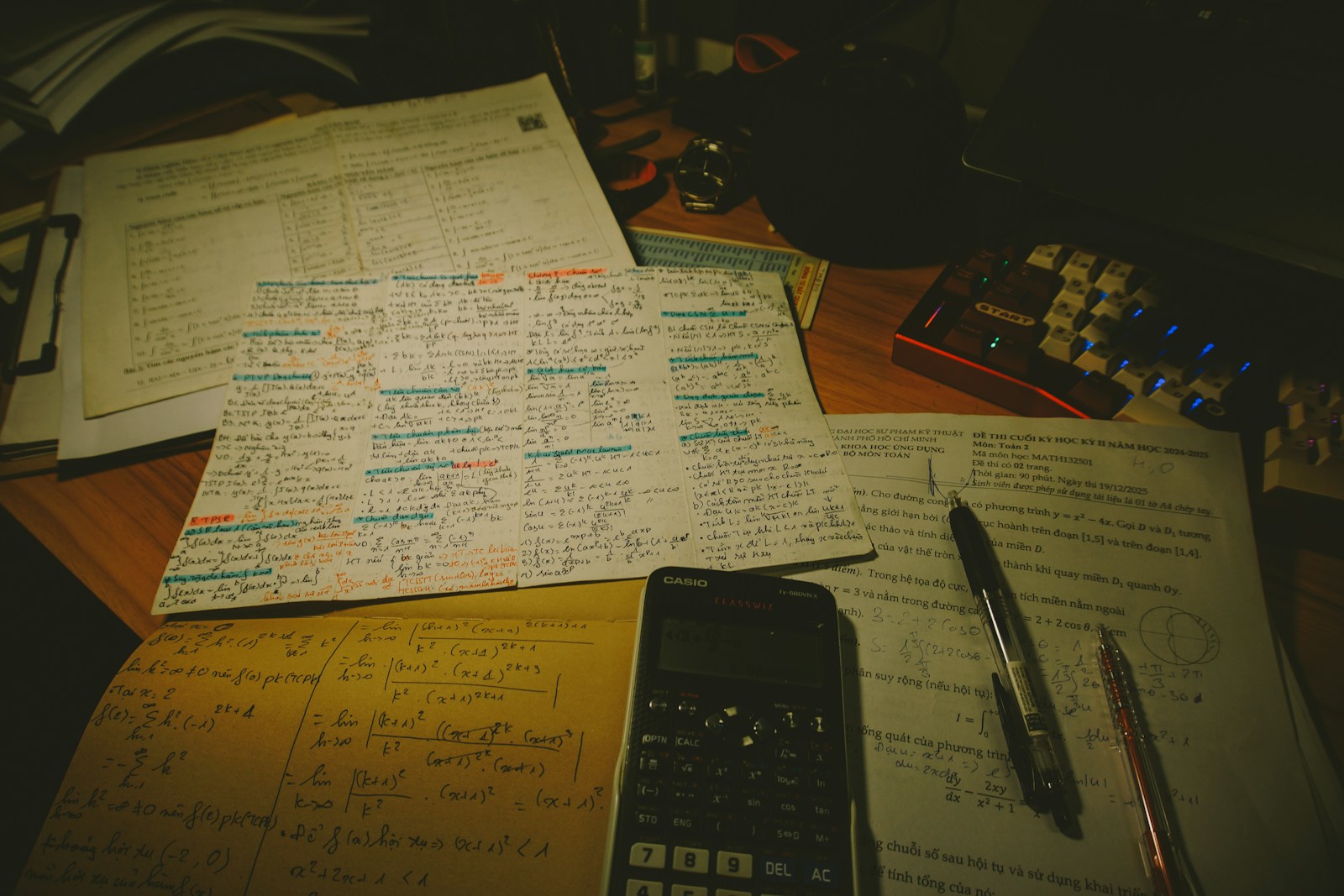
A graph places those ordered pairs on a coordinate plane. The input usually goes on the horizontal axis, and the output goes on the vertical axis. When the points from f(x) = 2x + 3 are plotted, they line up because the function is linear. The steepness of that line comes from the coefficient 2, which tells us the output rises by 2 whenever the input rises by 1.
Not every function makes a straight line. The function f(x) = x^2 makes a U-shaped curve called a parabola. The function f(x) = 2^x grows slowly at first and then rises very quickly. Graphs help students see behavior that may be harder to notice in an equation alone: where a function increases, where it decreases, where it crosses an axis, and where values change quickly.
The important point is that tables, graphs, and equations are not separate answers. They are different representations of one relationship. A strong algebra student learns to move among them: use an equation to build a table, use a table to sketch a graph, and use a graph to estimate what the equation is doing.
The Most Common Function Mistakes
One common mistake is treating f(x) as if it must always be solved for x. Sometimes the task is only to evaluate the function. If the problem says find f(6), it is asking for the output when the input is 6. There is no mystery variable to isolate unless the problem gives an output and asks which input produced it.
Another mistake is ignoring restrictions on the domain. In g(x) = 1/(x – 4), the input 4 is not allowed because it makes the denominator zero. In a word problem, the restriction may come from common sense rather than a denominator. A function for the number of rows of chairs cannot use 2.5 rows if the context requires whole rows.
Students also sometimes confuse a relation with a function. A relation is any set of paired values. A function is a special relation where each input has only one output. On a graph, the vertical line test checks this idea visually. If any vertical line hits the graph more than once, the graph is not a function because one input has more than one output.

Why Functions Matter Beyond One Algebra Unit
Functions become the language for many later math ideas. Linear functions describe constant rates of change. Quadratic functions describe many curved patterns. Exponential functions model repeated growth or decay. In statistics, functions can describe predictions from data. In calculus, functions are studied through change, accumulation, slopes, and areas.
They also help connect math to decisions. A family can use a function to compare the cost of two phone plans. A runner can use one to estimate distance over time. A scientist can use one to model temperature, speed, population, or concentration. In each case, the function helps separate the changing input from the output we care about.
The best way to understand functions is not to memorize a definition and move on. It is to keep asking three questions: What is the input? What rule connects the input to the output? What outputs are possible or reasonable? Those questions turn function notation, tables, and graphs into parts of the same idea. A function is a way to make change readable.




Add comment