 Akshay Dinesh
NATO Article 5 is often summarized in a single phrase: an attack on one is an attack on all. That short version is useful, but it can also make the rule sound more automatic than it really is. Article 5 is not a button that instantly sends every member country into the same war in the same way. It is a treaty promise that turns one ally’s security crisis into a shared decision for the alliance.
That distinction matters because NATO is both a military alliance and a political organization. Its members are sovereign countries with their own governments, laws, militaries, and voters. Article 5 gives them a solemn obligation to respond when an ally is attacked, but it also leaves room for judgment about what kind of help is necessary. The strength of the promise comes from that combination: a public pledge of solidarity, backed by national decisions that can include military force, intelligence, logistics, air defense, naval patrols, cyber support, or other measures.
The treaty promise behind Article 5
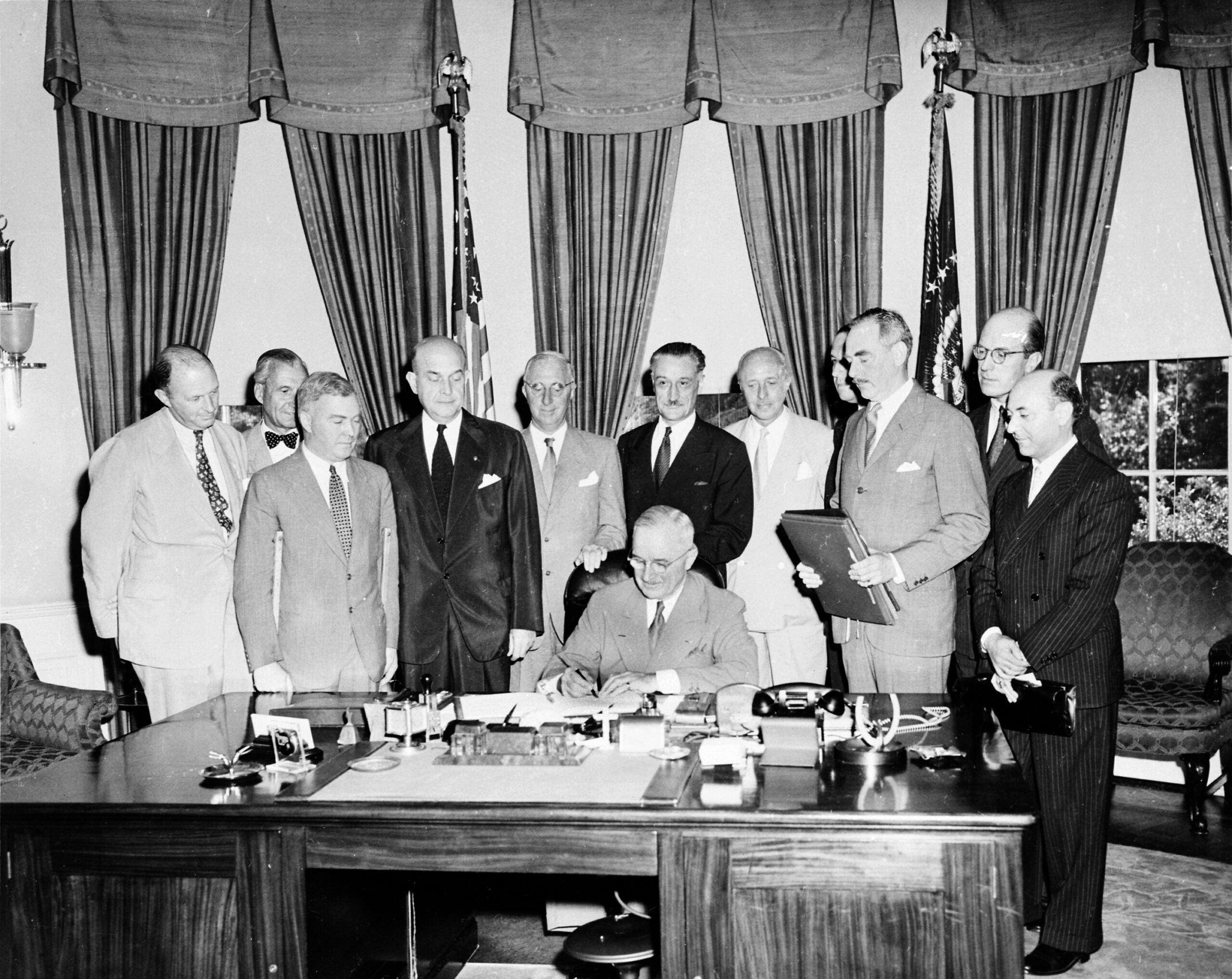
The North Atlantic Treaty was signed in Washington, D.C., on April 4, 1949, near the beginning of the Cold War. Twelve founding members created NATO because they feared that one country standing alone could be pressured or attacked more easily than a group acting together. The treaty was short, but Article 5 became its center of gravity.
In plain language, Article 5 says that an armed attack against one or more NATO members in the covered North Atlantic area will be treated as an attack against them all. Each ally then agrees to assist the country or countries attacked by taking action it considers necessary. The treaty specifically says that such action can include the use of armed force, but it does not say that force is the only possible response.
This wording was carefully chosen. The United States, Canada, and European allies wanted a strong deterrent: a potential attacker should not be able to isolate a smaller member and assume the rest of the alliance would look away. At the same time, each member kept control over its own constitutional process for using force. Article 5 therefore works as both a warning to outsiders and a framework for allies to act together.
Why collective defense is different from automatic war
The most common misunderstanding is that Article 5 automatically requires every NATO member to send troops. It does not. The treaty says each ally will take action it deems necessary to restore and maintain security. That phrase matters because an alliance response can be broader than battlefield combat.
One country might provide aircraft, another might send naval forces, another might share intelligence, and another might strengthen defenses elsewhere so the alliance is not exposed. Some members may offer medical support, logistics, transport, surveillance, sanctions coordination, or cyber defense. In a major crisis, several of these actions can happen at the same time.
This flexibility does not make Article 5 weak. In practice, it makes the promise usable. Modern security crises rarely fit into one neat category. An attack might involve missiles, sabotage, cyber operations, drones, terrorism, or a campaign designed to create confusion below the threshold of open war. A treaty that allows allies to choose necessary measures can adapt to the situation while still making clear that the attacked country will not face the crisis alone.
How NATO decides whether Article 5 applies
Article 5 is not invoked by a headline or a single country’s public statement. NATO decisions are made through the North Atlantic Council, where all member countries are represented. The council works by consensus, meaning allies must agree on the decision rather than simply outvote one another.
Before Article 5 becomes the central question, allies may use Article 4 of the treaty. Article 4 allows any member to ask for consultations when it believes its territorial integrity, political independence, or security is threatened. This consultation step gives allies a way to compare evidence, assess risks, and coordinate before deciding what comes next.
Article 6 also matters because it helps define the geographic scope of the Article 5 commitment. The treaty was written for the North Atlantic area, not for every possible conflict involving a member anywhere in the world. That boundary is one reason careful consultation is so important: allies have to ask what happened, where it happened, who was responsible, and whether the treaty conditions have been met.
The one time Article 5 was invoked
NATO has invoked Article 5 only once: after the September 11, 2001 attacks against the United States. The decision showed that Article 5 was not only a Cold War promise about tanks crossing borders in Europe. It could also apply to a large-scale terrorist attack when allies agreed that the attack came from abroad.
The response did not mean every NATO country took the exact same action. The alliance provided support through measures such as intelligence sharing, surveillance, and military operations connected to counterterrorism and maritime security. NATO aircraft helped patrol U.S. airspace through Operation Eagle Assist, and naval forces later supported Operation Active Endeavour in the Mediterranean.
That history shows how Article 5 turns solidarity into practical steps. The political signal came first: the attack on the United States was treated as a matter for the whole alliance. The actual response then developed through specific decisions about what help would be useful, lawful, and sustainable.
Why the promise still matters
Article 5 is strongest when it prevents conflict rather than when it is used after an attack. A potential aggressor has to think beyond the immediate target. If one ally is attacked, the attacker may face a coordinated response from many countries with different military, economic, technological, and diplomatic tools.
That is the logic of deterrence. The promise does not remove every risk, and it does not make alliance politics simple. Members can disagree about defense spending, threat priorities, strategy, and how much each country should contribute. Those arguments are real, but they happen inside a framework built around the idea that shared security is safer than isolation.
Article 5 also helps explain why alliances are about credibility. A treaty commitment is not just words on paper; it depends on repeated actions that convince allies and opponents that the promise will be honored. Military exercises, planning, troop deployments, equipment standards, and diplomatic statements all help make the promise more believable before a crisis arrives.
The clearest way to understand Article 5 is to see it as a serious obligation with room for judgment. It binds NATO members to treat an armed attack on one ally as a shared security problem, but it does not erase national decision-making or force identical responses. Its power lies in the message it sends before an attack happens: a country inside the alliance is not meant to stand alone.