
 Akshay Dinesh
A leaf may look sealed, but its surface contains tiny adjustable openings. These pores, called stomata, let carbon dioxide enter for photosynthesis while allowing water vapor to escape. Each opening is controlled by a pair of guard cells, which change shape as their water content changes. The result is a constant negotiation: a plant needs carbon dioxide to make sugars, but opening the route for that gas also exposes it to water loss.
Stomata are not lungs, and plants do not breathe as animals do. Gases move mainly by diffusion, from regions of higher concentration toward regions of lower concentration. Still, the comparison can help us notice a problem every land plant faces: exchanging gases with the air without drying out.
What stomata do inside a leaf
A single pore is a stoma; several are stomata. They occur in the outer surface of leaves and sometimes on young green stems. In many land plants, stomata are especially abundant on the lower leaf surface, though their distribution varies. Floating leaves of water lilies often have stomata on the upper surface, where they are exposed to air.
Inside the leaf are moist cell surfaces and air spaces. During photosynthesis, cells use carbon dioxide to build sugars, so its concentration inside an active leaf can fall below the concentration outside. Carbon dioxide then diffuses through open stomata and into the leaf. Oxygen produced by photosynthesis can diffuse outward through the same openings.
Water follows a different route. Roots absorb it from the soil, and much of it travels upward through the plant’s water-conducting tissue, the xylem. Water evaporates from moist surfaces within the leaf and its vapor diffuses out, mainly through stomata. This loss of water vapor is called transpiration. The University of Nebraska–Lincoln’s plant science teaching materials describe this movement from soil, through the plant, and into the air.
How guard cells open and close a pore
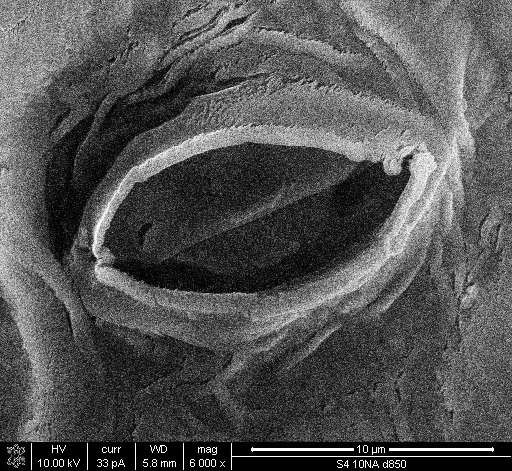
Guard cells form a pair around each stoma. Their walls and internal structures are arranged so that changes in pressure alter their shape. When guard cells accumulate dissolved particles, water moves into them by osmosis. As the cells swell and their internal pressure, or turgor, rises, they curve apart and the pore opens.
When guard cells lose dissolved particles, water tends to leave them. Their pressure falls, they become less swollen, and the pore narrows or closes. This is not a simple on-off switch: a pore can be partly open, and many stomata on a leaf can respond to changing conditions at different rates. The basic relationship between guard-cell water content and the opening is illustrated in the California Academy of Sciences’ stomata investigation.
Light, carbon dioxide concentration, humidity and water availability all influence stomatal behavior. In many plants, stomata generally open in daylight, when photosynthesis can use incoming carbon dioxide, and narrow at night. But “open by day, closed by night” is a useful starting pattern, not a rule for every plant or every condition.
Why water conservation has a cost
Imagine a plant on a hot, dry afternoon. Dry air can increase the tendency for water vapor to leave the leaf. If the soil cannot replace that water fast enough, the plant can respond by reducing stomatal opening. A plant hormone called abscisic acid helps trigger changes in guard cells that promote closure during water stress.
Narrowing the pores slows water loss, but it also restricts the entry of carbon dioxide. With less carbon dioxide available, photosynthesis can slow, limiting the raw material available for growth. Closing the pores does not make a leaf completely waterproof: some water can still escape through the cuticle, the protective outer layer. Nor is closure the only factor that can limit photosynthesis in a stressed plant.
Transpiration has a useful side, too. Evaporation removes energy from a leaf and can help cool it, much as evaporation cools a wet surface. A leaf that closes its stomata may conserve water but give up some of that cooling. Whether it actually becomes warmer depends on sunlight, wind, air temperature and other conditions. The tradeoff helps explain why abundant sunshine alone does not guarantee rapid growth.
Different plants, different solutions
Plant structure and environment shape how this balance is managed. A broad leaf with many exposed pores can exchange gases quickly when water is plentiful, but its surface also presents opportunities for water loss. Some plants in dry habitats have sunken stomata, smaller leaves or thicker cuticles that can slow evaporation. These traits are adaptations to particular conditions, not a universal recipe for every dry-climate plant.
Cacti and many other succulents use a different timing strategy called crassulacean acid metabolism, or CAM. They generally open stomata at night, when conditions are often cooler and less drying, and store incoming carbon dioxide in an organic acid. During the day, they release that stored carbon dioxide inside the plant for photosynthesis while their stomata are mostly closed. As the Royal Horticultural Society explains, this helps conserve water; it does not mean the plant performs light-dependent photosynthesis in darkness.
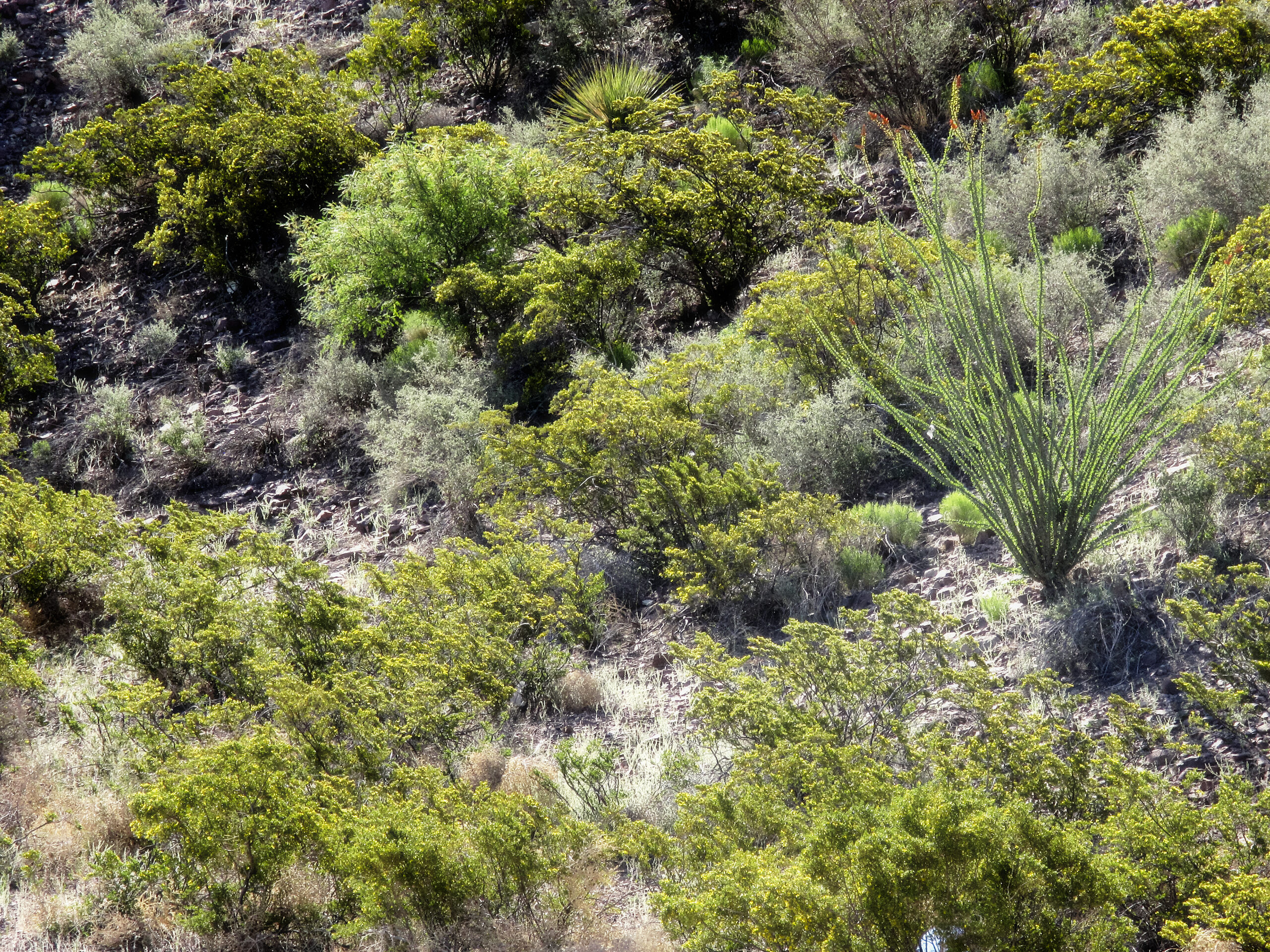
CAM is not exclusive to deserts, and not every succulent uses it in exactly the same way. It is one example of how plants can shift the timing of gas exchange to suit their surroundings. Grasses such as corn use another set of photosynthetic adaptations, but their stomata still regulate the exchange of carbon dioxide and water vapor.
What the pores reveal
Stomata connect processes that can seem separate in a biology diagram: photosynthesis, water transport, evaporation and responses to drought. When water evaporates from leaf surfaces, it contributes to the pull that moves water upward through the xylem. When stomata narrow, both that water loss and the supply of carbon dioxide change. A microscopic adjustment can therefore affect the temperature, growth and water use of an entire plant.
Researchers study these openings to understand how crops respond to heat and water shortages. Measuring the number of pores is only part of the picture: their size, how far they open and how quickly they respond also affect exchange. For a reader looking at an ordinary leaf, the surprising lesson is that its quiet surface is active and responsive, continually balancing access to air with the need to hold on to water.