

 Akshay Dinesh
A fishing boat can have a poor day even when a fish population is healthy, and a busy dock can hide a population in trouble. That is why scientists do not judge the condition of a fishery from a few catches or a single season. They combine surveys, biological measurements, fishing records, and mathematical models to estimate what is happening to an entire population. Two labels sit at the heart of that work: overfishing and overfished. They sound nearly identical, but they answer different questions.
Overfishing describes a rate: fish are being removed faster than the population can replace them over the long run. Overfished describes an amount: the population has fallen below a defined threshold. A stock can be experiencing one, both, or neither condition. Understanding that distinction makes fisheries reports far easier to read and shows why recovery rarely depends on one number alone.
A fish stock is more specific than a species
A fish stock is a population that scientists and managers treat as a unit. It may be a species living in a particular region, such as Gulf of Maine cod, rather than every cod in the Atlantic. The boundary can reflect where fish spawn, how they migrate, genetic differences, and where fishing occurs. Managers sometimes group several closely related stocks into a stock complex when the catches are difficult to separate or the species share similar habitats.
That local focus matters because populations of the same species can follow very different paths. One group may reproduce successfully while another encounters warmer water, damaged nursery habitat, or heavy fishing pressure. Calling a species “healthy” without naming the stock can therefore conceal the condition that matters to a particular ecosystem and fishing community.
NOAA Fisheries reported on 522 federally managed U.S. stocks and stock complexes for 2025. Yet not every stock had enough information for every status determination. The agency knew the current overfishing status of 372 and the overfished status of 265. Missing status does not automatically mean a stock is safe or collapsing. It means the available evidence does not support that specific judgment with sufficient confidence.
Overfishing and overfished measure different things
Imagine a savings account. The balance tells you how much money is there, while the withdrawal rate tells you how quickly it is leaving. An overfished stock resembles a balance that has dropped too low. Overfishing resembles withdrawing too quickly. A large balance can withstand heavy withdrawals for a time, and a low balance can begin recovering once withdrawals slow. Fish populations work in a more complicated way, but the comparison captures why the two labels can diverge.
Scientists often describe population size as biomass, the total weight of fish in a stock. Fishing pressure is commonly expressed through fishing mortality, the share of the population removed by fishing over a period. Managers compare both measures with reference points. If fishing mortality rises above its limit, overfishing is occurring. If biomass falls below its threshold, the stock is overfished.
This produces four possible combinations. A stock can be healthy in size and fished at a sustainable rate. It can still be large but face overfishing that threatens future abundance. It can be small but no longer experience overfishing because catch limits have been reduced. Or it can be both overfished and still subject to overfishing, the most urgent situation.
NOAA’s 2025 report counted 15 stocks subject to overfishing and 42 classified as overfished. Those totals are not contradictory. They describe two separate dimensions of status. Eight stocks left the overfishing list during the year, including Atlantic blue marlin for the first time since its 1998 listing, while some depleted populations remained in rebuilding plans.
How scientists estimate fish that cannot all be counted
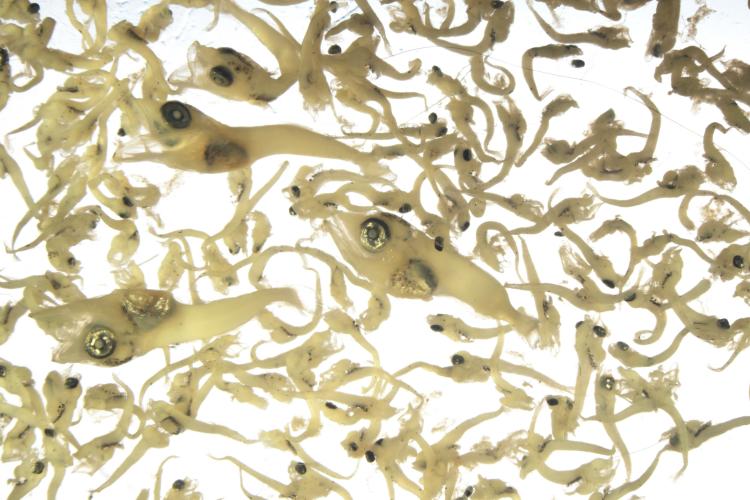
No one can count every fish in an ocean. A stock assessment instead works like a carefully built estimate, drawing on several streams of evidence that cover different pieces of the population. Research vessels may tow standardized nets, record fish detected by sonar, or sample eggs and larvae. Scientists measure the age, length, weight, and reproductive condition of captured fish. Tags and genetic data can reveal movement and whether seemingly connected fish belong to distinct populations.
Commercial and recreational fisheries supply another view. Landing records show how much was brought ashore, while electronic monitoring, onboard observers, logbooks, and dockside sampling help describe what was caught and where. Catch per unit of effort can offer clues: if boats need twice as many hours or hooks to catch the same amount, abundance may have fallen. The relationship is imperfect because better equipment, changing regulations, fish behavior, and shifts in fishing grounds can alter catch rates without matching population change.
Assessment models combine these observations with what is known about growth, natural mortality, reproduction, and fishing. The model does not simply extend a trend line. It reconstructs how fish of different ages move through the population and tests which population history best fits the evidence. NOAA Fisheries completed 173 stock assessments in fiscal year 2025, and regional peer review is part of the federal process before the results guide management.
Uncertainty remains visible rather than being wished away. Surveys may miss a year, recreational catch can be difficult to estimate, and a warming ocean can move fish beyond familiar sampling areas. Assessments often report a range of plausible values and test how results change under different assumptions. A status line may look crisp on a chart, but the scientific judgment behind it includes those margins and sensitivity tests.
Reference points turn evidence into a status decision
The central target is often maximum sustainable yield: the largest long-term average catch a stock can produce under prevailing environmental and fishing conditions. In simplified population models, a stock below its unfished size can grow quickly because food and habitat are less crowded. Harvesting some of that growth may be sustainable. Harvesting more than the population replaces pushes abundance downward.
Real ecosystems refuse to hold still. Young fish may survive well in one year and poorly in the next. Predators, disease, habitat, ocean temperature, and prey availability change the productivity of a stock. Maximum sustainable yield is therefore not a promise that managers can remove the same tonnage forever. It is a model-based benchmark that must be revisited as data and conditions change.
Managers use the assessment to set an overfishing limit, then generally create buffers before establishing allowable catch. Those buffers account for scientific and management uncertainty. Annual catch limits, size rules, seasonal closures, gear restrictions, protected areas, and measures that reduce accidental catch can all help keep fishing mortality below the limit. The exact mix depends on the biology of the stock and the people who rely on it.
A surprising status change does not always mean the ocean transformed overnight. New survey data or an improved model may show that the population was smaller, less productive, or differently structured than scientists previously understood. That is a correction in knowledge, not a failure of measurement. Updating the estimate when evidence improves is one of the safeguards built into the process.
Recovery is a path, not a switch
When a stock is overfished, a rebuilding plan aims to raise its biomass to a sustainable target. Fishing often continues at a reduced level so the population can grow while fishing communities remain active. The timeline depends on how quickly the species matures, how many young fish survive, environmental conditions, and the size of the initial decline. A short-lived species may respond quickly; a long-lived fish that matures late may need many years.
A stock can leave the overfished list before it is fully rebuilt. Crossing the minimum biomass threshold means it is no longer classified as overfished, but the population may still be below the larger rebuilding target. NOAA reported that 47 stocks or stock complexes were in rebuilding plans in 2025. Ten were no longer overfished yet remained in those plans because they had not reached target biomass.
Lowering fishing pressure cannot remove every obstacle. Habitat loss, pollution, disease, unusual temperatures, and changes in prey or predators can slow recovery. Climate-driven range shifts can also make historical survey locations and productivity assumptions less reliable. Good management responds by updating models and rules, not by treating an old target as permanent.
That is the larger value of stock assessment. It turns scattered observations into a repeatable way to ask whether fishing pressure is sustainable, whether abundance is adequate, and whether management is working. The labels are useful only when read precisely: overfishing is about the speed of removal, overfished is about the size of the population, and rebuilding describes the longer journey back to a target. Together, they replace a vague question—“Are there enough fish?”—with evidence that can guide real decisions.