

 Akshay Dinesh
A beach can look inviting even when the water contains a harmful bloom. Florida red tide is caused mainly by a microscopic marine alga, Karenia brevis, which can multiply and produce toxins that affect fish, shellfish and people. The water is not always red, and the bloom is not caused by the daily rise and fall of the tide. Knowing what is happening beneath the surface helps explain why conditions can differ sharply from one beach to the next.
What makes a red tide different?
Most microscopic algae are part of the ocean’s food web. They use sunlight to grow and help support other organisms. A harmful algal bloom occurs when algae accumulate or grow to levels that cause harm, whether by producing toxins or through other effects. Different species can produce harmful blooms in different parts of the world; “red tide” is a common name, not the name of a single organism.
In Florida and parts of the Gulf of Mexico, the species most often associated with red tide is K. brevis, a single-celled dinoflagellate. Its toxins are called brevetoxins. The Florida Fish and Wildlife Conservation Commission (FWC) notes that blooms can discolor water, but color varies with concentration and conditions. Clear-looking water is not proof that the organism is absent, and discolored water alone cannot identify the species.
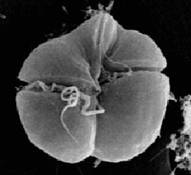
Florida’s marine red tide is also different from the blue-green blooms often seen in freshwater lakes. Those blooms are typically caused by cyanobacteria, not K. brevis. Both can be harmful, but their organisms, settings and management are different.
How a bloom reaches the coast
Cells of K. brevis occur naturally in Gulf waters. A bloom develops when a combination of biological and physical conditions allows the population to accumulate and grow. Light, nutrients, salinity, water movement and interactions with other organisms all play a part. No single ingredient reliably explains every bloom or predicts exactly when one will begin.
FWC explains that Florida red tides generally begin offshore, roughly 10 to 40 miles from land, and may later be carried toward the coast by winds and currents. Near shore, cells can use nutrients from both ocean and land sources, including human-related runoff. That distinction is useful: it is misleading to say that runoff necessarily starts a Florida red tide, but it is also wrong to assume that nutrients from land cannot contribute to its growth once it moves inshore.
Movement continues after a bloom arrives. A current may concentrate cells along one stretch of coast while another beach sees much less. A bloom can persist for weeks or longer, change in intensity, or move away and return. A report for an entire county cannot describe every hour at every shoreline.
Why fish, shellfish and beachgoers are affected
Brevetoxins interfere with nerve signaling in fish and other vertebrates. At sufficient exposure, the result can be a fish kill, with currents and waves washing dead animals ashore. Fish kills have other possible causes too, so their presence alone does not establish that red tide is responsible. Water testing helps identify what is actually present.
The route into the air is less obvious. Breaking waves can rupture K. brevis cells and carry toxin in tiny droplets of sea spray. When wind blows onshore, some people may experience coughing, sneezing or eye and throat irritation even without entering the water. NOAA notes that people with chronic respiratory conditions can have more serious reactions and should avoid affected areas.
Oysters, clams and other filter-feeding shellfish can accumulate the toxin as they feed. Eating contaminated shellfish can cause neurotoxic shellfish poisoning, and cooking does not reliably destroy the toxin. State agencies monitor harvesting areas and issue closures; anyone collecting shellfish should check the relevant state’s current notices rather than judging safety by appearance or smell.
How scientists track a moving bloom
Researchers combine several kinds of evidence. Field teams collect water samples and count K. brevis cells, while satellite images help show patterns in surface water over a wider area. Satellites are useful for locating possible blooms, but a colored patch is not by itself a species identification. Clouds, other particles and the limits of surface observations complicate the picture, so images are interpreted alongside samples and other measurements.
NOAA’s Gulf Coast harmful algal bloom forecasts bring observations together with information about winds and currents. Forecasts can estimate where a known bloom may move and where respiratory irritation is more likely; they are not a guarantee that every nearby beach will have the same conditions. FWC’s red tide status reports and local beach-condition reports add observations that can change as new samples arrive.
Before visiting a beach or harvesting shellfish, check the latest local advisories and the time and place of the observations. A sample is a snapshot, not a permanent verdict. If the area is affected, choosing another location and following public-health guidance is more dependable than relying on the color of the water.
Florida red tide shows how a microscopic organism can connect offshore currents, coastal water quality and everyday decisions on land. Its movement is complicated, but the practical lesson is straightforward: use current local monitoring, and remember that what looks calm at the shoreline may tell only part of the story.
Sources and current conditions: Florida Fish and Wildlife Conservation Commission: Red Tide FAQ; About Red Tides in Florida; NOAA Gulf Coast Harmful Algal Bloom Forecast; and NOAA red tide FAQs.



Add comment