
 Akshay Dinesh
Near the Moon’s south pole, sunlight can disappear at the edge of a crater and never return. Some crater floors remain in permanent shadow, preserving temperatures low enough for water ice and other volatile substances to survive for immense spans of time. Those dark regions are scientifically valuable, but they are difficult places for a robot to work: solar panels cannot generate power there, the terrain is poorly known, and direct control from Earth is slowed by communication delays.
NASA’s Polar Rover for Observation, Mapping, and In-Situ Exploration, or PROMISE, is designed for that problem. The agency announced on November 7, 2026, that it is moving forward with the six-wheeled, nuclear-powered rover for a planned late-2028 launch and an 18-month primary mission. PROMISE will travel near the lunar south pole, drill into the ground, analyze possible ice deposits, measure radiation, and map terrain that future explorers may cross. Its larger purpose is to turn an intriguing patch of the Moon into a place that mission planners understand well enough to use.
Why the lunar south pole demands a different kind of rover
The Moon’s polar regions do not experience day and night in the familiar way. Because the Moon’s axis is only slightly tilted, the Sun stays low on the horizon near the poles. High ridges may receive long periods of illumination, while deep crater interiors can remain permanently shadowed. At Shackleton Crater, for example, the rim can be bright while much of the interior never sees direct sunlight. NASA describes the crater as roughly 21 kilometers wide and 4 kilometers deep.
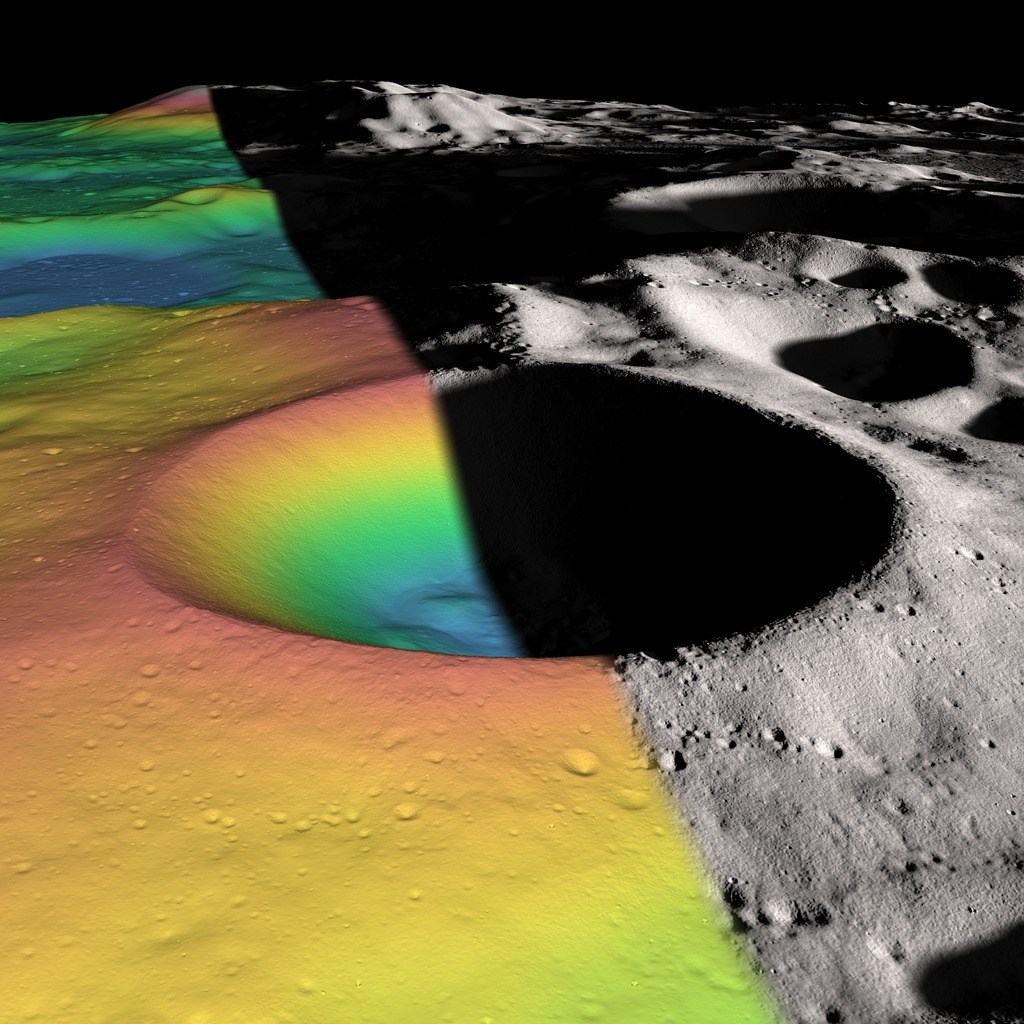
Permanent darkness creates what scientists call cold traps. Water molecules and other volatile compounds that enter one of these regions may freeze into or among grains of regolith, the loose dust and broken rock covering the surface. Orbital measurements have found strong evidence of hydrogen and water ice in parts of the polar terrain, but an overhead instrument cannot fully reveal how the material is distributed underground, how concentrated it is, or how hard it would be to extract. Those questions require measurements at the surface.
The same shadows that may preserve ice also complicate exploration. Temperatures in some polar cold traps may fall to about minus 242 degrees Celsius. A rover must handle steep slopes, loose soil, rocks, darkness, and large temperature differences while keeping its electronics and instruments alive. PROMISE is meant to enter places where a solar-powered vehicle would face an immediate energy problem, then stay long enough to compare several sites rather than relying on a single sample.
A nuclear generator supplies steady power and heat
PROMISE will carry a flight-spare multi-mission radioisotope thermoelectric generator, commonly shortened to MMRTG. It is not a small nuclear reactor and does not use a chain reaction. Inside the generator, plutonium-238 naturally decays and releases heat. Thermocouples convert part of the temperature difference between the hot fuel and the colder surroundings into electricity, while the remaining heat can help protect the rover from extreme cold.
This power source changes where and when the rover can operate. Solar panels work well only when light reaches them, and batteries can store only a limited amount of energy before they must be recharged. An MMRTG produces a modest but continuous electrical supply through darkness, dust, and changing seasons. Curiosity and Perseverance use the same general type of system on Mars, where reliable power allows them to operate without depending on daily sunlight.
That does not give PROMISE unlimited energy. Radioisotope generators produce far less electrical power than a household outlet, and their output slowly declines as the fuel decays and components age. Engineers must budget electricity among driving, computing, communications, drilling, instruments, and heaters. The advantage is predictability: the rover can plan around a steady source rather than waiting for sunlight that may never reach the most interesting ground.
Mars rover hardware is being adapted for the Moon
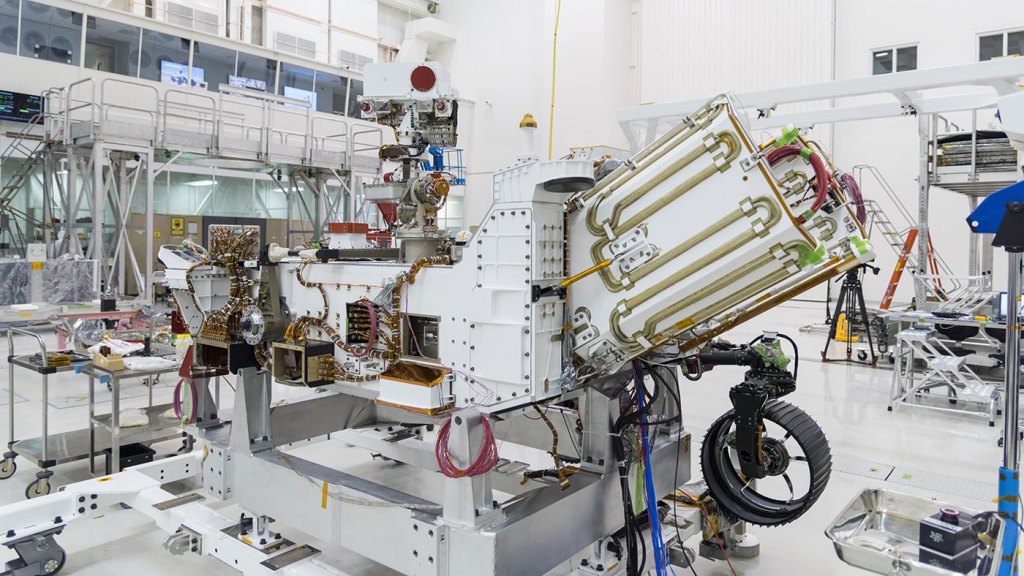
PROMISE is new as a lunar mission, but much of the vehicle will not begin as a blank-sheet design. NASA’s Jet Propulsion Laboratory plans to transform the duplicate Curiosity rover used as a vehicle-system test bed, combining its electronics, body structure, and mobility system with spare and test components from Curiosity and Perseverance. Reusing proven equipment can shorten development and reduce cost, but it is not as simple as sending a Mars rover to a different destination.
Mars has an atmosphere, though it is thin, while the Moon is exposed to near-vacuum. Mars gravity is about twice lunar gravity. Lunar regolith is made of sharp, unweathered grains that can cling electrostatically to surfaces, and the south-polar lighting geometry produces long shadows that can hide hazards. Thermal control also differs because the Moon lacks air to carry heat by convection. Components that worked on Mars must be checked as a complete lunar system.
The rover’s six-wheel suspension provides a useful starting point for crossing rough ground. Its mobility system will also become a scientific instrument in its own right. Engineers can study wheel slip, motor load, sinkage, and trenching to learn whether the regolith is firm, loose, or uneven. Those measurements matter beyond one rover: landers, cargo carriers, crewed vehicles, and surface structures all depend on how the ground bears weight and responds to repeated movement.
NASA has selected Blue Origin to deliver PROMISE aboard its Mark 1 cargo lander. The agency’s announced base award is $94 million, with a performance-based option worth another $140 million. A landing is only the beginning, however. The rover must deploy safely, establish communication, test its systems, and begin navigating terrain that has never been examined at wheel level.
Drilling and spectroscopy will test what is beneath the dust
PROMISE will look for more than a bright patch of exposed ice. Its instrument suite is designed to connect several clues: where hydrogen appears, what compounds are released from a sample, how minerals reflect light, how cold the ground is, and how physical properties change with depth. The central tool is TRIDENT, a rotary-percussive drill that can reach about one meter below the surface. It will bring regolith upward in ten-centimeter steps while recording temperature, strength, and compactness.
Material exposed by the drill will be examined in several ways. The MSOLO mass spectrometer will measure gases released from the sample and identify their chemical makeup. NIRVSS will use near-infrared measurements to distinguish ices and minerals. A neutron spectrometer will search for hydrogen below the surface, because hydrogen-rich ground can signal the presence of water. Together, these instruments can test whether an orbital detection corresponds to usable ice, a thin coating, scattered molecules, or a different hydrogen-bearing material.
Another instrument, LAFORGE, will map extremely cold terrain and identify possible cold traps while gathering information about surface composition. A radiation detector descended from the instrument operating on Curiosity will measure energetic particles from the Sun and deep space. That record will help planners estimate the exposure astronauts and equipment could face at particular locations. A laser retroreflector will give orbiting spacecraft a precise reference point for locating the rover.
The measurements have both scientific and practical value. Polar ice may preserve a record of material delivered by comets, asteroids, and the solar wind. It could also become a resource if it can be extracted efficiently: water supports people, oxygen can be separated for breathing, and hydrogen and oxygen can be used in propulsion. PROMISE will not build a fuel plant. Its job is more basic and more necessary: determine what is present, how it varies from place to place, and what the ground is like around it.
Autonomy will matter most when the rover enters darkness
Driving on the Moon cannot be handled like steering a remote-controlled car. A radio signal takes roughly 1.3 seconds to travel one way between Earth and the Moon, so a command-and-response loop is too slow for reacting to every rock or drop-off. Darkness makes human interpretation harder, and constant stopping would waste mission time. PROMISE will therefore test a set of computing, sensing, and navigation technologies intended to let it make more decisions on board.
A lidar system called SCAN-3D will send out laser pulses and measure their return to build a local three-dimensional map. The High Performance Spaceflight Computing system will process that map using radiation-tolerant hardware. Navigation software known as HI-RATE will use the terrain data to choose safer routes with less intervention from Earth. Illuminators and a stereo camera suite called Lunar Dashcam will record the landscape even where sunlight is absent, producing detailed three-dimensional views for scientists and mission planners.
Autonomy does not mean the rover will choose its own scientific goals. Teams on Earth will still select destinations, plan observations, and review results. The rover’s task is to handle the fast, local judgments that cannot wait for a round trip to Earth: recognize an obstacle, estimate whether a slope is passable, and adjust a short drive. The better it becomes at those decisions, the farther it can travel during each period of communication and planning.
PROMISE brings several strands of exploration together. A steady radioisotope power source opens terrain that sunlight cannot reach. Reused Mars hardware provides a tested mechanical foundation. Drills and spectrometers turn hints of polar ice into direct evidence, while lidar and onboard computing help the rover move through a landscape hidden in shadow. If the mission succeeds, its most valuable product will not be a single dramatic discovery but a connected map of resources, hazards, temperatures, radiation, and soil behavior. That is the kind of knowledge needed to change the lunar south pole from a distant target into a place where longer missions can be planned with confidence.