Akshay Dinesh
A bat crossing open water leaves almost no obvious trail. It flies after dark, may pass far beyond the shoreline, and can cover a surprising distance before sunrise. For years, that made coastal bat migration easy to overlook: researchers knew that some species traveled long distances, but not exactly when they reached the coast, how often they flew offshore, or whether they followed dependable routes. A growing combination of ultrasonic listening stations and tiny radio transmitters is beginning to turn those hidden journeys into data.
The question has become especially timely as offshore wind development expands. Migratory bats are among the species most often found below land-based wind turbines, yet the ocean part of their movement remains poorly mapped. New work summarized by the U.S. Geological Survey in October 2026 reports bats using coastal, island, and offshore environments throughout the year in California, with activity rising during spring and fall. The finding does not mean every bat crosses the ocean, but it shows that the shoreline is not a hard boundary.
The migration map is still full of gaps
Bird migration can be watched in daylight, counted at narrow flyways, and even seen sweeping across weather radar. Bats are harder to follow. They are small, mostly nocturnal, and often travel alone or in loose groups rather than in conspicuous flocks. Many species also spend the day hidden in trees, rock crevices, buildings, or caves, so a researcher cannot simply trace their route from one visible resting place to the next.
The equipment creates another problem. A transmitter must be light enough not to interfere with flight, which rules out many devices commonly used on larger animals. A detector on the ground may hear a bat for only a few seconds, while a radio receiver can register a tagged animal only when it passes within range. Each method captures a piece of the journey rather than the entire trip.
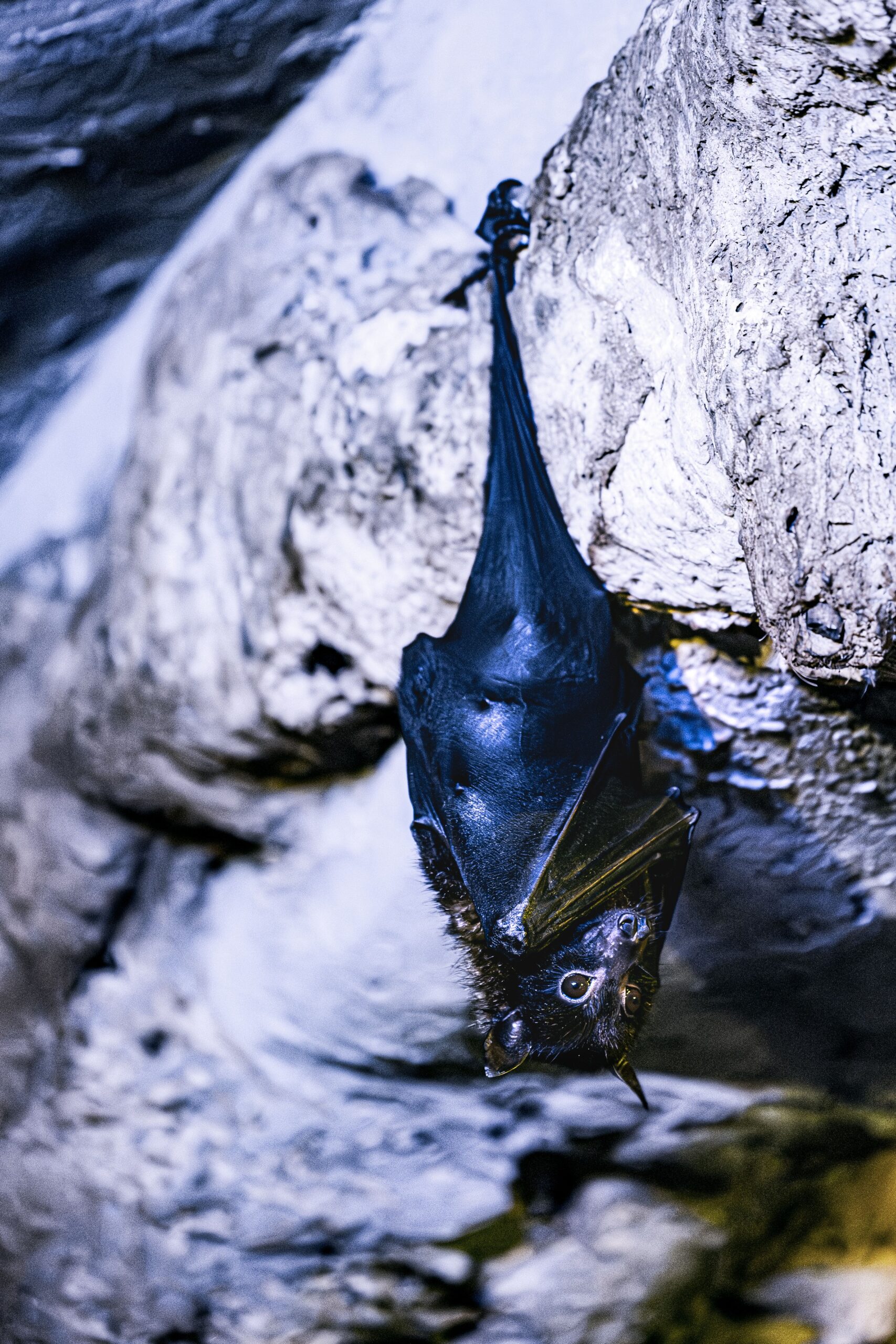
That incomplete view matters when researchers try to distinguish migration from ordinary nightly activity. A bat heard near the coast might be moving hundreds of miles, feeding locally, or commuting between a roost and a familiar hunting area. A strong study therefore needs repeated observations, seasonal comparisons, weather records, and, when possible, information from individually tagged animals. The goal is not merely to prove that bats are present, but to understand what they are doing there.
Acoustic detectors listen for invisible travelers
Most bats navigate and hunt by echolocation. They release high-frequency calls and interpret the returning echoes to judge distance, shape, and motion. Many of those calls are ultrasonic, above the range of human hearing, but an acoustic detector can record them. Software turns the sound into a spectrogram, a picture of frequency changing through time, so analysts can compare the call’s shape, duration, and rhythm with known species.
A network of detectors can reveal patterns that a person with a flashlight would never see. Researchers can place weather-resistant microphones on coastal bluffs, islands, lighthouses, or other offshore structures and let them listen night after night. When detections rise in spring or fall, that seasonal pulse may point to migration. Matching the recordings with temperature, wind speed, and visibility can also show the conditions under which bats are most likely to fly.
Acoustic evidence has limits, and good interpretation depends on respecting them. A recording usually represents a bat pass, not a known individual, and one bat circling a microphone may produce several files. Closely related species can make similar calls, while wind, waves, insects, and the bat’s angle of flight can affect recording quality. A silent detector does not prove that no bats passed nearby; they may have flown beyond its listening range or called in a way the equipment did not capture.
Radio tags connect detections into movement
To follow particular animals, researchers can attach very small radio transmitters that send a unique signal. The Motus Wildlife Tracking System links automated receiving stations across many regions. When a tagged bat passes near an antenna, the station records the signal’s identity and time. A sequence of detections can show that the same animal moved from one part of a coastline to another, sometimes over a period too short to be explained by local foraging.
The U.S. Geological Survey and its partners expanded this approach in the Southern California Bight, the stretch of ocean and islands between Santa Barbara and Baja California. The project added 25 coastal and offshore Motus stations to strengthen a much larger collaborative network. Small flying animals are difficult to equip with satellite devices, so coordinated radio receivers provide a practical way to detect them without recapturing each animal.
Radio telemetry fills an important gap left by acoustic monitoring. A microphone can indicate that a species was active at a location; a coded transmitter can identify an individual. Even then, the line on a map is not continuous. A bat may disappear between receivers, take a route with no antenna coverage, or carry a tag whose battery eventually runs down. Researchers combine detections with time, distance, weather, habitat, and acoustic records to build the most plausible movement picture without pretending that every turn is known.
What researchers are finding over the coast
In its October 2026 preview of a Bat Week research presentation, the U.S. Geological Survey reported that migratory and resident species were acoustically active in California coastal and offshore environments throughout the year. Activity peaked in spring and fall. Offshore and island locations recorded much less activity than coastal locations, while northern locations generally recorded more than southern ones across seasons and species. Tagged bats sometimes covered long distances quickly and did not appear to use one consistent migration route.

Those results are a research summary rather than a final paper describing every method and statistical test, so they should be read as an emerging picture. They also fit earlier evidence from the Atlantic coast. A 2021 study in the journal Animals analyzed acoustic recordings collected from four barrier-island lighthouses and an offshore light tower near Virginia between 2012 and 2019. Tree-bat detections were more likely on warmer nights with lower wind speeds and better visibility, especially during spring and fall.
Together, the studies challenge the simple idea that migratory bats follow a narrow land corridor. Some may use islands as stopping places, cross bays, or move over open water for part of a journey. Routes may shift with weather instead of repeating like a fixed road. Species, age, sex, season, and local geography can all influence movement, so a pattern measured on the Virginia coast should not automatically be copied onto California or any other region.
Better tracking can guide safer wind energy
Knowing when bats enter offshore airspace can help planners focus protection where it has the greatest effect. Wind turbines do not pose the same risk on every night. On land, many bat deaths are concentrated during particular seasons and weather conditions. If offshore monitoring identifies similarly narrow high-risk windows, operators may be able to reduce turbine movement during those periods while keeping them available at other times.
This kind of targeted curtailment requires reliable local data. A rule based only on the calendar could miss an early migration pulse or stop turbines when cold, windy conditions already make bat activity unlikely. Acoustic detectors can show when activity rises; weather models can identify conditions associated with flight; radio tags can reveal how quickly animals move through an area. None of those tools is sufficient alone, but together they can support decisions that are more precise than treating the entire coast as equally risky.
Wind energy is only one part of the conservation picture. Bats also face habitat loss, disease, pesticides, and the loss of safe roosts. Their ecological work is easy to miss because it happens at night: they consume insects, pollinate plants, and disperse seeds in many ecosystems. Protecting migration therefore means understanding the whole route, from inland roosts to coastal feeding areas and the unexpected stretches of ocean between them.
The most revealing part of bat tracking is not a perfect map, because no such map exists yet. It is the growing evidence that these animals use a larger and less predictable landscape than people once assumed. Every recorded call and radio detection adds a point to that hidden geography. As the listening and receiving networks grow, researchers can replace guesswork with a clearer account of when bats travel, where they go, and how human infrastructure can share the night sky with them.