Akshay Dinesh
A spacecraft returning from orbit reaches the atmosphere at several kilometers per second. It must shed nearly all that speed before landing, and the energy cannot simply disappear. The air ahead of the vehicle is compressed into an intensely hot shock layer while drag converts the spacecraft’s motion into heat in the surrounding gas and protective surface. A heat shield keeps that energy away from the people, instruments, fuel, and structure behind it. The challenge is not merely to make a material that tolerates a high temperature. Engineers must control where the shock forms, how quickly the vehicle slows, how heat moves through the shield, and whether the craft remains stable throughout its descent.
Why atmospheric reentry becomes so hot
Objects in low Earth orbit travel at roughly 7.8 kilometers per second, or about 17,500 miles per hour. Because kinetic energy grows with the square of speed, an orbital spacecraft carries an enormous amount of energy even if it is relatively small. Reentry begins when the craft dips into air dense enough to exert significant drag. Molecules cannot move out of the way gently at hypersonic speed, so they pile up and compress in front of the vehicle.
That compression is a major source of reentry heating. The gas in the shock layer can become hot enough for molecules to break apart and for atoms to lose electrons. Friction along the surface contributes too, but the familiar idea that a spacecraft heats up only because it rubs against the air misses the central physics. Much of the severe heating comes from the shock wave and from energy transferred out of the compressed, chemically reacting gas.
A heat shield therefore works with the airflow rather than acting like a simple fireproof wall. Most reentry vehicles use a broad, blunt face. Although a pointed nose looks more streamlined, a blunt body pushes the strongest part of the shock wave away from the surface. The pocket of gas between that detached shock and the shield helps limit direct heat transfer. The shape also produces high drag, allowing the spacecraft to surrender speed before it reaches denser air near the ground.
Three ways a shield manages heat
No single material is best for every mission. Designers choose a thermal protection system by considering entry speed, vehicle mass, atmospheric density, landing accuracy, cost, and whether the hardware must fly again. The main approaches manage heat in different ways.
Ablative shields are meant to change as they protect the craft. Their outer material chars, melts, or turns into gas in a controlled manner, carrying energy away and leaving behind an insulating char layer. NASA’s Phenolic Impregnated Carbon Ablator, commonly called PICA, combines a lightweight carbon-fiber structure with a phenolic resin. Variants of this family have protected missions including Stardust, Mars Science Laboratory, and Mars 2020. Ablators are especially useful for demanding entries, though a heavily eroded shield is not ready for another flight without refurbishment or replacement.
Reusable insulation takes a different approach. The silica-based tiles used on the space shuttle could withstand very high surface temperatures while conducting heat inward slowly. Their low density made them excellent insulators, but thousands of individually shaped tiles required careful inspection and repair. Reusable systems save material across flights only when their durability and maintenance needs fit the vehicle’s operating plan.
Flexible and deployable protection expands the design space. NASA’s Materials Engineered for Re-entry using Innovative Needling Operations, or MERINO, use layers of carbon and phenolic fibers stitched together in a felt-like structure. Other concepts place flexible insulating layers over an inflatable frame. A shield that folds for launch and opens in space can have a much larger diameter than a rigid shield confined inside a rocket fairing.

NASA’s LOFTID demonstration inflated a broad aeroshell in space before atmospheric entry. Credit: NASA.
Why a larger shield can make landing easier
Heat resistance is only half of the problem. A spacecraft must also slow down. One useful quantity is ballistic coefficient, which compares a vehicle’s mass with the drag created by its shape and frontal area. A heavy, compact object tends to retain speed and travel deeper into an atmosphere. Increasing the shield’s area gives the air more surface to push against, lowering the ballistic coefficient and helping the vehicle decelerate higher up, where the atmosphere is thinner.
That relationship becomes crucial when landing large payloads on Mars. The Martian atmosphere is thick enough to create dangerous heating but far thinner than Earth’s atmosphere, so it provides less drag. A rigid aeroshell must also fit inside its launch rocket, placing a practical limit on diameter. Inflatable or umbrella-like decelerators can launch in a compact package and open later, giving a heavy spacecraft the broad profile it needs during entry.
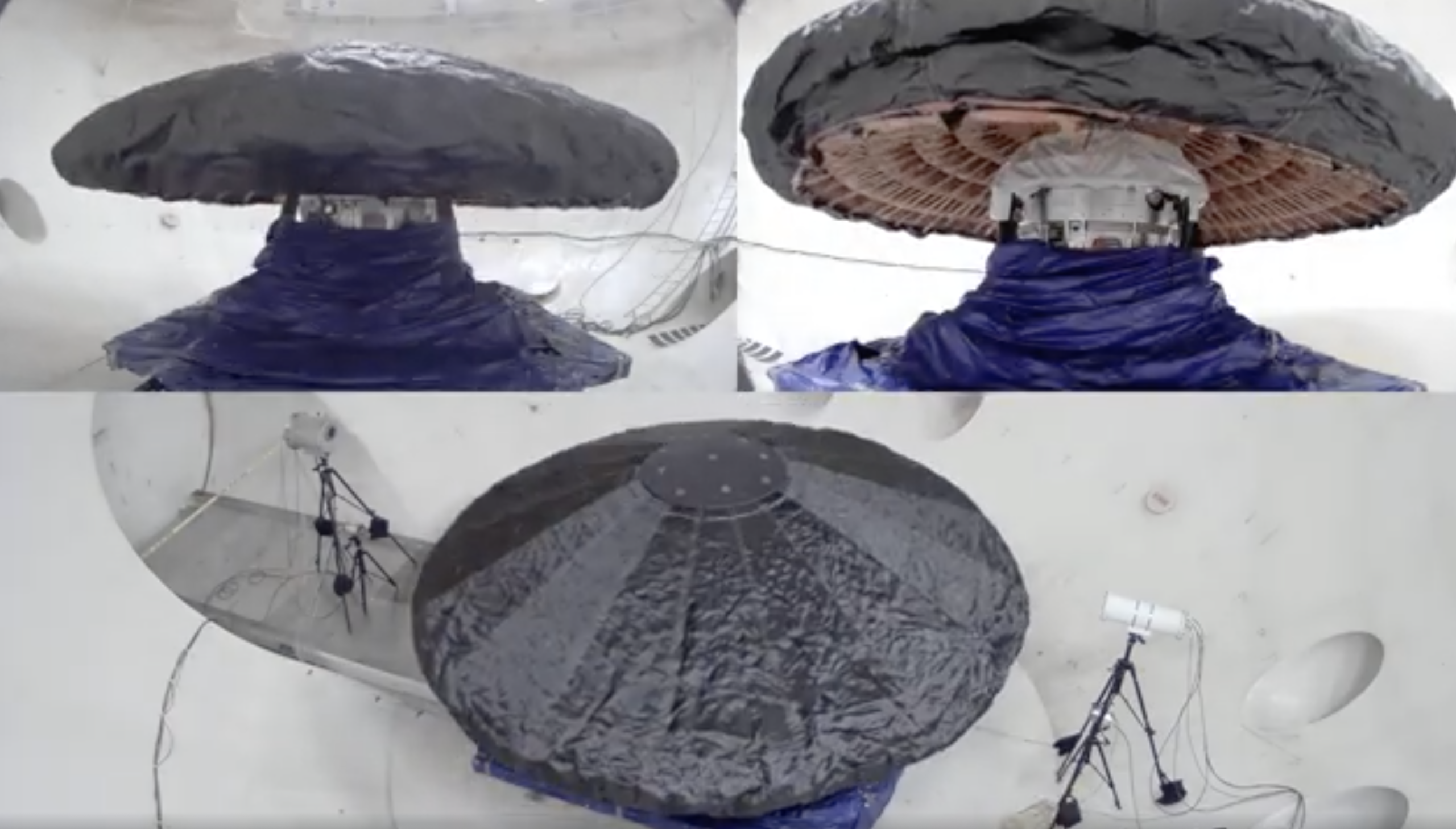
The LOFTID aeroshell shows how a deployable structure can create far more drag than a compact spacecraft body. Credit: NASA.
NASA tested that principle at full scale with the Low-Earth Orbit Flight Test of an Inflatable Decelerator, or LOFTID, in 2022. The six-meter aeroshell entered Earth’s atmosphere at more than 18,000 miles per hour and remained stable as it passed through hypersonic, supersonic, transonic, and subsonic flight. By the time its parachutes deployed, it had slowed to less than 80 miles per hour. The flight showed that a stack of strong, pressurized rings covered by flexible thermal protection could survive both severe heating and aerodynamic force.
Size alone does not guarantee a safe descent. The center of mass, angle of attack, surface shape, and changing airflow all affect stability. A shield that pitches or tumbles may expose an unprotected surface to the shock layer. Engineers use wind tunnels, arc-jet facilities, computer models, drop tests, and flight data to examine those interactions, but the atmosphere still delivers combinations of heat, force, vibration, and chemistry that are difficult to reproduce perfectly on the ground.
How small reentry probes turn a return trip into a laboratory
NASA’s Kentucky Reentry Probe Experiment provides a clever way to gather that missing flight evidence. The third mission in the series, KREPE-3, traveled aboard the Cygnus XL 24 cargo spacecraft that had supplied the International Space Station. Before Cygnus departed in October 2026, astronauts loaded it with waste and activated 12 small experimental capsules. As the cargo craft broke apart during its planned atmospheric disposal, the capsules were designed to separate and transmit measurements during their own descents.
The probes carry sensors for temperature, pressure, motion, magnetic field, and light. Together, those measurements reveal more than whether a sample survived. Temperature sensors track how quickly heat crosses a material. Pressure and motion data show the aerodynamic loads and whether a capsule stays stable. Comparing those observations with predictions allows researchers to find where a model is accurate and where its assumptions need work.
KREPE-3 also tests several ideas side by side. One capsule carries a 3D-printed heat shield developed through work at NASA’s Johnson Space Center and Oak Ridge National Laboratory. Others use MERINO coverings made at NASA Ames. A dual-cone experiment combines a tungsten tip, heat-resistant fiber layers, and a MERINO-covered aft section. Another capsule resembles the aeroshell planned for Dragonfly, the rotorcraft mission intended for Saturn’s moon Titan, and uses PICA to study the shape’s dynamic stability.
A deployable design called Adaptable Deployable Entry and Placement Technology opens like an umbrella to create more area and drag. That compact experiment addresses the same basic constraint as LOFTID: the shield needed for landing may be wider than the rocket that carries it. KREPE-3 does not replace a large mission demonstration, but it lets engineers expose many materials and shapes to genuine reentry conditions at lower cost. The returning cargo vehicle already had to be disposed of, so its final trip became a ride for a fleet of laboratories.
What heat-shield research changes for future missions
Better thermal protection can alter what a mission is able to carry and where it can land. A lighter shield leaves more of a spacecraft’s mass allowance for scientific instruments, supplies, or crew systems. A larger deployable aeroshell can help deliver heavier cargo through a thin atmosphere. Materials that are faster to manufacture may reduce cost and make it practical to tailor protection to different parts of a vehicle rather than treating the shield as one uniform surface.
Different destinations still demand different solutions. Returning from the Moon involves a faster entry than returning from low Earth orbit. Mars offers limited atmospheric braking, while Titan’s dense, nitrogen-rich atmosphere presents its own heating and stability conditions. A crew capsule must protect lives and meet strict reliability standards; a small instrument package may accept different risks. Even the best-performing material can be the wrong choice if it is too heavy, too fragile, or difficult to inspect.
The central idea remains remarkably consistent: a heat shield succeeds by managing energy. Its shape moves the shock wave, its area creates drag, and its material keeps heat from reaching the spacecraft long enough for the dangerous part of the descent to pass. New fibers, printed structures, sensors, and deployable frames refine each part of that job. Flight tests such as KREPE-3 and LOFTID then reveal how the complete system behaves when a laboratory simulation gives way to the real atmosphere.