Akshay Dinesh
A spacecraft may look motionless on the launchpad, but the trip ahead is violent. Rocket engines create powerful vibrations and pressure waves. Stages separate with sudden shocks. Once the vehicle reaches space, air can no longer carry heat away, sunlight can warm one side while the other faces darkness, and a stray electrical signal can confuse a sensor at exactly the wrong moment.
Engineers cannot reproduce an entire mission on Earth, so they break the danger into testable environments. They shake hardware, flood it with sound, remove almost all the air around it, cycle it through heat and cold, and listen to hundreds of sensors for responses that calculations may have missed. A 2026 campaign for the Griffin-1 lunar lander at NASA’s Jet Propulsion Laboratory shows how those tests fit together. Passing them does not prove that a mission will succeed, but it replaces many assumptions with measured evidence before the spacecraft leaves the ground.
Launch is a problem of vibration, sound, and shock
A rocket does not produce one neat, steady shake. Engines, pumps, airflow, structural flexing, and changing thrust create energy across many frequencies. If one of those frequencies is close to a spacecraft structure’s natural frequency, resonance can amplify the motion. A bracket, cable, circuit board, or instrument that seems strong under a simple pull may behave very differently when it is flexed thousands of times per minute.
On a shaker table, engineers fasten the spacecraft or a component to a moving platform and drive it along controlled axes. Accelerometers and strain gauges show how the structure responds as the force and frequency change. The aim is not merely to see whether anything visibly breaks. Engineers compare the measured response with their mathematical models, watch for unexpected resonances, and confirm that the hardware still works after the test.
Acoustic testing attacks the same launch environment from another direction. A rocket’s roar creates fluctuating air pressure that can make broad panels, covers, and lightweight structures vibrate. In August 2026, JPL surrounded Griffin-1 with microphones and used compressed-nitrogen-powered horns to produce sound levels up to 153 decibels. Vibration and acoustic tests are related, but they are not interchangeable: the shaker sends motion through mounting points, while an acoustic chamber loads exposed surfaces through the air.
Shock is shorter and sharper. Separation devices, release mechanisms, and deployments can send a brief high-frequency pulse through a vehicle. Engineers may test those events separately because a component that tolerates sustained vibration can still be vulnerable to a sudden jolt. The sequence matters, too. After each exposure, teams inspect the spacecraft, repeat functional checks, and compare new sensor data with the baseline recorded before testing.
Vacuum changes the rules of temperature
Space is often described as cold, but that shorthand hides the real engineering problem. In a vacuum there is almost no surrounding gas, so heat cannot move by ordinary convection. A sunlit surface may absorb radiation and become hot, while a shaded component radiates energy away and cools. The temperature of each part depends on its coating, insulation, power use, view of the Sun, and thermal connection to the rest of the spacecraft.
A thermal-vacuum chamber removes air with powerful pumps and surrounds the test article with temperature-controlled surfaces. Engineers cycle the hardware through hot and cold conditions while operating its electronics, heaters, sensors, and communications. NASA’s Goddard Space Flight Center describes thermal-vacuum testing as a way to qualify components and complete spacecraft under spaceflight conditions, while its smaller engineering chamber can reach below 1 × 10⁻⁵ torr. The exact test limits depend on the mission rather than on one universal “space temperature.”
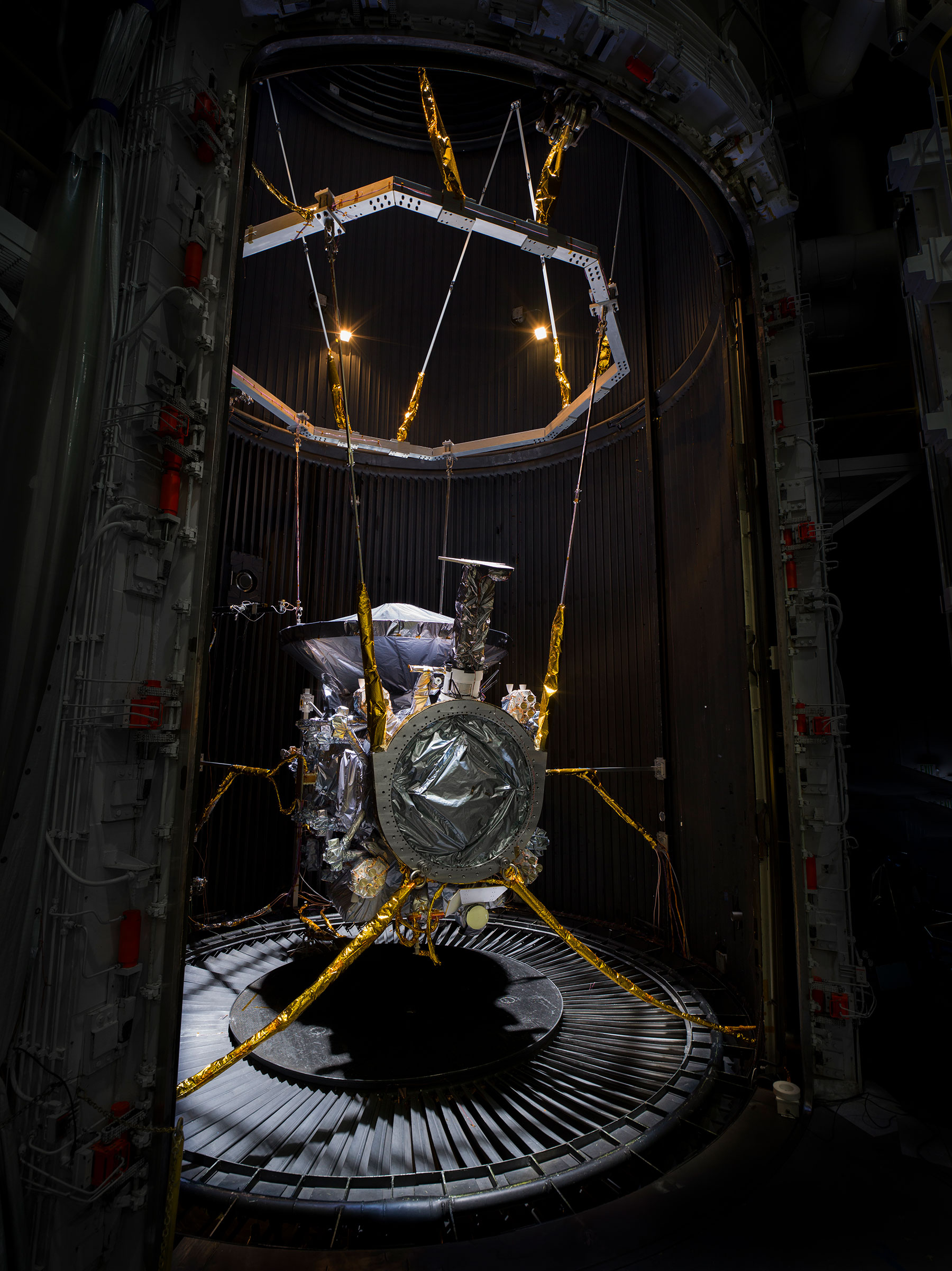
Griffin-1 spent about two weeks in JPL’s 25-Foot Space Simulator. NASA reported that the lander was heated to 167 degrees Fahrenheit (75 degrees Celsius) and cooled to minus 148 F (minus 100 C). Those limits were selected to represent conditions expected during its journey and lunar operations. The test also gave engineers time to see how the vehicle behaved through repeated transitions rather than at a single hot or cold point.
Vacuum testing can expose problems that are easy to miss in ordinary air. Materials may release trapped gases, a process called outgassing, and those molecules can settle on sensitive optics or cold surfaces. Lubricants and adhesives may behave differently. Because no air is available to cool a hot electronic component, a weak thermal path can become obvious. The chamber is therefore both a simulation and a diagnostic tool.
Electronics must work without fighting each other
A spacecraft is crowded with radios, computers, motors, power converters, sensors, and long runs of cable. Every changing electrical current can produce an electromagnetic field, and every conductor can act as an unwanted receiving antenna. If emissions from one system disturb another, a perfectly healthy component can receive bad data or fail at the system level.
Electromagnetic interference and compatibility testing asks two questions: does the spacecraft emit more electrical noise than allowed, and can each system keep operating when expected interference is present? Tests often take place in an anechoic chamber lined with absorbing material so reflections from the room do not confuse the measurements. Engineers operate transmitters, switch motors, change power states, and monitor vulnerable circuits while antennas and probes measure emissions.
Griffin-1 underwent this testing in a chamber whose long foam spikes absorb electromagnetic waves as well as sound. The appearance is dramatic, but the purpose is practical. A lander must communicate, navigate, control propulsion, and run scientific payloads in a compact electrical environment. Compatibility testing finds conflicts while engineers can still reroute a cable, add shielding, change grounding, filter a signal, or revise operating procedures.
Balance and mass distribution shape how a spacecraft moves
Total mass is only part of the flight-dynamics story. Engineers also need the center of gravity and moments of inertia, which describe how mass is distributed around each axis. Two objects can weigh the same yet respond differently to the same turning force if one concentrates its mass near the center and the other spreads it outward. Guidance software and thruster commands depend on those properties.
JPL engineers placed the 2,789-pound (1,265-kilogram) Griffin-1 on a special rotating table to measure its mass properties and look for unexpected wobble. The results feed models used to predict how the lander will turn, navigate, and settle during surface operations. Small changes matter because flight hardware evolves: cables move, instruments are installed, propellant loads are refined, and the final configuration may differ from an early design model.
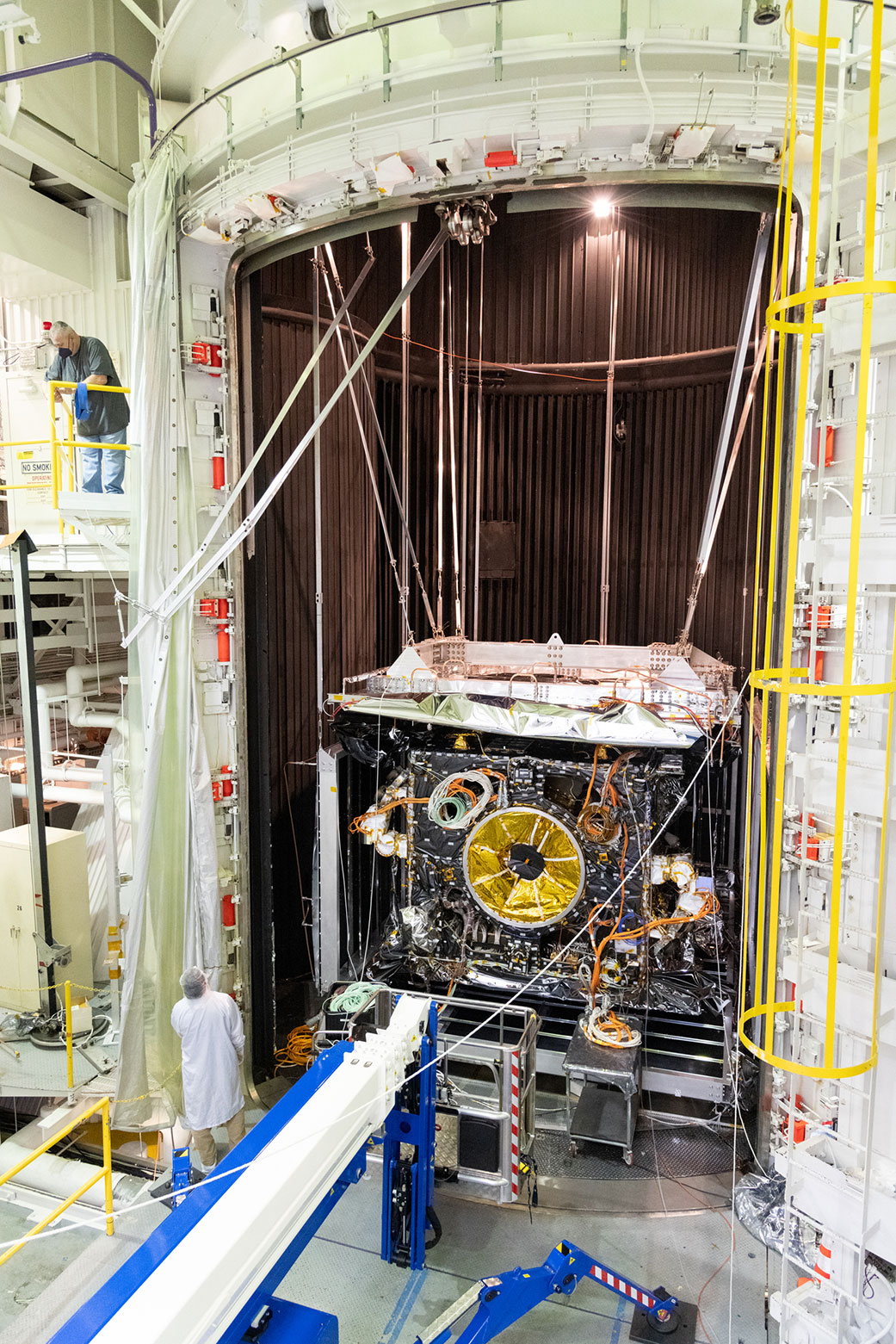
Deployment tests cover another kind of motion. Solar arrays, antennas, booms, covers, landing legs, and release mechanisms may remain folded for launch and operate only once in flight. Ground crews test clearances, timing, electrical signals, and the forces required to move them. Gravity can distort the result, so fixtures may support part of a mechanism’s weight to imitate the lower loads it will experience in space or on another world.
No single facility can reproduce launch, vacuum, temperature, radiation, low gravity, and landing at once. The engineering case is built from analysis, component tests, subsystem tests, full-vehicle tests, and rehearsals. Each layer addresses a different uncertainty, and the results are compared so that one successful demonstration does not hide a weakness elsewhere.
A passed test is evidence, not a promise
Spacecraft tests are designed around expected environments plus defined margins. Qualification testing may push a design beyond the levels predicted in flight to show that the design has reserve strength. Acceptance testing checks that the particular flight unit was built correctly and can withstand the required environment without being unnecessarily overstressed. Programs tailor the details because a small instrument, a crew capsule, and a lunar lander face different risks.
Testing is valuable even when something goes wrong. During acoustic testing of the James Webb Space Telescope’s spacecraft element in 2018, inspections found fastening hardware for sunshield membrane covers had come loose. Discovering such a problem on Earth allowed the team to investigate and correct it before launch. A ground-test anomaly is not simply a failure; it is information obtained while the hardware is still reachable.
Griffin-1’s environmental campaign covered mass properties, electromagnetic compatibility, vibration, acoustic loads, and thermal vacuum. It is expected to carry more than 1,100 pounds (455 kilograms) of cargo, including 10 science and technology demonstrations from six countries, toward the lunar south polar region. The completed tests show how the lander performed under specified simulated conditions. They do not establish that launch, navigation, descent, or landing will unfold exactly as planned.
That distinction is the heart of responsible spacecraft testing. Engineers cannot remove every unknown, and a test that is too mild teaches little while one that is unrealistically severe can damage good hardware. The craft lies in choosing representative loads, measuring the response closely, and following every surprise until it is understood. By launch day, the spacecraft is still embarking on an experiment no chamber can fully copy, but it carries a much stronger record of evidence than appearance alone could provide.