Akshay Dinesh
At the South Pole, a small building sits above one of the largest scientific instruments ever made. The instrument has no giant mirror or dish. Most of it is invisible, frozen more than a kilometre beneath the surface, where thousands of light sensors watch a cubic kilometre of clear Antarctic ice. This is the IceCube Neutrino Observatory, built to detect particles that can cross planets almost as if they were empty space.
On October 6, 2026, the Royal Swedish Academy of Sciences awarded the Nobel Prize in Physics to Francis Halzen for decisive contributions to IceCube and the discovery of high-energy neutrinos from beyond the solar system. The prize recognizes more than one clever detector. IceCube opened a new way to study the universe by using particles called neutrinos as messengers from places that ordinary telescopes cannot fully reveal.
Why neutrinos are valuable and frustrating messengers
Neutrinos are fundamental particles with no electric charge and only a tiny mass. They are produced in nuclear reactions, including those inside the Sun, and in violent cosmic environments where matter is accelerated to extreme energies. Roughly 100 trillion neutrinos pass through a human body each second, according to IceCube’s published quick facts, yet almost none of them collide with anything inside us. Their weak interaction with matter is the reason they are often nicknamed “ghost particles.”
That elusiveness creates both the promise and the problem. Light can be blocked by dust, absorbed by matter, or scattered before it reaches Earth. Charged cosmic rays are bent by magnetic fields, so the direction from which they arrive may no longer point back to their source. A neutrino usually travels straight through matter and across space without losing much energy or changing direction. Detect one, reconstruct its path, and it may point toward the cosmic engine that produced it.
The same property makes detection extraordinarily difficult. A camera can collect vast numbers of photons, but a neutrino detector must wait for the rare moment when a neutrino interacts with an atomic particle. Making the detector larger increases the amount of matter available as a target. Halzen’s bold proposal was to stop thinking of a detector as a tank that had to be built and instead turn a huge volume of naturally clear ice into the detecting material.
A telescope buried inside a cubic kilometre of ice
IceCube lies beside the Amundsen-Scott South Pole Station. Its in-ice detector contains 5,160 digital optical modules, or DOMs, attached to 86 vertical cables called strings. The sensors extend from about 1,450 to 2,450 metres below the surface. Arranged across roughly one cubic kilometre, they transform an immense block of Antarctic ice into a three-dimensional particle detector.
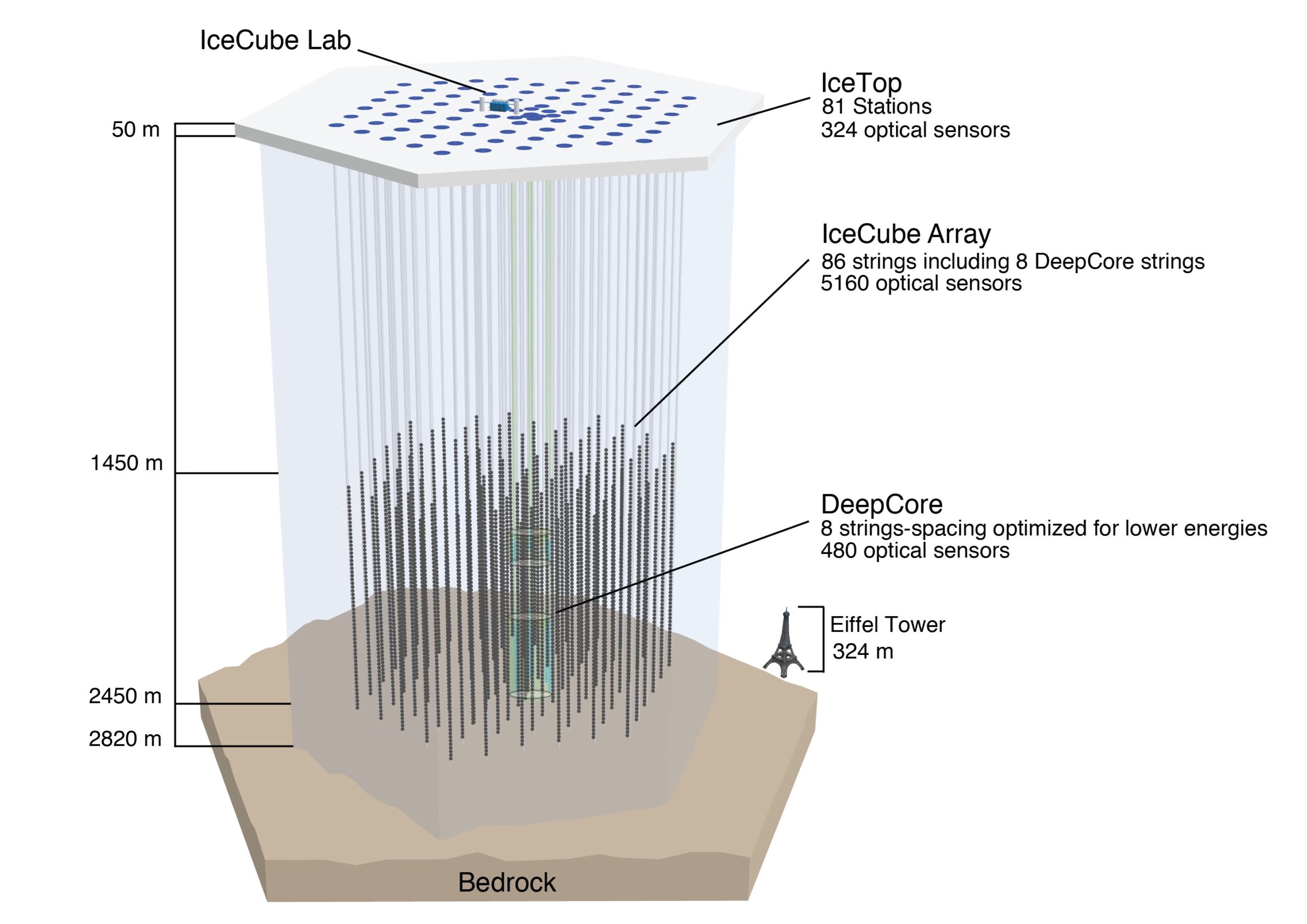
The location is not convenient, but the ice has unusual advantages. At great depth it is dark, stable, and clear enough for faint flashes of blue light to travel between sensors. The enormous volume is essential because the high-energy cosmic neutrinos IceCube seeks are rare. At the same time, the detector must distinguish those events from a far larger background of particles created when cosmic rays strike Earth’s atmosphere.
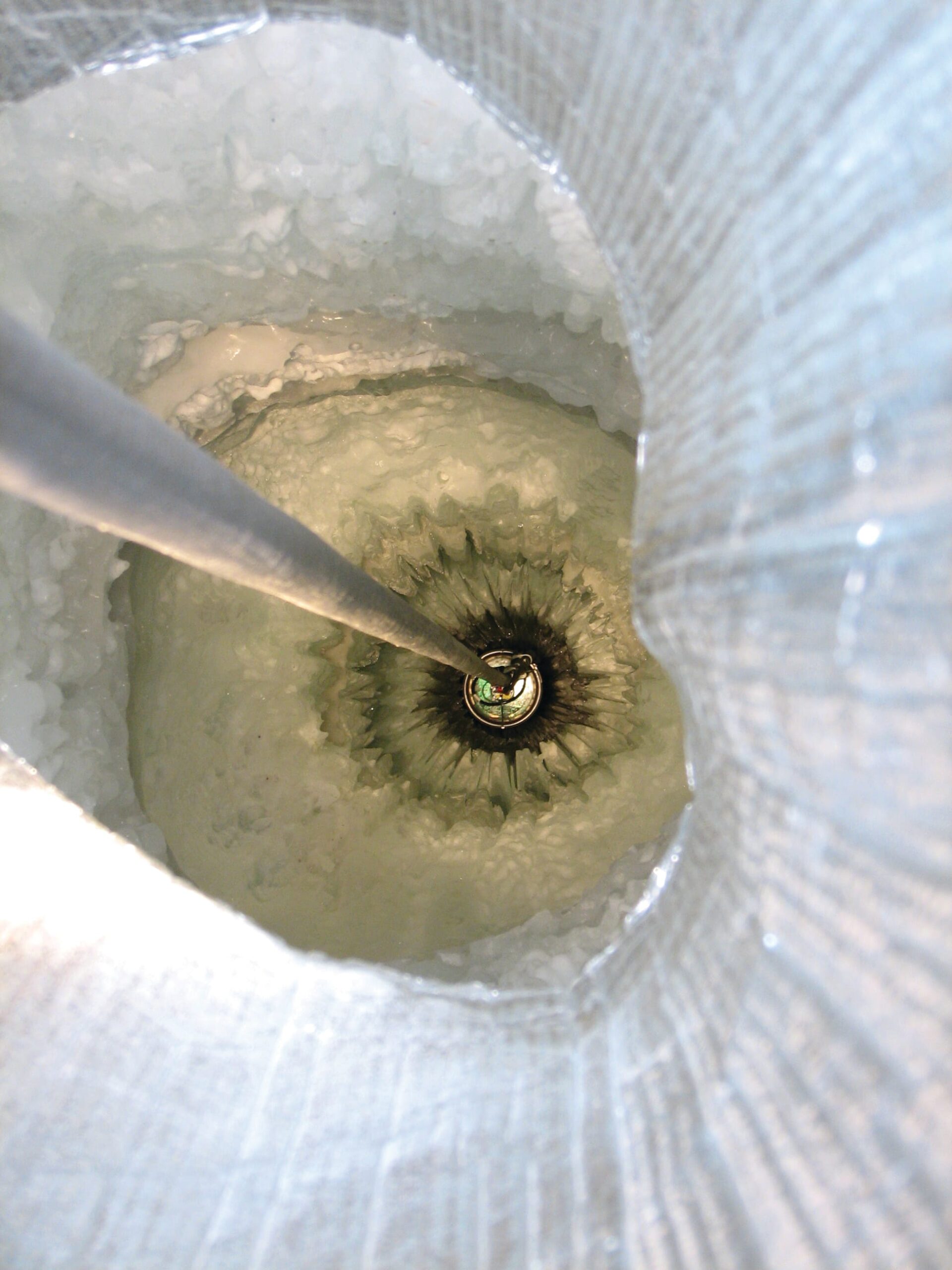
Construction demanded its own kind of precision. Crews used hot-water drills to melt narrow holes more than two kilometres deep, then lowered strings of sensors before the water refroze. Once trapped in the ice, the modules could not be repositioned or repaired like equipment in a surface laboratory. The main array was completed in 2010, and the observatory began full operations in 2011.
How an invisible particle produces a visible signal
IceCube does not see a neutrino directly. On a rare occasion, a neutrino collides with a particle in the ice and creates electrically charged secondary particles. Some of those particles move through the ice faster than light can travel through ice. They do not exceed the speed of light in a vacuum; instead, they outrun light’s reduced speed in that material.
The result is Cherenkov radiation, a brief cone of blue light often compared with the shock wave made by a supersonic aircraft. Nearby optical modules detect individual photons and record their arrival times with great accuracy. A single sensor tells scientists very little, but the pattern across many sensors becomes a track or a spreading shower of light.
Computers compare the timing, brightness, and position of those signals. From that pattern, researchers estimate the incoming neutrino’s direction and energy. Long tracks are commonly associated with muons created by muon neutrinos, while compact cascades can result from other interactions. The reconstruction is not a photograph of a particle. It is an inference built from precisely timed flashes scattered through a vast volume of ice.
Finding a cosmic neutrino among the background
Most of the signals recorded around IceCube do not come from distant astrophysical sources. Cosmic rays striking the atmosphere produce showers of secondary particles, including muons and neutrinos. The detector therefore faces a difficult sorting problem: identify a small extraterrestrial population inside an enormous stream of atmospheric events and instrument noise.
Direction helps. A particle that travels upward through the detector must first have crossed Earth, which filters out nearly all muons while allowing neutrinos to pass. Energy helps too, because the most energetic events are less likely to come from ordinary atmospheric processes. Researchers also study the shape and timing of the light pattern, then compare the observations with detailed simulations of signal and background.
No single clue is perfect. Earth itself begins to absorb a larger fraction of neutrinos at the highest energies, and downward-moving events can still be scientifically useful when other evidence separates them from atmospheric muons. IceCube’s conclusions emerge from many events, careful calibration, statistical tests, and checks by a large international collaboration. That is why the discovery took years even after the detector was operating.
What IceCube changed about astronomy
In 2013, the IceCube Collaboration reported evidence for a population of high-energy neutrinos from beyond the solar system. These events showed that the cosmos was sending detectable neutrino signals at energies far above those produced by the Sun. The finding established the central result recognized by the 2026 Nobel Prize and turned neutrino astronomy from an ambition into an observing method.
The next challenge was to connect neutrinos with particular sources. In 2017, IceCube detected a high-energy neutrino whose direction was traced to a flaring blazar, an active galaxy powered by a supermassive black hole aimed roughly toward Earth. Observations from telescopes across the electromagnetic spectrum strengthened the connection. Later work found evidence of high-energy neutrino emission from the active galaxy NGC 1068 and from the plane of the Milky Way.
This coordinated approach is called multi-messenger astronomy. Light, neutrinos, cosmic rays, and gravitational waves carry different information about the same universe. Light reveals radiation from hot matter and magnetic fields. Gravitational waves expose accelerating massive objects. Neutrinos can escape dense regions and preserve their direction from the source. Used together, the messengers provide a fuller account than any one of them can give alone.
Why the detector’s size still matters
IceCube’s scale can be hard to picture because nearly all of it is hidden. Its kilometre-wide spacing is not excessive engineering; it is a response to the rarity of the interactions. A smaller instrument would miss most high-energy cosmic neutrinos simply because too little material would be available for them to strike. Even a detector containing a billion tonnes of ice records a sparse sample of the particles researchers most want to study.
More observations can sharpen maps of the neutrino sky, test possible sources, and reveal unexpected phenomena. The completed IceCube Upgrade adds new instruments to improve calibration and sensitivity, while the proposed IceCube-Gen2 would expand the observing volume. Better detectors will not make neutrinos less elusive. They will increase the chances that the occasional collision leaves enough light for scientists to reconstruct where it came from.
IceCube succeeds by turning a weakness into a tool. Neutrinos are difficult to catch because they pass through almost everything, but that same freedom lets them carry unaltered information across the universe. Deep under Antarctic ice, a grid of patient light sensors waits for the rare flash that converts an invisible traveller into evidence. Each one can point beyond the ice toward some of the most energetic places in the cosmos.