 Akshay Dinesh
A balloon that pulls hair upward, a sweater that crackles in the dark, a sock that clings to a shirt, and a tiny shock from a doorknob are all signs of the same quiet process. Static electricity appears when electric charge builds up on a surface instead of flowing away right away. Most of the time the charge is invisible, but its effects are easy to notice because charged objects can pull, push, spark, and stick without glue or magnets.
The word static can make the idea sound still, but the story begins with movement. Materials touch, rub, separate, and trade tiny charged particles called electrons. If one surface ends up with extra electrons, it becomes negatively charged. If another surface loses some electrons, it becomes positively charged. The imbalance may be small, but electric forces are strong enough that a few moved charges can make lightweight things behave in surprising ways.
Static Electricity Starts With Uneven Charge
Atoms contain positively charged protons in the nucleus and negatively charged electrons around it. In an ordinary object, the positive and negative charges usually balance, so the object behaves as neutral overall. The protons are locked inside atoms, but some electrons near the outside of materials can shift more easily. That is why everyday static electricity usually involves electrons moving from one material to another, not protons marching through solid matter.
When two surfaces rub together, they make repeated contact at many tiny points. Each contact gives electrons chances to move depending on how strongly the materials hold onto them. Rubber, plastic, hair, wool, cotton, polyester, glass, and metal do not all attract electrons in the same way. After the materials separate, one may carry extra negative charge while the other is left with a positive imbalance.
Physics teachers often call this charging by friction, though the rubbing itself is not magic. The important step is contact and separation between different materials. Rubbing simply creates many contact moments and increases the chance that enough electrons move to produce a noticeable effect. The Physics Classroom describes this as a transfer of electrons between objects, which is why a rubbed balloon or comb can act differently from the same object before it was rubbed.
Why Hair Stands Up
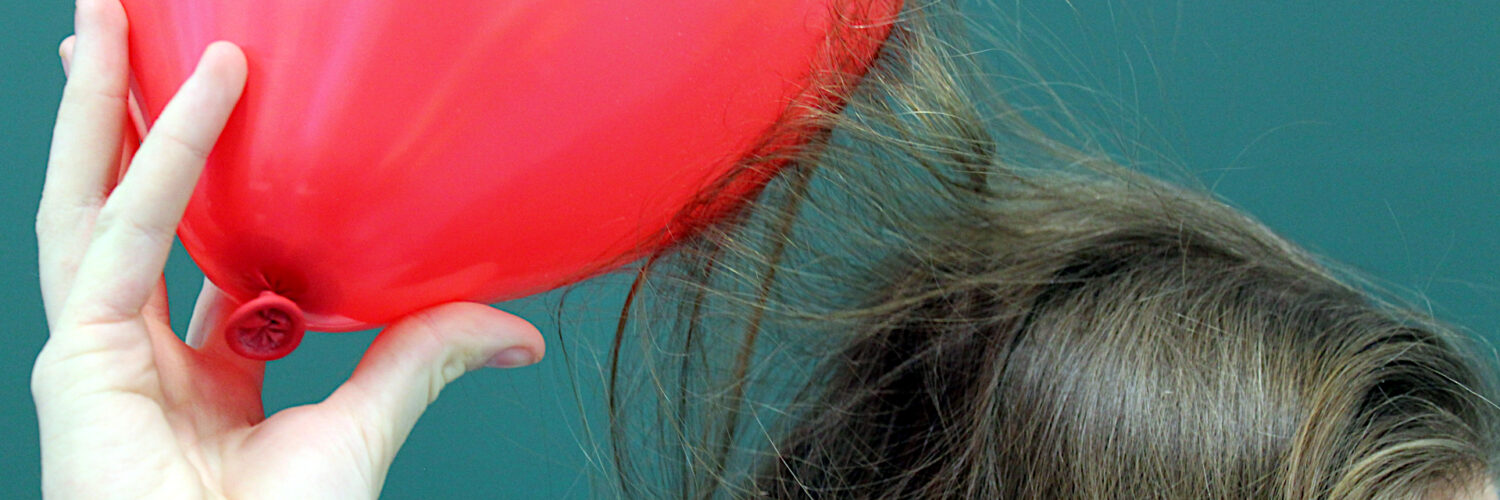
The classic balloon-and-hair demonstration works because the balloon and hair do not keep charge balanced after contact. When the balloon is rubbed against hair, electrons tend to move onto the balloon. The balloon becomes negatively charged, while the hair is left with a positive imbalance. Opposite charges attract, so the hair is pulled toward the balloon.
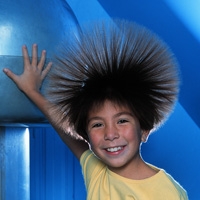
That is only half of the picture. The separate strands of hair now carry the same general kind of charge, so they repel one another. Each strand pushes away from nearby strands, and the hair fans outward instead of lying flat. A Van de Graaff generator makes the same idea more dramatic by placing the same kind of charge across a person’s hair. The strands repel each other so strongly that they spread like a halo.
The same rule explains why two charged balloons can push apart after being rubbed with the same material. Like charges repel; opposite charges attract. Coulomb’s law gives the mathematical version of that rule: the electric force grows when charges are larger and weakens quickly as the distance between them increases. A student does not need the formula to understand the everyday pattern, but the pattern is powerful enough to become formal physics.
Why Charged Objects Stick to Neutral Ones
Static electricity would be simpler if charged objects only reacted with other charged objects. Instead, a charged balloon can stick to a wall, pull bits of paper upward, bend a thin stream of water, or roll an empty soda can across a table. Those objects may begin neutral, but their charges can shift slightly inside them when a charged object comes near.
This effect is called polarization. In a neutral object, positive and negative charges are still present; they are just balanced overall. When a negatively charged balloon comes near a wall, electrons in the wall’s surface are repelled a little farther away, leaving the nearer surface slightly more positive. The wall is still neutral as a whole, but the closest side is attracted to the balloon more strongly than the farther side is repelled. That uneven distance creates a net pull.
The Exploratorium uses simple activities with balloons, cans, and water streams to show this effect without special equipment. The charged balloon does not have to touch the can for the can to move. Its electric field rearranges charges inside the can, and the nearer opposite charge feels a stronger pull. That is why static effects often look like invisible strings at work.
Why Dry Air Makes Static Worse
Static electricity shows up more often in dry weather because charge has fewer easy paths to leak away. Water molecules in humid air and thin moisture films on surfaces can help charges move and neutralize gradually. When the air is dry, many surfaces stay better insulated, so charges remain separated for longer. That is why winter rooms, heated indoor air, synthetic carpets, and dry laundry can turn small charge imbalances into noticeable cling or shocks.
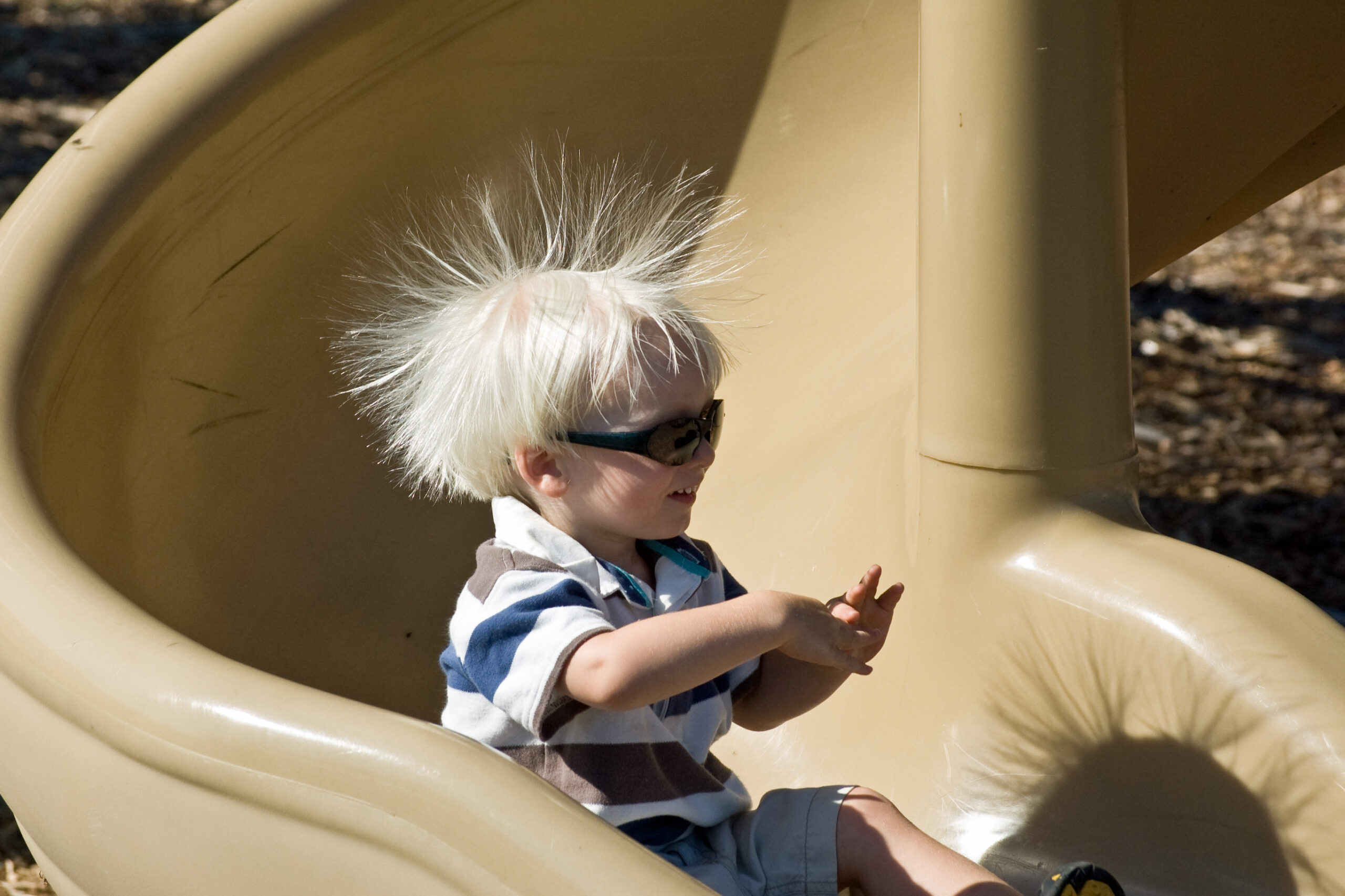
Clothes in a dryer are a perfect everyday example. Fabrics tumble, touch, and separate over and over. If a cotton sock and a polyester shirt trade electrons, they may come out with opposite charges and cling together. Dryer sheets and antistatic products reduce that effect by making surfaces less eager to exchange or hold separated charges, often by adding a thin coating that helps charge spread out more evenly.
The shock from a doorknob is the same story with a sharper ending. Walking across carpet can leave the body with extra charge. A metal doorknob gives that charge a good path to move. When the electric difference becomes strong enough, electrons jump through a tiny gap of air before the finger fully touches the metal. The snap, flash, and sting come from a brief current and a small spark.
Insulators Hold Charge, Conductors Let It Move
Whether static charge stays put depends heavily on the material. Insulators such as rubber, plastic, glass, dry hair, wool, and many synthetic fabrics do not let charge move freely through them. A charged area can remain localized, which is why one part of a balloon can cling strongly after rubbing. Conductors such as metals allow electrons to move much more easily, so charge spreads across the surface or flows away through a path to ground.
This difference explains why static demonstrations often use plastic balloons, combs, foam plates, or tape. Those materials can hold separated charge long enough for the effect to be seen. Metal objects behave differently unless they are insulated from the ground. A metal pie pan sitting on an insulating surface can be charged by induction, but a metal object held directly in a person’s hand may lose charge through the body before much happens.
Grounding simply means giving charge a path into or out of the much larger Earth. The ground can accept or supply electrons without changing its overall charge in any noticeable way. Touching a charged object can ground it through the body, which is why a static spark often ends the effect. The charge imbalance had been stored; the spark is the fast return toward balance.
From Tiny Shocks to Lightning
A doorknob spark and a lightning flash are not the same in size, but they belong to the same family of phenomena. Both involve separated electric charge, a growing electric field, and a sudden discharge when air can no longer keep the charges apart. The National Weather Service explains thunderstorm electrification through collisions among ice crystals, graupel, supercooled droplets, and strong updrafts. Those collisions help separate charge inside the storm, with positive charge often carried higher and negative charge building in the middle to lower part of the cloud.
As charge separation increases, the electric field between cloud regions, other clouds, or the ground becomes stronger. Air normally resists electric current, but a strong enough field can ionize air molecules and open a path for charge to move. That movement produces the bright flash of lightning and heats the surrounding air rapidly. Thunder follows because the heated air expands explosively and sends a sound wave outward.
Everyday static is usually harmless, but the comparison helps show why small demonstrations matter. A balloon lifting hair, a charged comb tugging bits of paper, and a spark from a fingertip all make electric forces visible at a human scale. They reveal that matter is not electrically empty. It is full of charged particles that usually balance so quietly that the balance is easy to forget.
Static electricity is not a special kind of electricity separate from the rest of physics. It is ordinary electric charge caught out of balance for a while. Once electrons shift, surfaces that looked neutral can attract, repel, cling, or spark. The surprise lasts only until the charges find a path back toward balance, but in that brief moment an invisible part of matter becomes something a person can see, hear, and feel.