 Akshay Dinesh
A guitar capo looks simple: a small clamp across the fretboard. Yet it can make a song feel suddenly easier, brighter, or better matched to a singer’s voice. The clever part is that the player’s fingers do not have to learn a completely new set of chord shapes. The capo moves the guitar’s starting point, so the same familiar shapes produce higher-sounding chords.
That is why a guitarist might play the shape that looks like G major while the music coming out is actually A major. The hand still feels the old shape, but the instrument is now speaking from a different fret. Once that idea clicks, capo charts stop feeling mysterious. They are really a shortcut for transposition, which means moving music from one key to another while keeping its relationships intact.
The capo acts like a movable nut
On a standard guitar, the nut is the small strip near the headstock where the strings begin vibrating when they are played open. If no finger presses a string, that open string vibrates from the nut to the bridge. A capo clamps the strings down at a fret, making that fret behave like a temporary new nut. The open strings are no longer E, A, D, G, B, and E. They have all been raised by the same number of half steps.
Each fret on the guitar raises a pitch by one half step. Put the capo on the first fret, and every open string sounds one half step higher. Put it on the second fret, and every open string sounds two half steps higher. The shape under the player’s fingers has not changed, but the entire fretboard has shifted upward from the listener’s point of view.
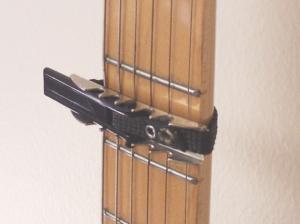
This is also why the capo does not tune each string separately. It does not turn only one note into a new note or fix one chord at a time. It raises the whole open-string system together. If the guitar was already in tune before the capo went on, the capo preserves the spacing between the strings and moves the playable shapes into a higher register.
Chord shapes and sounding chords are not the same thing
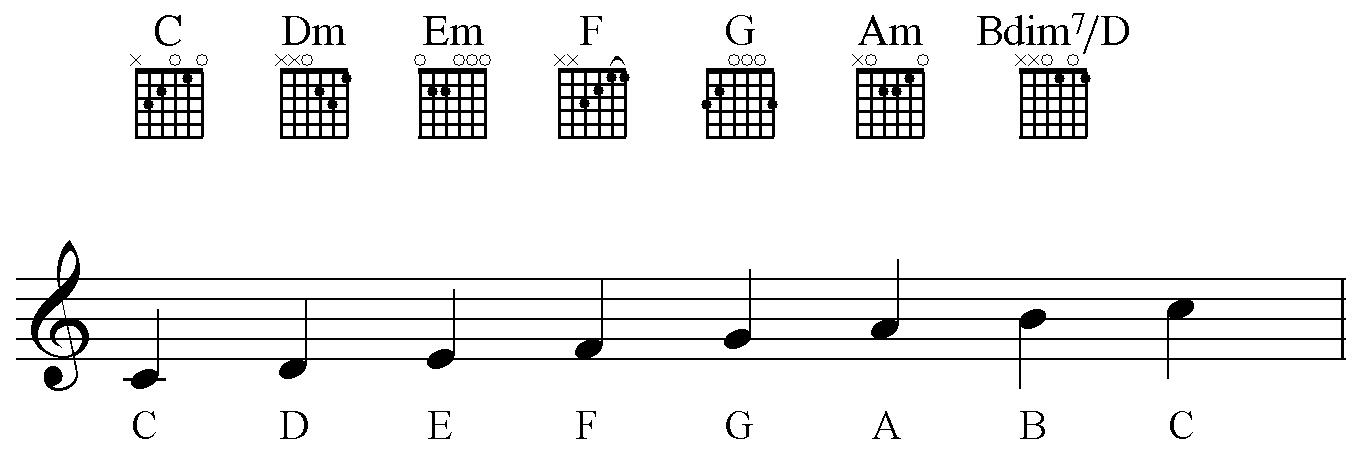
The main source of confusion is the word chord. Guitarists often use it in two slightly different ways. Sometimes they mean the shape their fingers make: a G shape, a C shape, an E minor shape. Other times they mean the actual concert pitch that is heard: G major, C major, E minor. With no capo, those usually match. With a capo, they no longer have to.
For example, place a capo on the second fret and play the familiar G major shape. Every note in that shape has moved up two half steps. G moves to A, B moves to C sharp, and D moves to E. The shape feels like G, but the sounding chord is A major. A singer or another instrumentalist would call that chord A, even if the guitarist thinks of the fingering as a G shape.
This difference is not a trick or a mistake. It is a useful separation between how the guitarist plays and what the music sounds like. A song sheet for guitar might say “capo 2, play G, C, D.” That usually means the guitarist should use G, C, and D shapes with the capo on the second fret. The actual chords sounding would be A, D, and E.
Why singers and songwriters use capos
One of the most common reasons to use a capo is vocal range. A song that sits too low for a singer may feel dull or uncomfortable, even if the guitar chords are easy. Moving the capo upward raises the song without forcing the guitarist to replace every open chord with a harder barre chord. The singer gets a more comfortable key, and the guitarist keeps familiar hand shapes.
Suppose a song uses G, C, Em, and D shapes. With the capo on the second fret, those shapes sound as A, D, F sharp minor, and E. With the capo on the fourth fret, they sound as B, E, G sharp minor, and F sharp. The musical relationships stay the same: home chord, neighboring chords, and emotional direction. Only the pitch level changes.
Capos also preserve the color of open-string playing. Open chords often ring with a bright, airy sound because some strings are not stopped by the fingers. If a guitarist transposes the song using only barre chords, the harmony may be correct, but the texture can feel heavier. A capo lets the player move the key while keeping much of the ringing, folk-style quality of open shapes.
How to figure out the real chord name
The simplest method is to count half steps from the chord shape. If the capo is on the third fret, every shape sounds three half steps higher. A C shape becomes E flat. A D shape becomes F. An A minor shape becomes C minor. The chord quality, such as major, minor, or seventh, stays the same unless the guitarist changes the shape itself.
A small mental chart helps. Capo 1 means everything is up one half step. Capo 2 means up two half steps. Capo 3 means up three half steps. From there, name the chord by walking forward through the musical alphabet with sharps or flats as needed. A G shape with capo 2 is A. A C shape with capo 2 is D. An Em shape with capo 2 is F sharp minor.
It can help to separate the question into two parts: What shape am I playing? and How far has the capo moved it? The shape tells you the starting chord. The capo position tells you how many half steps to raise it. This is the same logic a pianist or horn player uses when transposing music, but the guitar gives the player a physical shortcut.
- Capo 1, D shape sounds as E flat.
- Capo 2, C shape sounds as D.
- Capo 3, G shape sounds as B flat.
- Capo 4, A minor shape sounds as C sharp minor.
The exact spelling can depend on the key. The same pitch might be called C sharp or D flat in different musical contexts. For everyday guitar playing, the practical goal is usually to know the chord another musician needs to hear. More advanced theory can refine the spelling later.
What a capo cannot do
A capo is powerful, but it is not a magic substitute for understanding chords. It raises pitch; it does not change major into minor, fix a weak rhythm, or make every key equally comfortable. A song may still need different voicings if the melody clashes with the new range. Some capo positions also make the guitar sound thinner because the vibrating string length becomes shorter.
There are physical limits too. If the capo is placed too high, the frets become crowded and the sound can lose warmth. If the capo squeezes unevenly, some strings may go slightly sharp or buzz. Good placement matters: the capo should sit close behind the fret, hold the strings firmly, and avoid pulling them sideways. A quick tuning check after clamping it on is normal, especially on acoustic guitars.
Capos also do not replace movable chord knowledge. Barre chords, triads, and scale shapes help guitarists understand the fretboard without relying on open-position shapes. The capo is best seen as another tool. It is especially good for matching a voice, keeping open-string sparkle, and quickly trying a song in a new key.
The real lesson is transposition you can feel
A capo makes music theory visible under the hand. Move it up one fret, and everything rises one half step. Move it up two frets, and the same chord shapes now sound a whole step higher. The guitar becomes a transposition machine, but the player experiences that change through touch rather than through a page of rewritten chords.
That is why the capo remains useful from beginner songs to professional performances. Beginners use it to avoid awkward keys while they build strength and confidence. Songwriters use it to test where a melody sits best. Performers use it to keep the sound of open chords while fitting a singer, an ensemble, or a recording arrangement.
The small clamp is doing a precise musical job. It shortens the strings, raises their pitch, and lets familiar shapes speak in a new key. Once a guitarist can hear the difference between the shape being played and the chord being sounded, the capo stops feeling like a shortcut around theory. It becomes a clear, practical way to understand it.