 Akshay Dinesh
A trumpet has only three valves, yet a player can produce a full chromatic scale across several octaves. The valves are not buttons that each make one fixed note. They are switches in an acoustic system: pressing one redirects the moving air through extra tubing, while the player’s lips choose among the resonances that the new tube length can support. The result is a compact partnership between mechanics and musicianship.
The sound starts before the valves move
Brass instruments begin with a buzz. The player closes the lips lightly against the mouthpiece and sends air between them, causing the lips to open and close rapidly. Those pulses disturb the air inside the instrument. The tubing does not accept every possible vibration equally, however. It strongly reinforces certain frequencies, called resonances, and the player’s lips tend to lock onto one of them.
This is why a trumpet is more than a megaphone for a lip buzz. The lips provide energy, but the air column inside the instrument helps organize that energy into a stable musical pitch. Researchers in the University of New South Wales Music Acoustics group describe the lips as a vibrating valve that works together with the instrument’s resonances. Some sound energy eventually leaves through the bell, while the player continually replaces energy lost to radiation and friction.
The length and shape of the air path set the locations of those resonances. As a useful first approximation, a longer air column supports lower resonant frequencies, while a shorter one supports higher frequencies. That relationship explains the basic purpose of a valve: it changes the length of the route the air must travel.
A valve adds tubing instead of plugging a hole
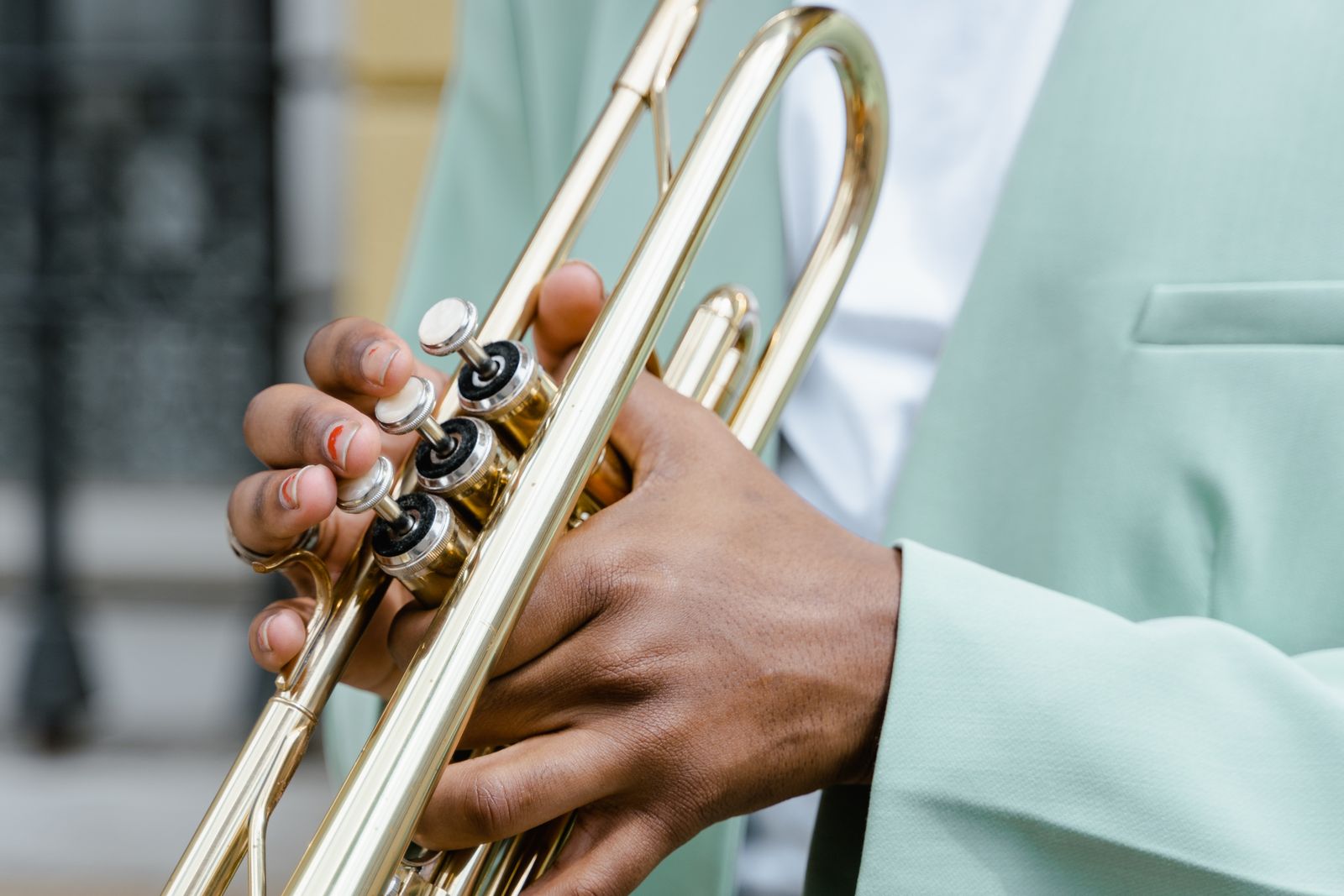
Look closely at a piston-valve trumpet and each valve appears to be a metal cylinder with passages bored through it. With the valve up, those passages guide air along the main route. Pressing the valve aligns a different set of passages and sends the air through a valve slide, an added loop of tubing, before returning it to the main bore. Releasing the valve lets a spring restore the shorter route.
The three loops have different lengths because they must lower the pitch by different musical intervals. On a standard B-flat trumpet, the second valve lowers an open note by one semitone, the first lowers it by two semitones, and the third lowers it by roughly three semitones. Yamaha’s instrument guide gives representative added lengths of about 70 millimetres for the second valve, 160 millimetres for the first, and 270 millimetres for the third. Exact dimensions depend on the instrument, but the pattern remains: a larger pitch drop needs a longer detour.
Combining valves adds their loops to the air path. Pressing the first and second valves produces roughly a three-semitone drop; pressing the first and third produces about five. Three valves provide eight up-or-down combinations, including all valves open. Two of those routes are nearly equivalent in pitch, so the system supplies seven basic tube lengths rather than eight completely different ones.
The important motion is inside the bore. Air does not simply travel from mouthpiece to bell as a single packet and then become sound. Pressure waves reflect through the tubing and establish patterns of vibration. Changing the route changes the frequencies at which those patterns are easiest to sustain.
The harmonic series supplies many notes from one tube length
If valves only created seven tube lengths, seven pitches would be a poor return. Each length actually supports a family of resonances called the harmonic series. A player moves between them by changing lip tension, airflow, tongue position, and the shape of the mouth. Musicians often call this coordination the embouchure.
That is why the same open fingering can produce several notes. On a B-flat trumpet, written C, G, the next C, E, and higher notes can share the same valve position even though they sound at different frequencies. The tubing has not changed; the player has selected a different resonance. As the series rises, the available resonances crowd closer together, which gives the player more nearby choices but also demands finer control.
The valves fill the gaps between these natural notes. Imagine the open instrument offering one ladder of resonances. Pressing the second valve lengthens the tube slightly and shifts the whole ladder downward by a semitone. The first valve shifts it farther, and combinations create more shifted ladders. By moving between ladders with the fingers and between rungs with the lips, a trumpeter reaches every note of the chromatic scale.
This division of labor also explains why simply holding the correct valves does not guarantee the correct note. The fingering establishes a likely resonance, not an automatic pitch command. A tired or inexperienced player can land on the wrong harmonic, bend the note sharp or flat, or produce a split attack even with the right fingers.
Why valve combinations are not perfectly in tune
The tidy interval values hide a mathematical complication. A valve slide is built to add the right percentage of length when used with the open instrument. Once another valve has already lengthened the tube, adding that same fixed loop becomes a smaller percentage of the new total. The combined tube therefore ends up a little too short for the ideal interval, making some valve combinations sound sharp.
The problem is easy to see with a simplified example. Suppose a valve must lengthen a 100-centimetre tube by about 5.9 centimetres to lower its resonance by an equal-tempered semitone. If other valves have already increased the working length to 133.5 centimetres, adding the same 5.9 centimetres is no longer a 5.9 percent change. It is only about 4.4 percent. The University of New South Wales acoustics explanation uses this proportional mismatch to show why fixed valve loops cannot make every combination exact.
Trumpeters correct the most troublesome notes with both technique and hardware. Many instruments have a movable third-valve slide controlled by the left ring finger and a first-valve slide controlled by the thumb. The player extends a slide on notes that would otherwise run sharp, especially low notes using the first and third valves or all three valves. Small adjustments of the lips help too, although forcing every correction with the embouchure can weaken tone and make playing less consistent.
This is not a manufacturing failure. It is a consequence of asking three fixed lengths of tubing to reproduce a set of proportional changes in many combinations. The design works remarkably well because players can make the remaining corrections while performing.
The same idea appears across the brass family
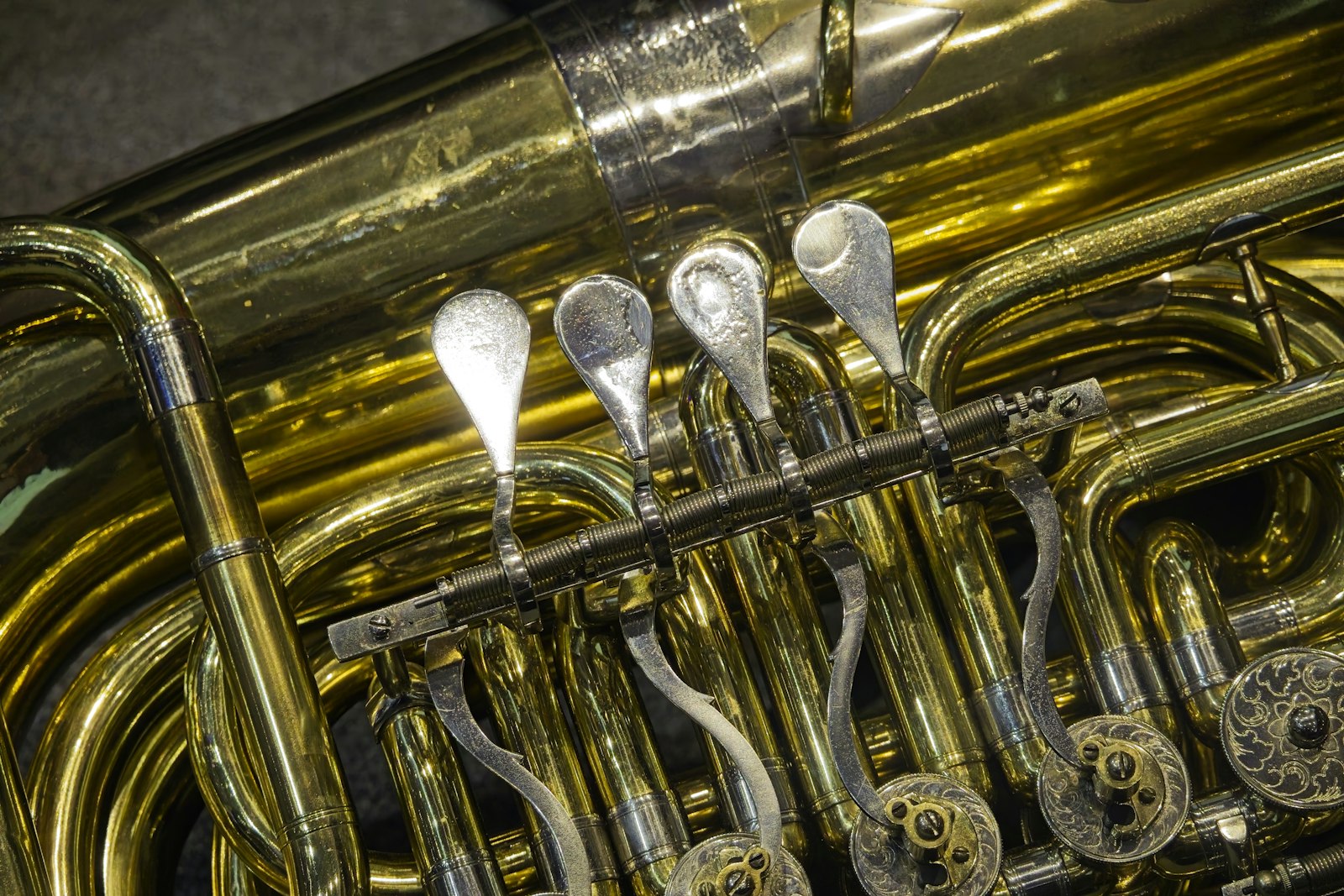
Trumpets, cornets, flugelhorns, euphoniums, and many tubas commonly use piston valves. French horns and some tubas often use rotary valves instead. A rotary valve turns an internal rotor to redirect air, while a piston moves up and down, but both mechanisms perform the same acoustic job: they insert extra tubing into the active air path.
Larger instruments often add a fourth valve. Yamaha’s guide to the tuba notes that this valve commonly lowers the pitch by about five semitones, or a perfect fourth. It extends the low range and can replace combinations that are especially sharp. Compensating euphoniums and tubas go further by routing air through additional correction tubing when several valves are used together.
The trombone makes the principle visible. Instead of pressing valves, the player extends a long telescoping slide. Moving the slide outward lengthens the tube continuously and lowers its resonances. A valved instrument packages selected versions of that same change into fast finger movements, which is one reason a rapid trumpet passage can move through notes without the player’s hand traveling along a long slide.
The bell, bore shape, mouthpiece, and material choices all influence response and tone color, but valves have a focused task. They redraw the air’s route. The player’s buzz supplies the vibration, the altered tube length shifts the available resonances, and the lips select and refine the final pitch. Three small pieces of moving metal can command an entire chromatic instrument because they never work alone.