 Akshay Dinesh
Bass clef is one of the first music symbols that can make a beginner feel as if the page has suddenly changed languages. Treble clef may look familiar from songs, classroom posters, and beginner piano books, but bass clef places the same musical alphabet in a lower range. Once the pattern is clear, it stops being a separate code and starts acting like a map for lower sounds.
The bass clef is used when music regularly sits below middle C. That includes the left hand of many piano pieces, the low notes of cello and double bass, bassoon parts, trombone music, tuba lines, and many bass guitar parts written in standard notation. Learning it well does more than help with note names. It helps musicians see how low notes support harmony, rhythm, and musical direction.
Why Music Needs More Than One Clef
A staff has only five lines and four spaces, so it cannot comfortably show every pitch an instrument might play. If all music used the same clef, low notes would require long stacks of extra little lines below the staff. High notes would need the same kind of extension above it. Reading would slow down because the page would be crowded before the musician even got to the rhythm.
Clefs solve that problem by assigning a reference point to the staff. Treble clef places the note G on a particular line, which is why it is also called the G clef. Bass clef places the note F on a particular line, which is why it is also called the F clef. The two dots of the bass clef sit around the line that represents F below middle C.
That reference point gives the rest of the staff its meaning. Once F is fixed, the notes move alphabetically up and down through A, B, C, D, E, F, and G, then repeat. The clef is not decoration at the beginning of the line. It tells the reader exactly where the note ladder starts.
The Line and Space Pattern
In bass clef, the five lines from bottom to top are G, B, D, F, and A. The four spaces from bottom to top are A, C, E, and G. Many students memorize these with sayings, but the deeper goal is to see the staff as a continuous pattern rather than a set of isolated labels.
Moving from one line to the next space always advances by one letter name. Starting on the bottom line, G moves up to the first space, A. Then it moves to the second line, B, and the next space, C. The staff works like a staircase: every step upward goes to the next musical letter, and every step downward goes to the previous one.
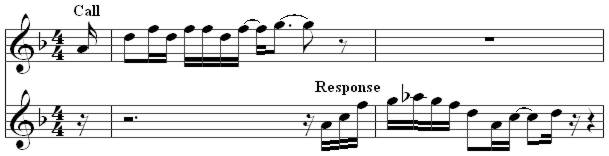
This matters because real music rarely gives a player one note at a time in a neat quiz format. A left-hand piano part might move from C to E to G as a broken chord. A cello melody might climb through neighboring notes before leaping downward. A reader who understands the staff pattern can follow the shape of the line instead of naming every note from scratch.
How Bass Clef Connects to Middle C
Middle C is the meeting place many beginners use to connect treble clef and bass clef. On the piano, it sits near the center of the keyboard. On the page, it sits between the two staffs used in grand staff notation. In treble clef, middle C appears on a short ledger line below the staff. In bass clef, it appears on a short ledger line above the staff.
That shared note helps explain why piano music often uses both clefs at once. The right hand commonly plays notes around and above middle C, while the left hand often plays notes below it. The two staffs are not two separate worlds. They are two nearby windows into one continuous pitch space.
Ledger lines extend the staff when a note falls just outside the five-line range. They are useful, but too many of them become hard to read quickly. Bass clef keeps lower music near the center of the staff, where patterns, intervals, and chords are easier to recognize at a glance.
What Bass Clef Shows About Musical Roles
Lower notes often carry the foundation of a piece. A bass line may outline the chord progression, steady the rhythm, or answer a melody in a lower register. In a choir, lower voices can give the harmony weight. In an orchestra, low strings, low brass, and bassoons can make a passage feel grounded, dark, tense, warm, or powerful depending on how they move.
Bass clef makes those roles visible. A pianist reading a left-hand accompaniment can see whether the part is walking step by step, jumping between chord tones, or repeating a pattern. A trombone player can tell whether a phrase rises toward brightness or settles back into a lower register. The clef gives low sounds a readable space where musical shape can be seen before it is played.
That is why bass clef should not be treated as a less important version of treble clef. Melodies can live there. Countermelodies can live there. Rhythmic patterns that drive the whole piece can live there. Much of the music’s structure becomes clearer once the lower staff feels familiar.
Common Mistakes When Learning Bass Clef
The most common mistake is trying to translate every bass clef note from treble clef. That works slowly at first, but it keeps bass clef feeling foreign. It is better to build direct recognition: bottom line G, second line B, middle line D, fourth line F, top line A, with the spaces A, C, E, and G in between.
Another mistake is treating note reading as pure memorization. Memorized landmarks help, but fluent reading comes from combining landmarks with movement. If a note starts on C and the next note is one step higher, the reader can recognize D even before naming it consciously. If a chord stacks line-space-line or space-line-space, the eye can begin to see thirds instead of disconnected dots.
Beginners also sometimes ignore rhythm while hunting for pitch names. Music reading needs both. A bass note that lands too late can weaken the beat even if the pitch is correct. Slow practice should still keep the pulse alive, because bass parts often do the quiet but essential work of making the meter feel stable.
A Practical Way to Learn It
A strong practice routine starts with a few reliable landmarks. Learn F between the bass clef dots, middle C above the staff, low C in the second space from the bottom, and the bottom-line G. Then read short groups of notes around those anchors rather than drilling random notes endlessly.
It also helps to connect the page to sound and motion. On piano, play a five-note pattern from low C to G while saying the note names. On a string or wind instrument, match written notes to familiar fingerings or slide positions. The goal is not to recite labels forever. The goal is to make the written note, the physical action, and the sound arrive together.
Bass clef becomes easier when it is practiced in real musical phrases. A short left-hand piano pattern, a simple cello line, or a bass melody with repeated rhythms teaches more than a page of isolated note names. The eye learns where notes sit, the ear learns how low-register movement sounds, and the hands begin to trust the staff. With enough contact, bass clef stops looking upside down and starts doing exactly what a clef is supposed to do: make music easier to read.