 Akshay Dinesh
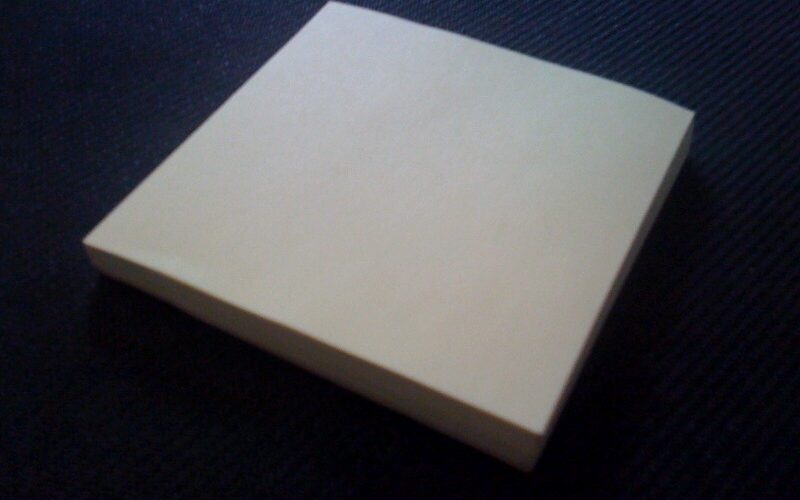
A sticky note looks almost too simple to be interesting: a small square of paper, a pale strip of adhesive, and enough grip to stay on a desk, notebook, folder, or wall. The surprising part is not that it sticks. Plenty of glues can do that. The clever part is that it sticks lightly, peels away cleanly, and often works again in a new spot.
That balance is a small materials-science trick hiding in plain sight. A useful sticky note has to make contact with a surface quickly, hold against gravity and small bumps, and then let go when someone pulls from an edge. If the adhesive were too strong, it would tear the paper, damage the surface, or leave residue. If it were too weak, the note would curl up and fall before the reminder mattered.
Sticky Notes Use a Different Kind of Adhesive
Many school glues and craft glues work by starting as a liquid and then changing as they dry. Water evaporates, polymers settle into place, and the glue forms a more permanent connection between two surfaces. That is why a glued paper project may be hard to separate later without ripping something. The goal is a bond that becomes stronger after time, pressure, and drying.
Sticky notes belong to a different family: pressure-sensitive adhesives. These adhesives do not need heat, water, mixing, or a long drying step. They are already tacky at room temperature, so a light press is enough to create contact. Tape, labels, bandages, and many removable wall hooks use related ideas, though their exact formulas are tuned for different jobs.
The word pressure matters because the adhesive has to be pushed close enough to the surface to grip it. A surface that looks smooth to the eye is full of tiny hills, valleys, pores, fibers, and scratches. When a sticky note is pressed down, its adhesive spreads over some of that microscopic landscape. More contact usually means more attraction, which is why rubbing a note down firmly often helps it stay longer.
Sticking Is Mostly About Close Contact
At the scale of everyday touch, a sticky note seems to hold on because it is covered with glue. At the molecular scale, sticking depends on close contact between materials. When the adhesive and the surface get near enough, weak attractions between molecules can add up across many tiny contact points. Each attraction is small, but thousands or millions of them together can be enough to hold a lightweight paper note.
The adhesive also has to behave in two different ways at once. It needs a soft, flowing side so it can spread into surface texture. It also needs an elastic side so it does not simply smear away or stay behind when peeled. Materials that combine those behaviors are often called viscoelastic. That means they can slowly flow under pressure like a thick liquid, but they can also spring back somewhat like a soft solid.
This is why sticky notes work better on some surfaces than others. A clean, smooth desk, glass door, whiteboard, or textbook cover gives the adhesive lots of usable contact. A dusty wall, rough brick, fuzzy fabric, or oily surface interrupts that contact. The adhesive may still feel sticky to a finger, but it cannot reach enough of the surface to make a reliable grip.
Why the Note Lets Go When You Peel It
The easiest way to remove a sticky note is to lift from one edge and peel across the strip. That action concentrates force along a narrow line. Instead of asking the whole adhesive area to let go at once, peeling breaks the contact bit by bit. The same note that can resist sliding downward may release easily when pulled from a corner.
This difference between forces is central to adhesive design. Shear force tries to slide one surface along another. A sticky note needs enough shear strength to keep from creeping down a wall. Peel force bends the paper away from the surface and focuses stress at the edge of the adhesive. A removable adhesive is designed so peel wins before the paper tears or the wall surface fails.
The paper itself helps. Because the note is thin and flexible, it can bend as it peels. That bending changes the angle of the pull and lets the adhesive separate gradually. If the backing were stiff, the same adhesive might feel harder to remove because more of the bond would be forced to resist at once.
Peeling direction also explains a familiar classroom annoyance: notes that curl and fall. If the paper bends away from the surface, the curled edge begins the peeling process on its own. Humidity, repeated handling, and old adhesive can all make this worse. Once the edge lifts, the remaining contact area shrinks, and gravity has an easier job.
The Secret Is Low Tack, Not Weak Science
A good sticky note is not simply using bad glue. It uses an adhesive with deliberately low tack compared with permanent labels or strong packing tape. Tack is the quick grab an adhesive has when it first touches a surface. High tack is useful when a shipping label must stay on a box. Lower tack is useful when a reminder should move from a notebook page to a desk without tearing either one.
The original removable-note adhesive developed at 3M is often described through tiny adhesive microspheres. Instead of forming a flat, continuous glue layer, those small rounded particles create limited contact points. That gives the note enough grip to hold lightweight paper, but not enough continuous bonding to behave like a permanent adhesive. The invention became famous partly because it turned a supposedly weak adhesive into exactly the right tool.
That design also helps explain why a sticky note can be reused a few times but not forever. Each use picks up dust, paper fibers, skin oils, and tiny bits of debris. Those particles block contact between the adhesive and the next surface. Pressing harder can help for a while, but once enough of the adhesive is covered or deformed, the note loses its clean peel-and-stick balance.
Different products tune that balance differently. Some notes are made for paper and desks. Others are made to grip walls, folders, or vertical displays more strongly. The stronger version may feel more reliable, but it may also be less forgiving on delicate surfaces. Adhesive design is always a tradeoff between grip, removability, residue, cost, and the surface the product is meant to touch.

Why Surfaces Change the Result
A sticky note on notebook paper behaves differently from one on painted cinder block because the surface decides how much contact the adhesive can make. Paper has fibers and pores, so the adhesive may grip unevenly. Glass is smoother, so the adhesive can spread into closer contact. A dusty shelf puts a layer of loose particles between the adhesive and the shelf, so the note sticks more to the dust than to the surface underneath.
Temperature can matter too. Many pressure-sensitive adhesives become firmer when cold and softer when warm. If the adhesive is too firm, it may not flow into the surface texture well. If it is too soft, it may leave more residue or creep under load. Ordinary room conditions are usually fine, but extreme heat, cold, or humidity can push the adhesive away from its best behavior.
Surface energy is another hidden factor. Some materials are naturally easier for adhesives to wet, meaning the adhesive can spread across them instead of pulling back into itself. Other materials, including certain plastics and coated surfaces, resist wetting. That is one reason two smooth objects can produce different results with the same note. Smoothness helps, but chemistry at the surface matters too.
The note’s own paper can change with moisture. In humid air, paper fibers absorb water and may curl, soften, or change shape slightly. The adhesive strip then has to hold a piece of paper that is trying to bend away from the surface. The failure may look like bad glue, but the cause can be a mix of paper movement, surface texture, and weakened contact.
A Small Object With a Big Materials Lesson
Sticky notes are useful because they sit in a narrow middle ground. They are not permanent enough to be glue, not weak enough to be loose paper, and not complicated enough to need clips or pins. Their chemistry gives them a temporary relationship with a surface: close enough to hold, limited enough to release.
That makes them a good reminder that materials are designed for specific forces, surfaces, and habits. The question is not simply whether something sticks. It is how quickly it sticks, how it handles sliding, how it handles peeling, what it leaves behind, and whether it can repeat the job. A sticky note works because its adhesive is engineered to answer those questions in a very particular way.
The next time a note stays neatly on a page, curls off a wall, or loses its grip after being moved too many times, the explanation is not random. It is a tiny lesson in contact, force, surface texture, and polymer behavior. The note is doing chemistry every time it sticks, and a little physics every time it peels away.