
 Akshay Dinesh
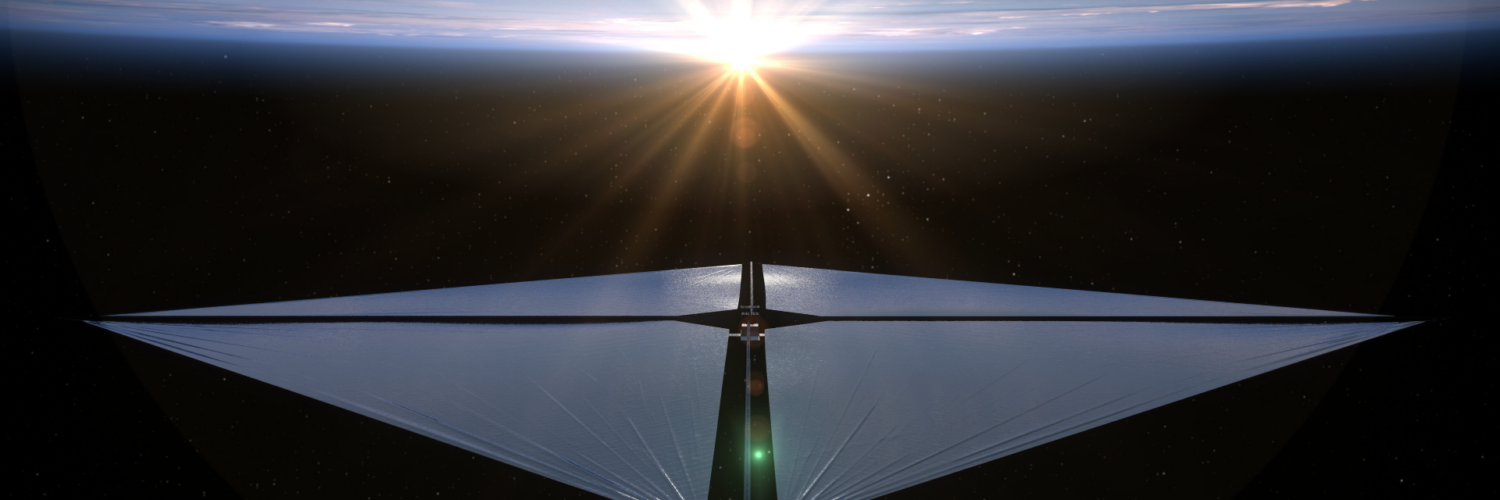
A spacecraft does not have to roar through space to keep moving. Once it has escaped Earth and reached orbit, even a very small push can matter if that push keeps arriving day after day. Solar sails use that idea in one of the most elegant forms of spacecraft propulsion: a huge, reflective sheet that catches momentum from sunlight instead of burning fuel.
The push is tiny. It is not wind, and it is not the solar wind of charged particles streaming from the Sun. It comes from light itself. Sunlight is made of photons, and photons carry momentum even though they have no rest mass. When photons strike a reflective surface and bounce away, they give the surface a small shove. Spread that shove across a large, light sail in the near-vacuum of space, and a spacecraft can slowly change speed or direction without using onboard propellant.
Light Can Push, Even When the Push Is Small
On Earth, light pressure is usually too small to notice. A breeze on your face is obvious because moving air molecules carry far more momentum at everyday scales. Sunlight touching your skin warms it, but the mechanical push is so faint that it disappears beneath gravity, friction, and air resistance. Space changes the balance. There is no road friction, no ocean drag, and very little atmosphere in a high orbit, so a small force can accumulate over time.
The physics is the same reason radiation pressure has to be included in careful spacecraft navigation. Light carries energy, and energy is tied to momentum. When light is absorbed, it transfers some momentum in the direction it was traveling. When light reflects from a mirror-like sail, the bounce can transfer even more momentum because the photon’s direction changes. The sail feels the result as a gentle pressure from the Sun.
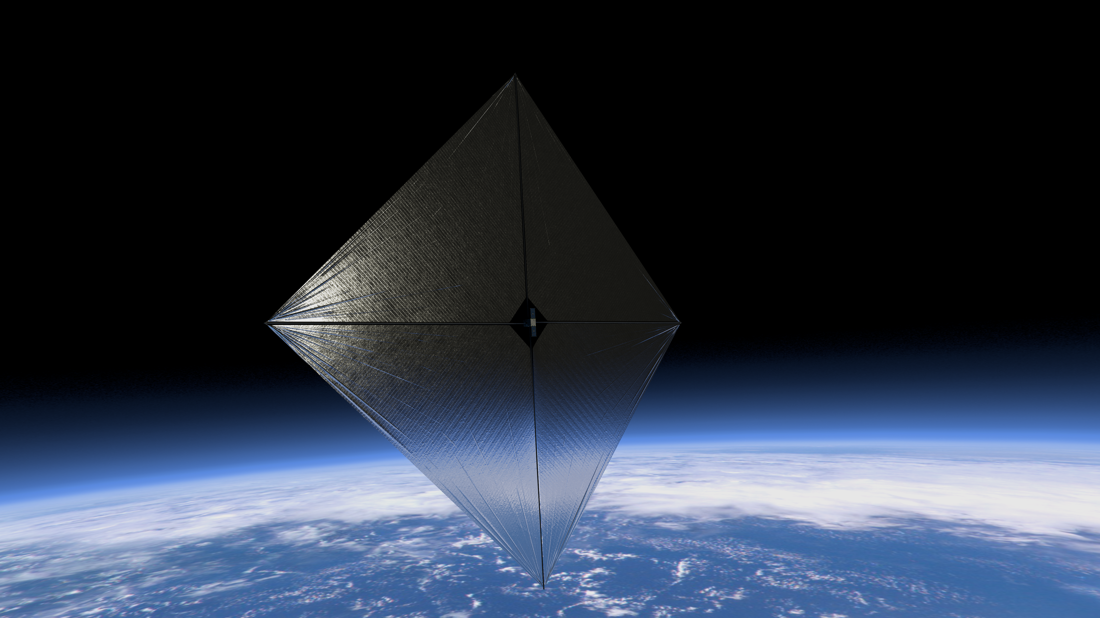
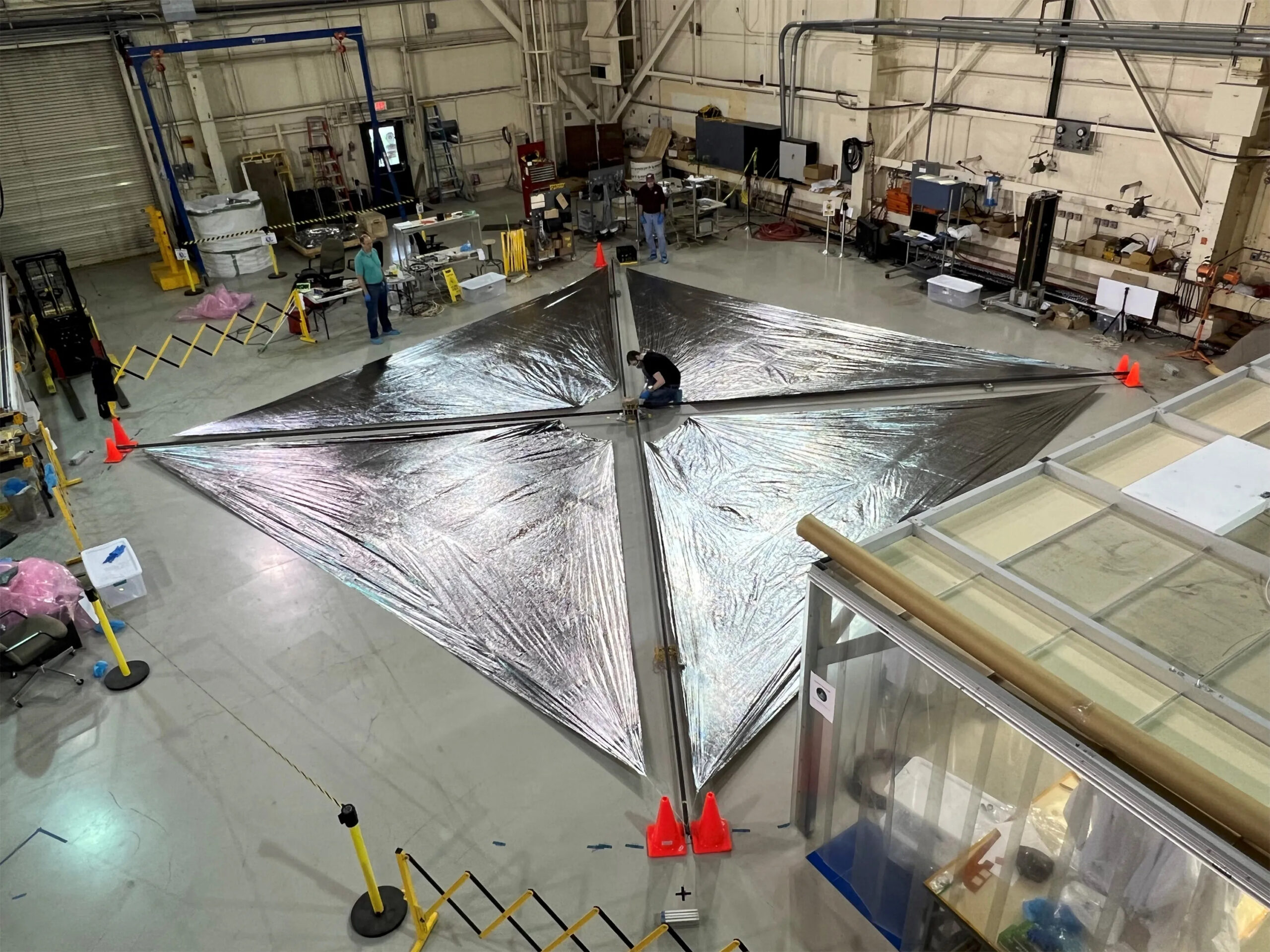
That pressure is why solar sails need to be large, shiny, and lightweight. A heavy spacecraft with a small sail barely responds. A small spacecraft with a wide sail has more reflecting area for each kilogram it carries, so the same sunlight can produce a more useful acceleration. NASA’s Advanced Composite Solar Sail System, known as ACS3, uses a CubeSat body with a square sail about 30 feet, or 9 meters, on each side. NOAA’s Solar Cruiser concept is much larger, with a deployed square more than 133 feet on a side, because stronger mission uses require far more collecting area.
Why a Sail Works Differently From a Rocket
A chemical rocket gets its force by throwing mass backward. Fuel and oxidizer react, hot gas shoots out of the engine, and the spacecraft is pushed the other way. That thrust can be powerful, which is why rockets are needed to launch from Earth and perform major maneuvers. The tradeoff is that every kilogram of propellant must be carried along, and carrying propellant makes the spacecraft heavier.
A solar sail avoids that tradeoff after launch. It still needs a rocket to reach space, but once it is deployed, the sail does not spend fuel to keep producing thrust. Sunlight supplies the momentum. The force is weak compared with a rocket engine, but it can continue as long as the spacecraft has sunlight and the sail remains healthy enough to operate.
That changes how the mission behaves. A rocket burn is usually brief and decisive: fire the engine, change the trajectory, then coast. A solar sail is patient. It nudges the spacecraft over many orbits, gradually raising or lowering an orbit or reshaping a path around the Sun. The Planetary Society’s LightSail 2 mission demonstrated this principle with a small spacecraft that used sunlight alone to change its orbit before reentering Earth’s atmosphere in 2022.
The difference can be compared to pushing a shopping cart once versus giving it a tiny tap every second for a long time. One tap is not impressive. Thousands of taps can become a real change in motion. In space, where nothing quickly stops the cart, repeated tiny pushes are valuable.
How a Solar Sail Steers
A solar sail does not simply fly straight away from the Sun. Direction depends on the angle of the sail. If the reflective surface faces the Sun directly, photons push mostly outward. If the sail is tilted, the reflected light leaves at a different angle, and the force on the spacecraft changes direction. Mission designers can use that geometry to raise an orbit, lower an orbit, or shift the spacecraft’s path.
This is why the word sail is more than a metaphor, even though the physics is not identical to wind on cloth. A boat can tack by angling its sail against the wind. A solar sail can also change its path by changing its angle relative to incoming sunlight. The control problem is delicate because the spacecraft must keep the sail shaped, oriented, and balanced while sunlight, gravity, and the spacecraft’s own rotation all interact.
NASA’s ACS3 mission is partly about that engineering challenge. The sail has to be packed into a compact spacecraft, then unfolded into a large, stable shape in orbit. Its booms act like structural supports, keeping the thin sail stretched. NASA describes the ACS3 booms as flexible polymer reinforced with carbon fiber, designed to roll up compactly and remain stiff after deployment. That matters because a wrinkled, bending, or poorly controlled sail cannot aim its reflective force as precisely.
Why Space Weather Missions Care About Solar Sails
Solar sails are often presented as futuristic deep-space technology, but one of their most practical near-term uses may be closer to home: space weather monitoring. Space weather includes bursts of solar activity that can disturb satellites, radio communication, navigation signals, and electric power grids. Earlier warning is valuable because some solar storms can affect large technological systems on Earth.
NOAA has described solar sail propulsion as a way to place future space weather observatories closer to the Sun than current missions can easily remain. A sail can help a spacecraft hold a position that would otherwise be difficult because the gentle sunlight force can partly balance gravitational effects. From a better vantage point, an observatory could detect solar activity earlier and give forecasters more lead time before a geomagnetic storm reaches Earth.
This is a good example of why fuel-free propulsion is not just about speed. Sometimes the important advantage is station keeping: staying where scientists want the spacecraft to stay. A conventional spacecraft can do that with fuel, but fuel eventually runs low. A solar sail has a different limit. Its useful lifetime depends more on the durability of the sail, the strength of its supports, spacecraft electronics, and how much sunlight reaches it.
The Main Limits Are Engineering, Not Imagination
The basic physics of solar sailing is well understood, but useful missions require hard engineering. The sail must be extremely thin, because a heavy sail wastes the advantage of having a large area. It must reflect well, because reflection transfers more useful momentum than absorption. It must survive sunlight, temperature swings, micrometeoroids, and the mechanical stress of deployment. It must also fold into a spacecraft small enough to launch affordably.
Size is another challenge. Bigger sails catch more sunlight, but they are harder to fold, deploy, stiffen, and control. A small CubeSat sail can prove a technology, but ambitious missions need larger structures with careful attitude control. If a boom bends, if the sail wrinkles, or if the spacecraft starts tumbling, the mission team has to understand how much control remains. NASA’s continuing ACS3 analysis is useful partly because real deployed structures never behave exactly like drawings on a design screen.
Distance from the Sun matters too. Sunlight weakens as a spacecraft travels farther away, so solar sailing is strongest in the inner solar system. A sail near Earth receives much more sunlight than one far beyond Mars. Future concepts sometimes imagine lasers pushing ultra-light sails over interstellar distances, but that is a much more demanding idea than using ordinary sunlight for near-Earth, lunar, asteroid, or solar-monitoring missions.
The promise is still remarkable. A solar sail does not replace rockets. It changes what can happen after a rocket has done its job. A spacecraft that can keep adjusting its motion without spending fuel can attempt missions that would be expensive, short-lived, or impractical with propellant alone.
A Slow Push Can Become a Long Journey
Solar sailing is a quiet technology. It has none of the drama of launch, no flame, and no sudden burst of acceleration. Its strength is persistence. Photons arrive constantly, bounce from a reflective surface, and leave behind a trace of momentum. Over time, that trace can become a planned change in orbit, a better observing position, or a path toward a more ambitious destination.
That makes solar sails a useful way to think about physics itself. Small effects are not automatically unimportant. In the right environment, with the right design, a force too faint to feel can steer a machine through space. The same sunlight that warms a sidewalk can, when reflected from a carefully built sail, become a source of motion.





Add comment