
 Akshay Dinesh
A dorm room can make one wall outlet feel responsible for half a life: a laptop, phone charger, desk lamp, fan, monitor, mini fridge, speaker, and maybe a few devices borrowed from a roommate. A power strip looks like the simple answer because it turns two receptacles into six or eight. The hidden problem is that a power strip adds places to plug things in, but it does not add electrical capacity. The same wall circuit still has limits, and heat is what turns a convenience device into a hazard.
That difference matters most during move-in season, when students are setting up rooms quickly and trying to make a small space work. Fire-safety groups such as the National Fire Protection Association and the Electrical Safety Foundation International warn against using extension cords as permanent wiring, running cords under rugs or doors, and plugging high-power appliances into power strips. The U.S. Consumer Product Safety Commission has also recalled faulty extension cords, power strips, and surge protectors when undersized wires, loose connections, poor grounding, or missing overcurrent protection created fire or shock hazards. The lesson is not that every power strip is dangerous. It is that power strips have to be matched to the job they are being asked to do.
Extra Outlets Do Not Mean Extra Power
Electric current is the flow of charge through a wire. When current flows through any real wire, some electrical energy becomes heat because the wire has resistance. A safe cord is designed so that the heat stays low under its rated load. Trouble starts when too much current passes through a cord, plug, outlet, or internal connection for too long. The device may still work, so the warning sign is not always a dramatic failure. The first clue can be a warm plug, a hot power strip, a faint burning smell, discoloration, or a breaker that keeps tripping.
A common household circuit in the United States is often 15 or 20 amps at about 120 volts. The useful idea is the power relationship watts = volts x amps. A 15-amp circuit at 120 volts has a theoretical ceiling around 1,800 watts, but that does not mean one power strip should be treated as a personal 1,800-watt supply. The circuit may serve other outlets, the power strip has its own rating, and continuous loads leave less room for error. A few low-power electronics may draw very little compared with a space heater, hair dryer, microwave, or toaster oven.
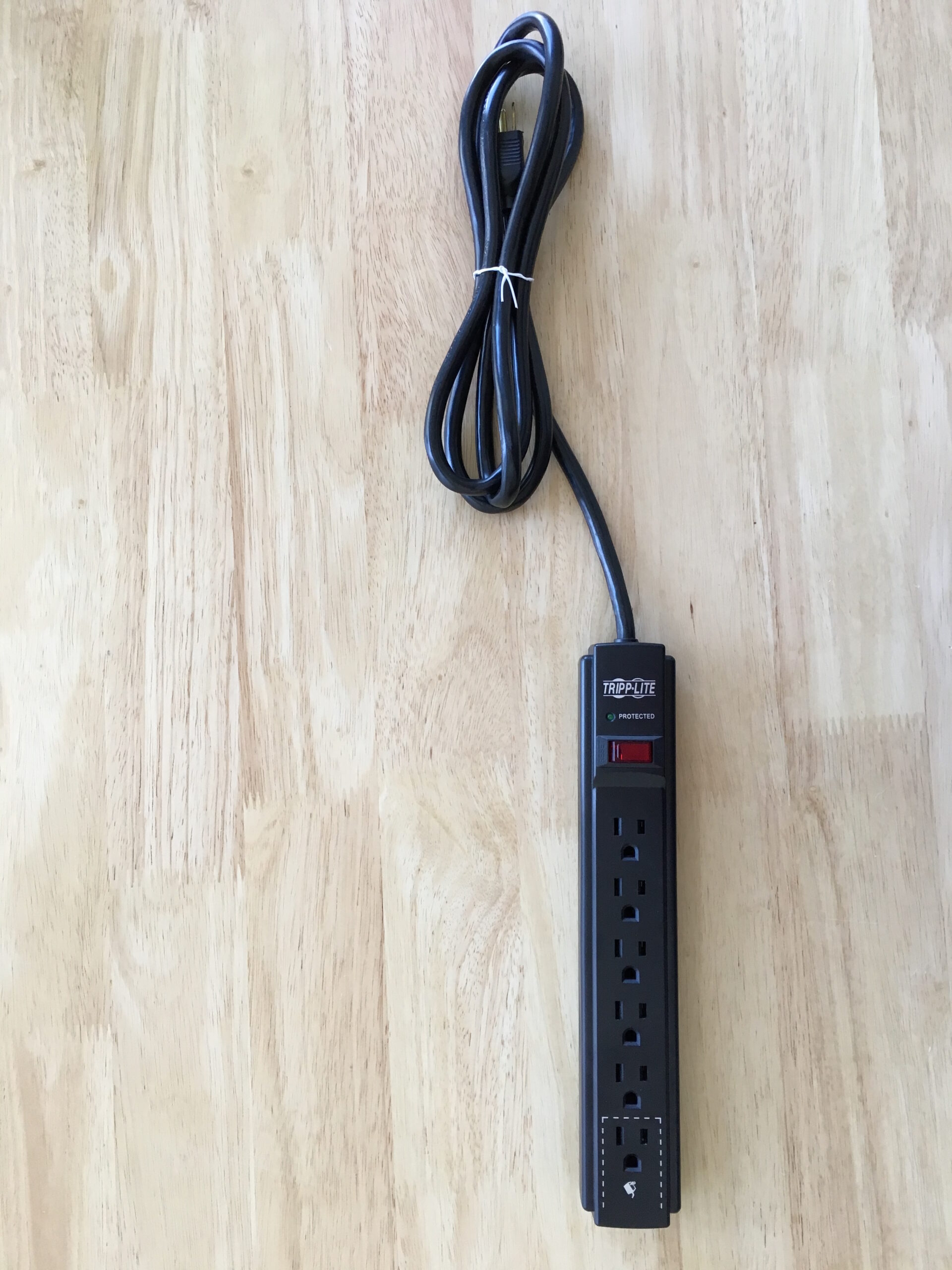
This is why dorm rules often separate ordinary electronics from heat-producing appliances. A laptop charger, phone charger, small desk lamp, and monitor are usually low-power loads. A heater, hot plate, toaster, kettle, or high-powered cooking appliance can pull far more current and create much more heat. Plugging those devices into a power strip is risky because the strip, cord, and outlet may be forced to carry current they were not meant to handle. The power strip is not failing because it has too many holes; it fails because the electrical load behind those holes is too large.
Why Heat Builds Up in Cords and Connections
The physics of overload is not mysterious, but it is easy to underestimate. Heat in a wire rises with current, and small increases in current can produce a bigger jump in heating than people expect. Connections matter too. A loose plug, damaged cord, worn outlet, or cheap internal contact creates extra resistance at one point. That small high-resistance spot can become much hotter than the rest of the cord, much like a narrow place in a pipe creates extra strain on the flow.
Covered cords make the problem worse. The National Fire Protection Association warns against running extension cords through doorways, walls, ceilings, floors, or under coverings because trapped heat cannot escape. A cord under a rug may look tidy, but the rug acts like insulation. A cord squeezed behind furniture can bend sharply, loosen, or wear down its outer jacket. In a dorm room, the neatest-looking setup is not always the safest one.
Power strips with built-in circuit breakers can help by shutting off when too much current flows through the strip. Surge protectors can help protect electronics from voltage spikes. Those are useful features, but they are not permission to ignore load limits. UL Solutions advises buyers to look for products certified by a recognized safety organization because testing looks at fire, shock, and injury hazards. Even then, the certification applies to proper use. A tested strip can still be misused if it powers high-wattage appliances, is damaged, is covered, or is linked to other strips.
Daisy Chains Turn Small Mistakes Into Bigger Ones
One of the most common power-strip mistakes is daisy chaining: plugging one power strip or extension cord into another. It may feel harmless because each individual device still has a plug that fits. Electrically, though, the load from several strips can funnel through one cord, one plug, and one wall receptacle. The first strip in the chain carries the total load of everything downstream. If students keep adding chargers, lamps, fans, gaming devices, and small appliances, the setup can become hard to judge and easy to overload.
Daisy chains also hide responsibility. When a device is plugged directly into a wall outlet, it is easier to see what that outlet is powering. When cords snake behind a bed, under a desk, and into another strip, the electrical path becomes harder to inspect. A tripped breaker may seem annoying, but it is a protective signal. A breaker that trips repeatedly is telling the room that the circuit is being asked to do more than it safely should.

The safer habit is simple: plug a properly rated power strip directly into a wall outlet, use it for low-power electronics, and stop there. If the room does not have enough outlets for normal use, that is a housing or facilities issue, not a puzzle to solve with a chain of cords. Residence hall staff may also have specific rules about surge protectors, extension cords, appliances, and cord length. Those rules can feel picky, but many are written around real fire inspections and past hazards.
Surge Protection Is Not the Same as Overload Protection
The words on the package can blur together. A basic power strip mainly expands the number of receptacles. A surge protector is designed to reduce damage from brief voltage spikes, such as those caused by switching events or nearby lightning-related disturbances. Some strips also include a resettable circuit breaker that trips when the current through the strip gets too high. These features solve different problems.
A surge protector does not make a heater safe to plug into a strip. A circuit breaker on the strip does not guarantee that every unsafe condition will be caught before damage occurs. A product labeled for indoor use should not be used in damp conditions. A strip with a damaged cord or cracked case should be removed from service even if it still turns on. Electrical safety depends on the whole setup: rating, condition, placement, load, and how long the equipment stays in use.
This also explains why cheap or recalled products are a special concern. The Consumer Product Safety Commission has warned about products with undersized wires, faulty components, improper grounding, or missing protective parts. A power strip is not just a plastic row of outlets. Inside it are conductors, contacts, switches, and protective components that must handle current without overheating. If those parts are poorly made, the margin of safety shrinks.
A Safer Dorm Setup Starts With the Load
The most useful move is to sort devices by power demand. Low-power electronics such as phone chargers, laptops, monitors, speakers, and small lamps are usually reasonable candidates for a certified power strip, assuming the strip is undamaged and plugged directly into the wall. Heat-making devices need much more caution. Space heaters are often banned in residence halls for good reason. Cooking appliances, hair tools, kettles, irons, microwaves, and refrigerators should follow campus rules and manufacturer instructions, and many should go directly into a wall outlet if allowed at all.
- Check the wattage or amp rating on devices before grouping them together.
- Use only power strips or surge protectors certified by a recognized testing laboratory.
- Keep cords visible, unpinched, and uncovered so heat can escape.
- Do not link power strips, extension cords, or multi-plug adapters together.
- Unplug and report any outlet, plug, or strip that feels hot, smells burnt, sparks, or shows discoloration.
There is also a planning lesson here. A dorm room works better when electrical demand is spread out instead of concentrated at one crowded corner. Put the desk near one outlet if possible, keep charging devices on a strip meant for electronics, and avoid letting bedding, clothes, or paper pile around cords. Leave high-power devices out of the room unless campus rules clearly allow them. A room that is slightly less convenient is far better than one that quietly builds heat behind a desk.
The Physics Is a Warning System
Power strips are not the enemy of dorm life. Used correctly, they help organize low-power electronics and reduce the mess of chargers around a desk. The danger comes from asking them to solve a different problem: not enough electrical capacity for too many devices. Extra receptacles can disguise that limit, but they cannot erase it.
The safest way to think about a power strip is as a distribution tool, not a power source. It shares the same circuit, the same current limit, and the same need for heat to escape. When students understand that, the rules about extension cords, heaters, daisy chains, and certified equipment stop sounding arbitrary. They are all ways of respecting the same basic fact: electricity is useful when its path is controlled, rated, and visible.






Add comment