
 Akshay Dinesh
Airport security can feel like a quick pause in a trip: shoes in a bin, laptop out or left inside depending on the lane, a bag sliding into a tunnel, a person standing with arms raised for a few seconds. Behind that routine is a careful use of physics. Scanners do not simply “look through” things in the way eyes look through clear glass. They send energy toward a bag, a body, or a metal object, then measure what comes back, what passes through, or how the material changes the signal.
The result is a set of clues. Dense objects block more energy. Some materials absorb X-rays differently from others. Curved surfaces scatter waves in recognizable ways. Metal changes magnetic fields. A security officer or detection system then interprets those clues to decide whether an item needs a closer look. The technology is powerful, but its basic idea is surprisingly familiar: if ordinary light cannot show what is hidden, use another kind of energy and measure how matter responds.
Why Different Scanners Use Different Kinds of Energy
No single scanner can answer every airport security question equally well. A carry-on bag is a compact pile of electronics, bottles, clothes, food, books, cables, and sometimes odd souvenirs. A passenger screening system has a different job: it must find objects on the outside of a person’s body without producing a detailed medical image. A walk-through metal detector has an even narrower goal, which is to notice metal quickly as many people pass through a checkpoint.
That is why airport checkpoints combine several technologies. X-ray baggage scanners are useful because X-rays can pass through many everyday materials while being absorbed more strongly by dense or high-atomic-number materials. Computed tomography, often shortened to CT, takes that same basic X-ray idea and adds many viewing angles so the system can build a three-dimensional picture. Millimeter-wave scanners use non-ionizing radio-frequency energy that reflects from the body and objects near the body. Metal detectors use changing electromagnetic fields to notice conductive objects.
The U.S. Environmental Protection Agency groups these systems by the kind of radiation or field they use. Metal detectors and millimeter-wave scanners use non-ionizing energy, which does not have enough energy per photon to remove electrons from atoms. X-ray baggage scanners use ionizing radiation inside shielded equipment, but the machine is designed so passengers and workers are not standing in the beam. The key lesson is that “scanner” is not one technology. It is a family of tools, each chosen because a particular kind of energy interacts with matter in a useful way.
How X-Ray Baggage Scanners Read a Bag
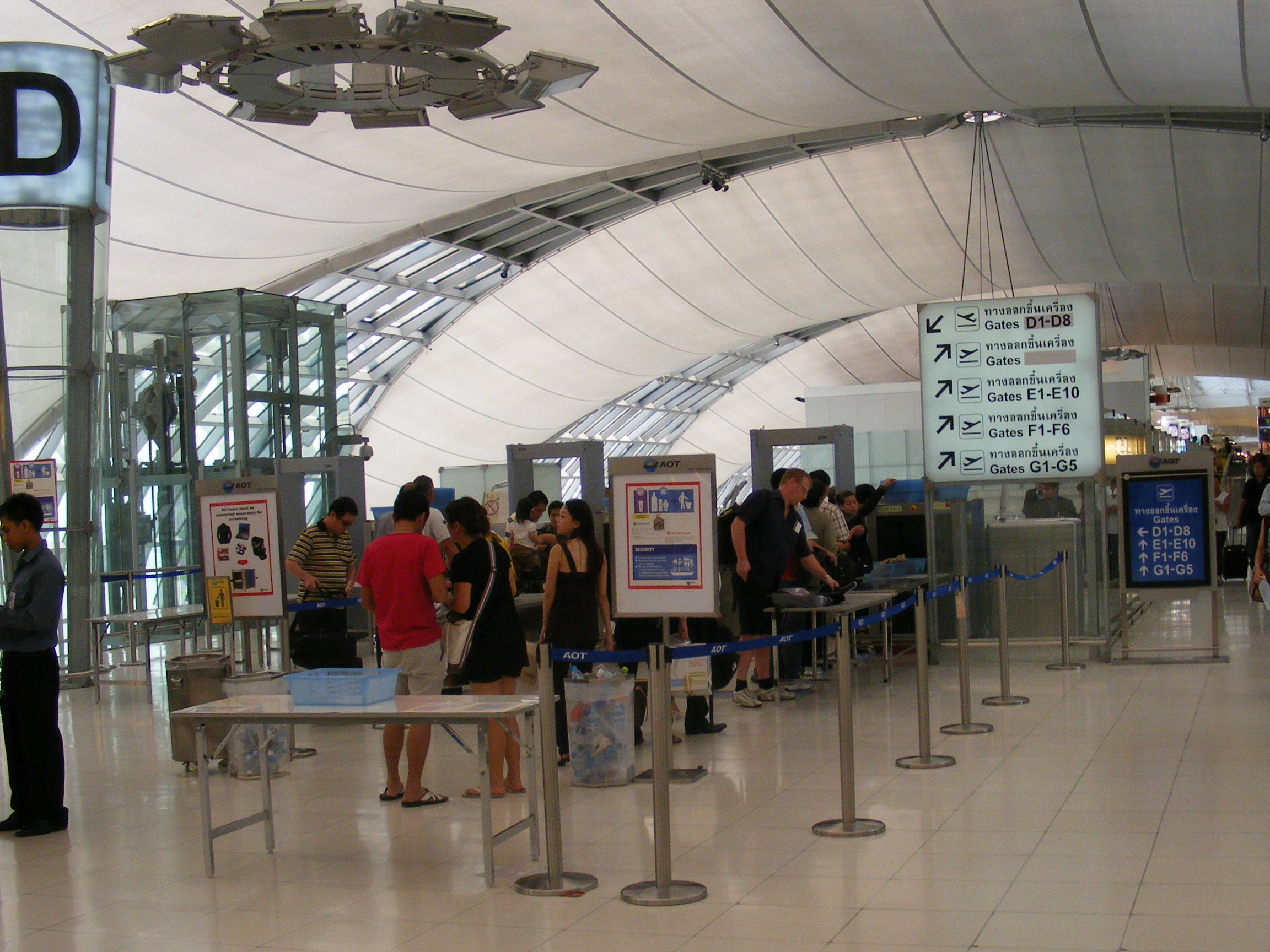
An X-ray baggage scanner works by sending a controlled beam of X-rays through a bag as it moves along a conveyor. On the other side of the tunnel, detectors measure how much of the beam gets through. If an object absorbs or blocks a lot of X-rays, it appears differently from a soft jacket or a paperback book. Dense materials stand out because they weaken the beam more strongly.
That difference is not just about thickness. Material matters too. X-rays interact more strongly with atoms that have more protons, so steel, copper, and other dense metals tend to look different from plastics, fabric, paper, or food. Many baggage scanners use more than one X-ray energy level, which helps the system estimate whether a region is more likely to be organic material, metal, or something in between. The colors shown on a security screen are usually not natural colors. They are display colors chosen to help people read material clues quickly.
A flat X-ray image has a limitation: objects overlap. A water bottle, laptop charger, hairbrush, and snack bag may be stacked in a way that makes the image hard to interpret. Security officers are trained to rotate their attention through shapes, densities, and possible outlines, but a single projection can hide one object behind another. That is one reason checkpoint technology has been moving toward CT systems for carry-on bags.
CT scanning solves the overlap problem by collecting X-ray measurements from many angles. A computer then reconstructs slices through the bag, somewhat like turning a loaf of bread into separate pieces instead of trying to understand the whole loaf from the outside. TSA describes modern checkpoint CT systems as producing three-dimensional images that officers can rotate on screen. The benefit is not that the machine magically identifies everything with perfect certainty. The benefit is that it gives a clearer spatial picture, so objects can be separated, inspected from different angles, and compared with expected shapes and densities.
Why CT Scanners Make Bags Easier to Understand
Computed tomography depends on a mathematical idea called reconstruction. Each X-ray view gives partial information about what is inside the bag. One view might show that a dense object is somewhere along a line through the suitcase, but it cannot alone say exactly where. When the scanner gathers many views from different angles, those partial measurements can be combined into a three-dimensional model.
The same basic principle is used in medical CT, though airport baggage CT is built for security screening rather than diagnosis. The machine does not need to show a clear image of living tissue. It needs to help distinguish objects in a crowded container and highlight possible threats for review. That makes the scanner both a physics tool and a pattern-reading tool. The physics creates the measurement; the display and detection software help turn the measurement into something a person can judge quickly.
CT also changes the way ordinary passengers experience the checkpoint. In many CT lanes, travelers may be able to leave electronics and some liquids inside the bag because the scanner can separate overlapping items more effectively. Rules still vary by airport, country, equipment, and security procedure, so the posted checkpoint instructions matter more than a traveler’s memory from a previous trip. The technology reduces some kinds of uncertainty, but it does not remove the need for human review or local rules.

How Body Scanners Find Objects Without Making an Ordinary Picture
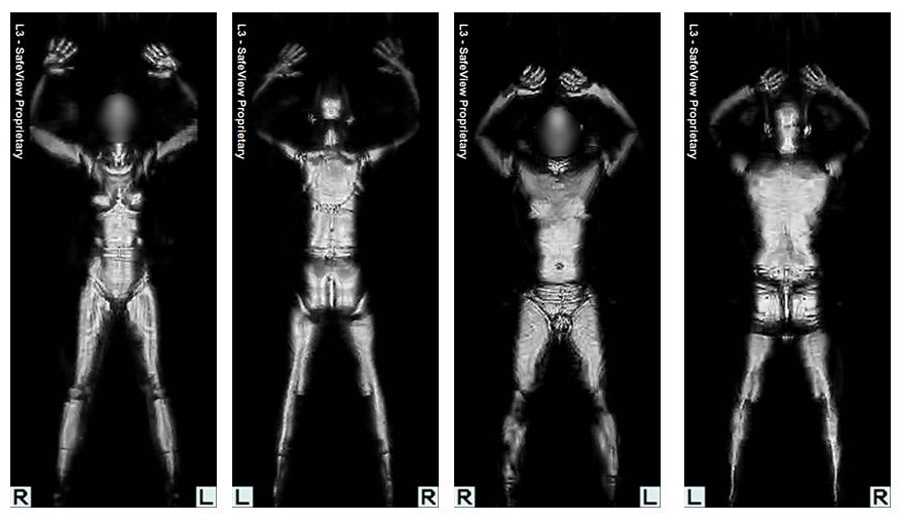
Passenger body scanners at U.S. airports generally use millimeter-wave technology rather than the older backscatter X-ray systems that were removed from U.S. airport screening. Millimeter waves sit in the radio-frequency part of the electromagnetic spectrum. They can pass through clothing, but they reflect from skin and from objects on or near the body. The scanner measures those reflections and looks for shapes or signals that do not match the expected outline.
This is different from taking a normal photograph. A camera records visible light reflected from the outside of clothing, skin, and objects. A millimeter-wave scanner sends out waves that interact with the surface of the body and items concealed under clothing. The system then processes the reflections. Modern airport displays are designed to show a generic body outline or an area that needs checking, rather than a detailed image of the person.
Because millimeter waves are non-ionizing, they are different from X-rays in an important safety sense. They do not carry enough energy per photon to break chemical bonds or ionize atoms. The Centers for Disease Control and Prevention describes millimeter-wave airport screening as using non-ionizing radiation, while noting that X-ray baggage machines are shielded cabinet systems. That distinction helps explain why the passenger scanner and the bag scanner are not the same machine doing the same job.
Millimeter-wave screening is best understood as surface detection. It can notice something that changes the expected reflection pattern on a person’s body, but it is not a medical scan and it is not built to see inside organs. If the system marks an area for review, security staff may inspect that location more directly. The machine narrows the question; it does not settle every question by itself.
Why Metal Detectors Still Matter
Walk-through metal detectors are older and simpler than CT scanners or millimeter-wave systems, but they remain useful because they are fast. A metal detector creates an electromagnetic field. When a conductive metal object passes through that field, the field changes. The detector senses the change and signals that something metallic may be present.
The physics depends on induction. A changing magnetic field can create tiny circulating electric currents in a metal object. Those currents create their own magnetic effects, which the detector can pick up. The stronger the response, the more likely the object is large, conductive, or positioned in a way that the detector can sense. That is why keys, belts, phones, coins, watches, and jewelry can matter at a checkpoint even if they are harmless.
Metal detectors have a narrower job than imaging scanners. They cannot tell whether a plastic item is suspicious, and they do not provide a detailed picture of a bag. Their strength is speed and reliability for a specific class of materials. In a layered security process, that narrow strength is valuable. A simple tool that answers one question well can work alongside more complex tools that answer different questions.
What Safety Rules Add to the Physics
Airport scanner safety is not left only to good intentions. X-ray baggage scanners are cabinet X-ray systems, which means the X-ray beam operates inside a shielded enclosure. Federal performance standards for cabinet X-ray systems limit radiation leakage outside the cabinet; the rule commonly cited in U.S. regulations is 0.5 milliroentgen in one hour at five centimeters from the external surface. The machine also uses curtains, shielding, warning systems, and interlocks to keep the beam contained during operation.
The National Academies has also explained that backscatter X-ray systems, once used for passenger screening, delivered very low individual doses, but those systems are no longer used for passenger screening at U.S. airports. That history matters because people sometimes mix together baggage X-ray machines, older passenger X-ray systems, and current millimeter-wave body scanners as if they are one device. They are not. A bag scanner uses X-rays inside a shielded tunnel. A millimeter-wave body scanner uses non-ionizing radio-frequency energy around the passenger. A metal detector uses electromagnetic fields to detect conductive material.
Safety rules also shape how operators use the technology. A person should not reach into an X-ray tunnel while the machine is running. Staff are trained to operate equipment properly and follow checkpoint procedures. Travelers, meanwhile, are not expected to calculate radiation levels while standing in line. The practical rule is simpler: follow checkpoint instructions, keep hands and belongings where staff direct them, and let the equipment do the job it was designed and regulated to do.
Airport scanners work because matter leaves clues. A dense object weakens an X-ray beam. A hidden item changes millimeter-wave reflections. A metal key disturbs an electromagnetic field. A CT scanner turns many partial X-ray views into a clearer three-dimensional model. None of these systems sees in the ordinary human sense. They translate invisible interactions into readable signals, which is why a few seconds at a checkpoint can reveal what ordinary eyes cannot see.




Add comment