
 Akshay Dinesh
By the summer of 1775, the American colonies were already fighting, but they had not yet declared independence. That awkward middle position created a problem Congress could not ignore. If colonial troops were surrounding British-held Boston and George Washington had just taken command of a continental army, the colonies needed to explain why armed resistance was legitimate. They also needed to speak to readers who still hoped for reconciliation with Britain.
The Declaration of the Causes and Necessity of Taking Up Arms, adopted by the Second Continental Congress on July 6, 1775, tried to do both. It defended the decision to fight while insisting that the colonies were not yet trying to break from the British Empire. That balance makes the document one of the most revealing steps between protest and independence. It shows a movement trying to justify war before it was ready to name separation as its goal.
A War Had Started Before Independence Had a Name
The crisis did not begin with a single document. For years, colonial leaders had objected to British taxes, trade rules, military enforcement, and Parliament’s claim that it could legislate for the colonies in all cases. The Coercive Acts after the Boston Tea Party sharpened the conflict by punishing Massachusetts and convincing many colonists that local self-government was under threat. Petitions and boycotts had already failed to restore trust.
Then came Lexington and Concord on April 19, 1775. British troops marched into the Massachusetts countryside to seize military supplies, and armed colonists met them on the road. The fighting did not produce a neat formal beginning to war, but it changed the political facts. Militia forces gathered around Boston, British troops remained in the city, and the colonies had to decide whether Massachusetts’s fight was a local emergency or a shared cause.
The Second Continental Congress answered by creating the Continental Army in June and appointing George Washington commander in chief. On July 3, Washington arrived at Cambridge to take command of the forces surrounding Boston. The next day, his general orders urged soldiers from different colonies to think of themselves as part of one common cause. Congress adopted the Taking Up Arms declaration two days later.

The timing mattered. The Battle of Bunker Hill had taken place on June 17, only weeks earlier. Britain had technically won the field, but the high casualties made the conflict look less like a disturbance and more like a real war. Congress could no longer act as if armed resistance were only a temporary reaction by one colony.
Congress Needed an Argument, Not Just an Army
Raising troops created a moral and political question. British officials could describe the colonists as rebels. Loyalists could accuse Congress of dragging the colonies into needless violence. Even sympathetic people in Britain might wonder whether the Americans had moved from constitutional protest into unlawful revolt. The declaration answered those audiences by presenting armed resistance as defensive, reluctant, and forced by circumstances.
That is why the document spends so much energy on grievances. It argues that Parliament had claimed unlimited authority over the colonies without colonial consent. It points to taxation without representation, expanded imperial enforcement, military pressure, and the use of force in Massachusetts. The logic is not simply that British policy was unpopular. The deeper claim is that ordinary legal channels had been closed, leaving the colonies to defend rights they believed they already possessed.
The National Park Service describes the declaration as an explanation of why the colonies felt compelled to take up arms. The Library of Congress places it among the documents that helped form the argument for American rebellion. Those descriptions are useful because they show the document’s real role: it was not a battlefield order or a final break with Britain. It was a public case for why fighting had become necessary.
The writers also had to make Congress sound united. The declaration speaks in the voice of the representatives of the United Colonies, not as a loose collection of provincial complaints. That language mattered in 1775 because military cooperation depended on political trust. A farmer from Connecticut, a merchant from Pennsylvania, and a planter from Virginia did not automatically see their risks in the same way. Congress had to turn separate colonial fears into a shared explanation.
Jefferson and Dickinson Pulled the Message in Different Directions
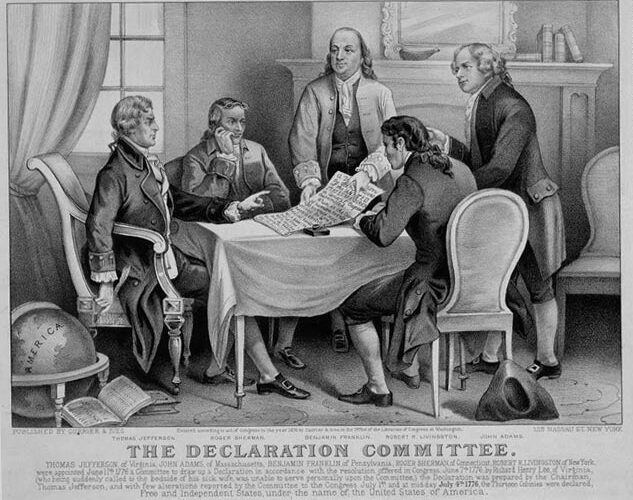
The drafting history helps explain the document’s unusual tone. Thomas Jefferson was involved in drafting it, and John Dickinson played a major role in revising the final language. Jefferson was already known for forceful arguments about colonial rights. Dickinson, famous for the earlier Letters from a Farmer in Pennsylvania, often favored firm resistance while still trying to keep reconciliation possible. The result was a document with heat and restraint at the same time.
The Library of Congress timeline notes that Jefferson drafted an address on the causes and necessity of taking up arms in June and July 1775, modifying arguments he had made the previous year in A Summary View of the Rights of British America. The Library’s exhibition material also notes that the final manifesto stressed a hope for the restoration of peace while still drawing on Jefferson’s energetic style. The final declaration therefore belongs to a political moment when Congress wanted to sound resolute without sounding reckless.
That tension appears in the way the document assigns blame. The George Washington Papers timeline from the Library of Congress points out that this 1775 declaration blamed Parliament primarily and King George III secondarily, unlike the Declaration of Independence a year later. That difference is easy to miss, but it is crucial. In 1775, many colonists still imagined the king as a possible protector against Parliament’s overreach. By 1776, that hope had largely collapsed.
John Dickinson’s influence also helps explain why the document did not simply race toward independence. He understood that public opinion moved unevenly. Some delegates wanted stronger language. Others feared that independence would divide the colonies before they were militarily or politically ready. The declaration had to keep those factions inside the same tent.
The Declaration Defended Resistance Without Declaring Separation
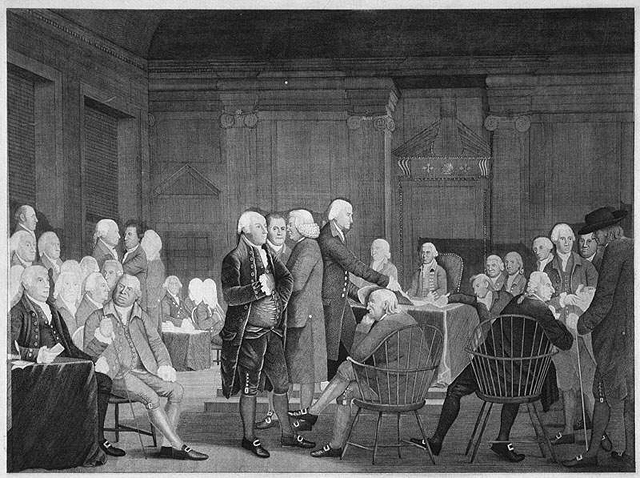
The most striking feature of the declaration is its refusal to say what later seems inevitable. Congress justified war, but it did not declare independence. It insisted that the colonies had not raised armies for conquest or for the purpose of setting up independent states. It presented armed resistance as a way to preserve liberty, not as a formal announcement of a new nation.
That position may sound contradictory, but it made sense in July 1775. Congress was trying to preserve room for negotiation while also proving that it would not surrender. The Olive Branch Petition, adopted around the same time, asked King George III for help in restoring peace. The Taking Up Arms declaration explained why the colonies were fighting if peace did not come. Together, the two documents show Congress walking a narrow line: loyal language in one hand, military justification in the other.
The argument was also aimed beyond America. Congress knew that British readers, colonial moderates, and potential foreign observers would judge the conflict differently depending on how it was framed. A rebellion for ambition looked dangerous. A defensive struggle for inherited rights could sound honorable. By laying out causes, Congress tried to control the meaning of the war before Britain defined it for them.
The language of necessity did a great deal of work. It suggested that Congress had not chosen violence casually. The colonies had petitioned, reasoned, and protested, the declaration argued, only to meet force and denial. Whether every reader accepted that argument was another matter. But politically, necessity was the bridge between resistance and legitimacy.
Why the Document Still Matters
The Declaration of the Causes and Necessity of Taking Up Arms is often overshadowed by the Declaration of Independence. That is understandable. The later document made the cleaner break, gave the United States its founding statement, and became one of the most famous political texts in the world. But the 1775 declaration shows the messy stage before that clarity existed.
It helps readers see that independence was not a light switch. Congress did not move from complaint to nationhood in one instant. The path ran through petitions, boycotts, battles, military organization, public arguments, and hard decisions about how far resistance should go. The Taking Up Arms declaration sits in the middle of that process, when Congress was still explaining war as defense rather than announcing revolution as independence.
It also reveals how founding-era documents worked as persuasion. They were not written only for archives. They were meant to shape opinion, unify supporters, answer critics, and create a record of principle. The declaration gave soldiers, colonial assemblies, and sympathetic readers a way to understand the war as something more than scattered fighting around Boston.
Within weeks, events moved further away from reconciliation. In August 1775, King George III declared the colonies to be in rebellion. In early 1776, Thomas Paine’s Common Sense would make independence a public argument in sharper terms. By July 1776, Congress would declare separation outright. The 1775 declaration did not make that final move, but it prepared the ground by teaching Americans how to explain resistance as a matter of rights.
A Step Between Loyalty and Revolution
The Taking Up Arms declaration matters because it captures a moment when the colonies were still deciding what kind of conflict they were in. Congress wanted to be seen as measured, constitutional, and reluctant. It also wanted Britain to know that the colonies would fight if forced. That combination made the document both cautious and bold.
For students of the American Revolution, the document is a reminder that political change often happens before people have agreed on its final name. In July 1775, Congress had an army, a siege, fresh battlefield losses, and a public explanation for armed resistance. What it did not yet have was independence. The year that followed would turn that unresolved position into a new political reality.




Add comment