
 Akshay Dinesh
An induction cooktop can look almost uneventful while it works. There may be no flame, no glowing coil, and no obvious hot plate under the pan. Yet a pot of water can begin heating quickly, and a skillet can respond almost as soon as the power level changes. The trick is that the cooktop is not mainly trying to heat the glass. It is using a changing magnetic field to make the pan heat itself.
That difference makes induction cooking a useful everyday example of physics. The same broad idea behind generators, transformers, wireless charging, and metal detectors appears in the kitchen: electricity and magnetism can affect each other. In an induction cooktop, that relationship is controlled carefully enough to turn electrical energy into heat inside the bottom of the cookware.
The cooktop creates a changing magnetic field
Under the smooth glass-ceramic surface of an induction burner is a coil of wire, often made from copper. When electric current flows through a coil, it creates a magnetic field. In an induction cooktop, the current does not simply flow steadily in one direction. It alternates rapidly, so the magnetic field grows, collapses, and reverses many times each second.
That rapidly changing field reaches upward through the glass and into the base of the pan. Glass does not respond strongly to magnetism, so the field can pass through it without turning the glass itself into the main heating element. The pan is different. If the cookware contains the right kind of magnetic metal, the changing field can interact with it strongly.
This is the key idea behind electromagnetic induction. A changing magnetic field can induce electric currents inside a nearby conductor. In a pan, those induced currents are not sent through a wire like current in a lamp cord. They swirl inside the metal itself. Because the metal resists the movement of charge, some of that electrical energy becomes thermal energy. The bottom of the pan warms, and the pan passes heat into the food.
Why the pan has to be magnetic
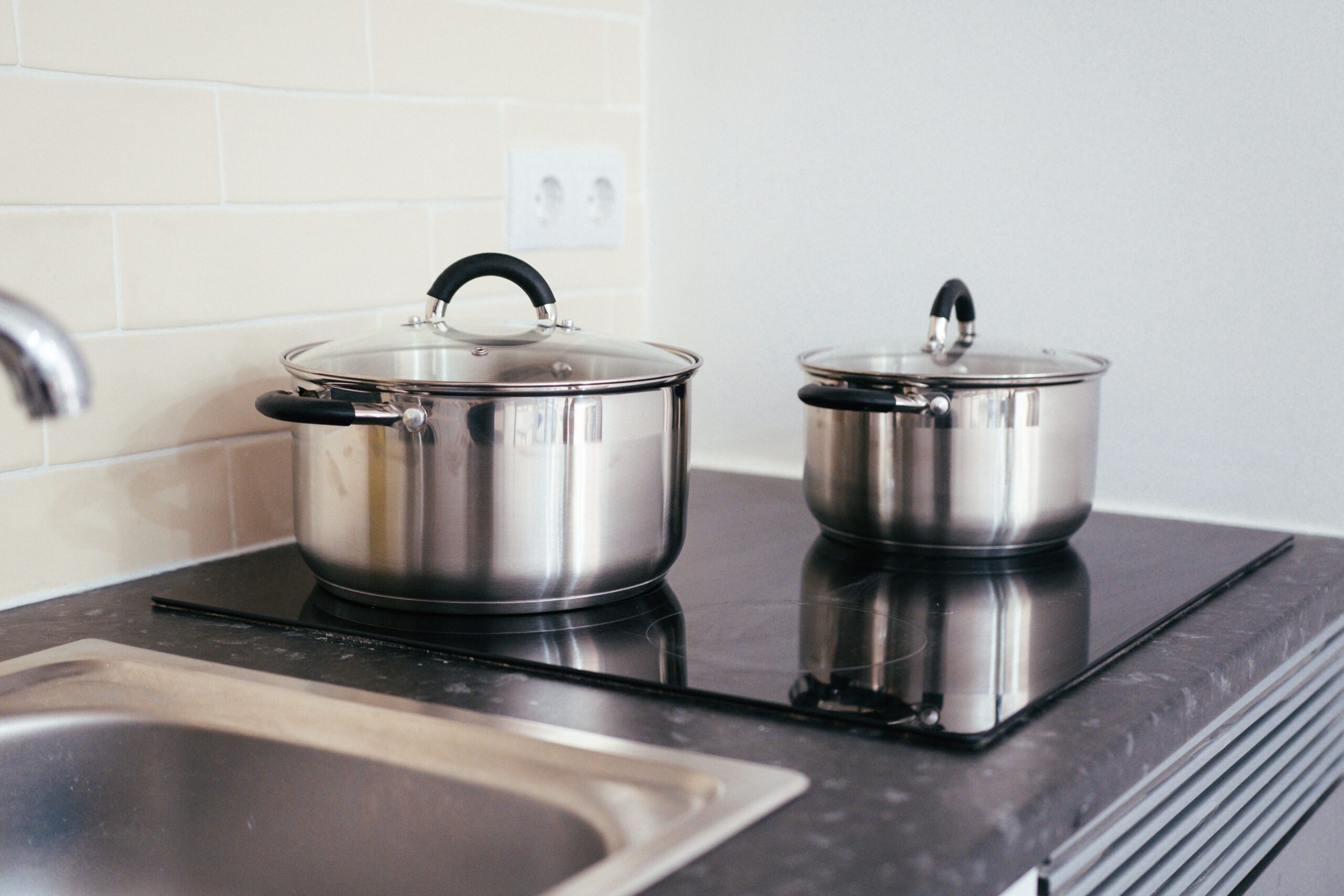
Not every pot or skillet will work well on an induction cooktop. The easiest home test is simple: if a refrigerator magnet sticks firmly to the bottom of the pan, the pan is likely induction-compatible. If the magnet barely clings or falls off, the cooktop may not detect the pan or may heat it poorly.
The reason is that induction cooking depends on strong coupling between the cooktop’s magnetic field and the cookware. Cast iron and many kinds of stainless steel contain iron in a form that responds well to magnetic fields. These materials are called ferromagnetic. When they sit over the induction coil, the magnetic field can concentrate in the pan base and induce useful currents there.
Pure aluminum, copper, glass, and ceramic cookware do not respond the same way. They may conduct heat beautifully on a gas flame or electric coil, but without a magnetic base they cannot couple efficiently to the induction field. Some modern aluminum or copper pans solve this by adding a bonded magnetic layer to the bottom. The visible cooking surface may be nonstick, stainless, or copper-colored, but the hidden base is what decides whether induction will work.
This is why two similar-looking stainless pans can behave differently. Some stainless steel is strongly magnetic; some is not. Labels can help, but the magnet test is often clearer. A pan also works better when its base is flat and close to the glass because the magnetic field weakens quickly with distance. A warped bottom, a tiny pan on a large zone, or a pan shifted far from the marked cooking circle can all reduce heating performance.
Eddy currents turn motion into heat
The currents induced inside the pan are often called eddy currents. The name comes from the way they circulate in loops, a little like swirling water. These currents are useful in a cooktop because they run into electrical resistance inside the metal. Resistance turns some organized electrical energy into random molecular motion, which is what temperature measures.
There is also a second effect in magnetic cookware. As the magnetic field changes direction, tiny magnetic regions inside ferromagnetic metal keep being pulled into new alignment. That repeated shifting can add heat too, though eddy-current heating is the main explanation in many pans. Together, these effects make the metal base warm from within rather than only from contact with a hot surface.
The result feels different from cooking on gas or a conventional electric burner. With gas, flames heat the bottom and sides of the pan while a lot of hot air escapes around it. With an electric resistance burner, a heating element becomes hot first, then conducts heat into the cookware. With induction, much of the useful heating begins inside the cookware base. That is why the response can feel quick when the power changes: the system does not have to wait for a heavy burner to heat up or cool down in the same way.
The pan still spreads heat by conduction after it warms. A thick pan may distribute heat more evenly but respond a little more slowly. A thin pan may heat fast but form hot spots or buzz more noticeably. Induction does not erase the importance of cookware design. It simply changes where the first major heating step happens.
Why the glass can stay cooler than the cookware
People sometimes say an induction cooktop stays cold. That is only partly true. The cooktop surface is not usually heated directly by a glowing element, so the unused area around the pan can remain much cooler than it would on many electric stoves. But the glass under the pan still gets hot because the hot pan conducts heat back into it.
This distinction matters for safety and for understanding the physics. The glass is not the primary heat source, but it is touching a very hot object. After cooking, the surface can still burn skin, melt plastic, or scorch spills. Many cooktops show a hot-surface warning even after the magnetic heating has stopped. The warning is there because heat has traveled from the cookware into the glass.
The cooler surrounding surface has practical effects. Spilled food may be less likely to bake onto unused areas, and the kitchen may receive less stray heat than it would from a flame. Still, induction is not magic insulation. A large pot of boiling water contains a lot of thermal energy, and any surface touching that pot will warm.

What makes induction efficient
ENERGY STAR describes induction cooktops and ranges as using electromagnetic energy to heat ferromagnetic cookware internally. That direct path helps explain why induction can be more efficient than conventional cooking methods. Less energy is spent heating the air around the pan, the grate under the pan, or a large burner that stays hot long after the food is done.
Efficiency here does not mean every meal uses the least possible energy in every kitchen. Pan size, pan material, lid use, cooking habits, and electricity generation all matter. But at the cooktop itself, induction has a clear physical advantage: energy is aimed at the cookware more directly. A covered pot that matches the cooking zone can transfer energy to water or food with relatively little waste.
This is also why induction can feel precise. Turning the control down reduces the magnetic field’s effect quickly, so the pan receives less energy almost right away. A simmer can settle down faster than it might on a heavy electric coil that remains hot. A pan can also heat very quickly at a high setting, which is useful for boiling water but can surprise cooks who are used to slower burners.
The quick response has a learning curve. Food can scorch if a pan is preheated too aggressively. Lightweight cookware may make clicking, humming, or buzzing sounds as magnetic forces and currents cause small vibrations. These sounds are usually harmless, especially at higher power levels, but they are another reminder that the pan is part of the electrical and magnetic system, not just a passive container.
How to read an induction cooktop more intelligently
The most useful way to understand induction is to follow the energy path. Electricity enters a coil under the glass. The coil creates a changing magnetic field. The field induces currents in a compatible pan. The pan’s electrical resistance turns those currents into heat. The hot pan cooks the food.
That path explains many everyday questions at once. The burner may not turn on without a pan because there is no suitable metal object to couple with the field. A copper pot may fail unless it has a magnetic base. The glass may be cooler than a conventional burner but still hot after use. A pan may heat unevenly if its base is too small, too thin, or not flat enough. A magnet can reveal compatibility because the same magnetic response that lets the magnet stick also helps the cooktop transfer energy.
Induction cooking is not just a modern kitchen feature. It is a visible example of electromagnetic induction doing practical work. A silent coil under glass reaches into a metal pan without a flame, and the pan becomes the heat source. Once that is clear, the cooktop stops seeming mysterious. It becomes a carefully controlled physics demonstration, one that happens to boil pasta, fry eggs, and make dinner a little faster.





Add comment