 Akshay Dinesh
The Tenth Amendment is only one sentence, but it helps answer one of the biggest questions in American government: who gets to decide? Some decisions belong to the national government, some belong mainly to the states, and some remain with the people. The amendment does not list every state power one by one. Instead, it gives readers a rule for thinking about powers the Constitution does not hand to Washington or deny to the states.
That rule matters because the Constitution created a stronger national government than the Articles of Confederation had allowed, but it did not erase the states. Roads, schools, elections, criminal law, health rules, marriage laws, business licensing, environmental enforcement, and emergency response often involve state authority, federal authority, or both at once. The Tenth Amendment sits in the background of those arguments. It reminds the country that constitutional power has limits, even when the limits are not always easy to draw.
What the amendment actually says
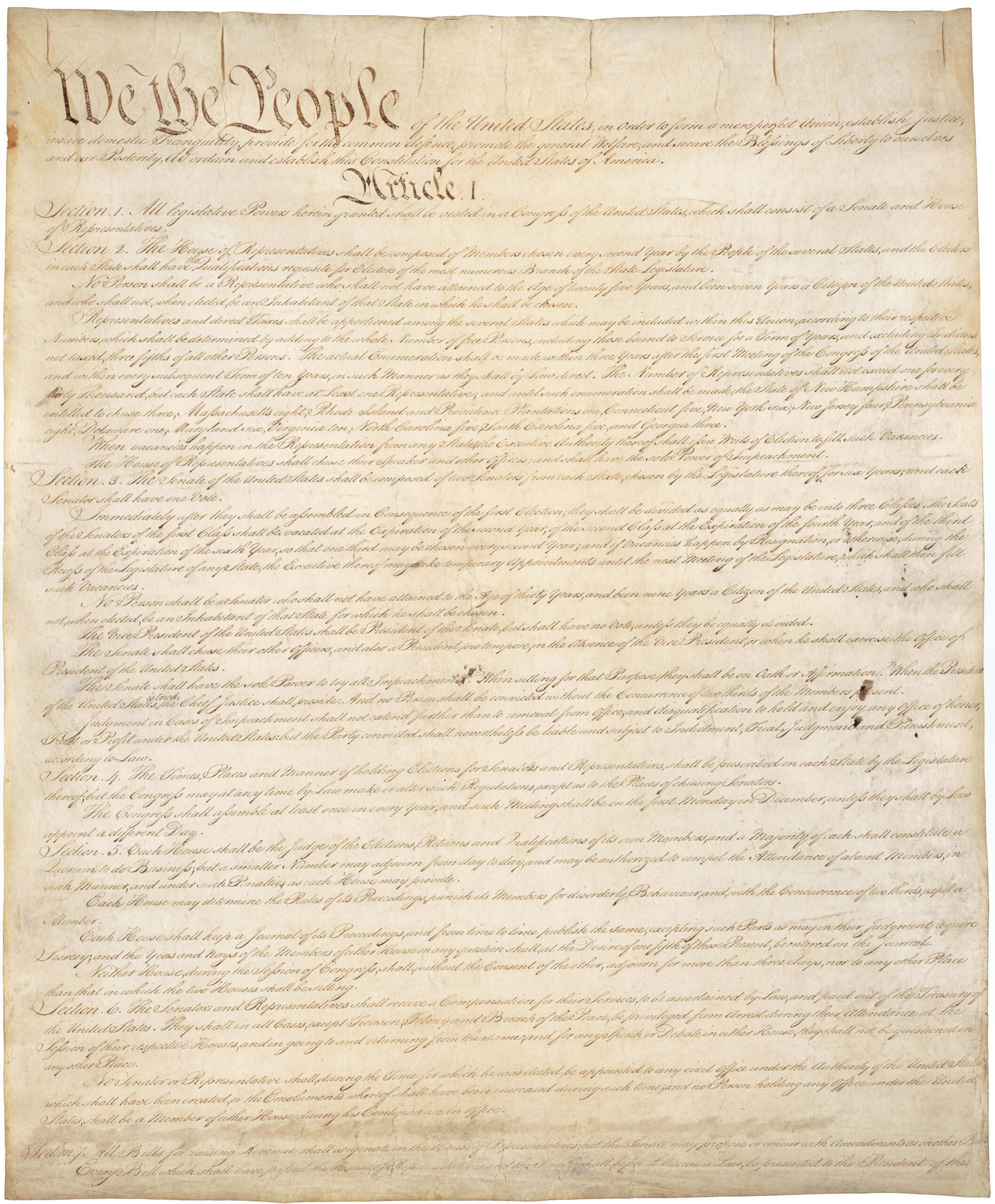
The amendment says that powers not delegated to the United States by the Constitution, and not prohibited to the states, are reserved to the states or to the people. The Library of Congress Constitution Annotated treats this sentence as the core text for understanding reserved powers. Its wording is careful. It does not say the federal government is weak, and it does not say states can ignore valid federal law. It says that the federal government must point to a constitutional source for its power.
That makes the Tenth Amendment different from amendments that protect a specific personal freedom, such as speech, religion, or jury trial. It is more like a boundary marker. If the Constitution gives Congress a power, such as regulating interstate commerce, taxing, spending, declaring war, establishing post offices, or making laws necessary and proper for carrying out listed powers, the Tenth Amendment does not cancel that grant. But if a power was never given to the federal government, and the Constitution does not forbid states from using it, the reserved-powers idea becomes important.
The phrase “or to the people” also matters. The amendment does not treat government power as something states and the federal government simply divide between themselves. The people remain part of the constitutional picture. In practice, that means the amendment belongs with the larger Bill of Rights, where limits on government and the source of political authority are both central concerns.
Why the founders wanted a reserved-powers rule
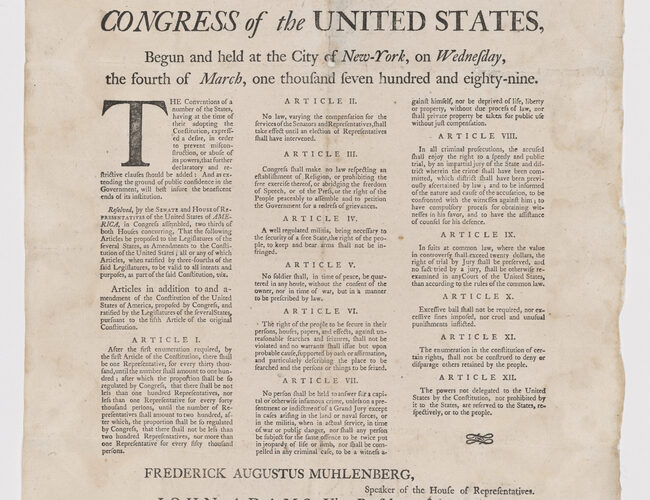
The Tenth Amendment grew out of the ratification debates of the late 1780s. Supporters of the Constitution argued that the new federal government would have only the powers granted to it. Critics worried that the national government would stretch those powers and crowd out state authority. The Bill of Rights helped answer that concern, and the Tenth Amendment closed the set by stating the reserved-powers principle directly.
One revealing detail is what the amendment does not say. The Articles of Confederation had reserved to the states every power not “expressly delegated” to the United States. The final Tenth Amendment did not include the word “expressly.” That omission was not accidental. The Constitution allows implied powers through the Necessary and Proper Clause, which lets Congress make laws needed to carry out its listed responsibilities. A national government that could tax, regulate interstate commerce, maintain armed forces, and manage foreign affairs needed room to function.
So the amendment was not a return to the Articles of Confederation. It was a compromise between national strength and local independence. The national government would be more capable than before, but it would still be a government of limited powers. States would remain important centers of lawmaking, experimentation, and public responsibility.

Federalism is not a simple scoreboard
It can be tempting to imagine federalism as a scoreboard: if Washington wins power, states lose it, and if states win power, Washington loses it. Real constitutional government is messier. Many subjects involve both levels at the same time. Education is a good example. States and local districts usually run schools, set many requirements, and license teachers, while federal law can influence civil rights protections, disability accommodations, nutrition programs, and funding rules.
Commerce works the same way. A local business may be licensed by a state, inspected by local officials, affected by state labor law, and still subject to federal tax rules, workplace standards, banking regulations, or shipping requirements. The Tenth Amendment does not automatically answer every question by saying “state” or “federal.” It asks whether the national government is using a valid constitutional power and whether it is respecting the structure of state government.
The Supreme Court’s 1941 decision in United States v. Darby shows the modern federal side of that balance. The Court upheld the Fair Labor Standards Act as a valid use of Congress’s power over interstate commerce. In doing so, it described the Tenth Amendment as a reminder that powers not surrendered are retained, rather than as a separate barrier against every federal law that touches local life. That did not make the amendment meaningless. It meant that the strength of a Tenth Amendment argument often depends on the federal power being claimed.
Where the Tenth Amendment still has force
One of the most important modern Tenth Amendment ideas is the anti-commandeering doctrine. The word sounds technical, but the basic point is understandable: the federal government generally may not order state governments or state officials to carry out a federal regulatory program. Washington can regulate people directly when the Constitution gives it power. It can often attach conditions to federal funding if the conditions follow constitutional rules. But it cannot simply turn state legislatures or state officers into federal tools.
The Supreme Court used that principle in New York v. United States in 1992, when it rejected part of a federal law that pressured states to take title to radioactive waste if they did not regulate according to federal instructions. In Printz v. United States in 1997, the Court said Congress could not require state and local officers to run background checks for a federal gun law. In Murphy v. NCAA in 2018, the Court struck down a federal sports-betting law that told states they could not authorize sports gambling under state law.
Those cases do not mean states can block federal law whenever they disagree with it. The Supremacy Clause still makes valid federal law supreme over conflicting state law. What the anti-commandeering cases say is narrower and more structural: Congress must govern through constitutionally proper federal action, not by issuing direct orders to state governments as if they were field offices of Congress.
Why the amendment still shapes everyday debates
The Tenth Amendment appears in arguments about health policy, environmental rules, marijuana law, immigration enforcement, education, voting rules, emergency management, and many other issues. Sometimes people invoke it carefully. Sometimes they use it as a slogan for any policy they prefer to keep away from Washington. A stronger reading asks two questions before reaching a conclusion. What constitutional power is the federal government using? And is the federal government regulating directly, or is it trying to force the states to govern for it?
Consider a state law that allows something federal law still prohibits. The Tenth Amendment may protect a state’s choice not to create its own matching prohibition, but it does not automatically erase federal enforcement authority. That is why state and federal law can sometimes point in different directions at the same time. Federalism can create conflict, but it can also allow local experimentation while national rules continue to exist.
The amendment also explains why state governments are not just administrative districts. They have their own constitutions, courts, legislatures, executives, election systems, and policy responsibilities. A person may experience government most often through state and local systems long before noticing a federal statute. Driver licensing, public schools, police powers, land use, family law, professional licensing, and many court proceedings usually begin close to home.
A short sentence with a long job
The Tenth Amendment does not solve every federalism dispute by itself. It works alongside Article I, the Necessary and Proper Clause, the Commerce Clause, the Supremacy Clause, the Fourteenth Amendment, and many Supreme Court decisions. Its power is partly symbolic and partly practical. Symbolically, it says the national government is not unlimited. Practically, it supports doctrines that protect the states from being drafted into federal service.
That combination is why the amendment remains worth studying. It keeps a basic constitutional question alive: when a government acts, where did that authority come from? In a federal system, that question cannot be answered by looking only at who has the most urgent policy goal. It has to be answered by looking at the structure of the Constitution itself.
The Tenth Amendment’s sentence is short because the idea behind it is broad. Power must be granted before it is used. Powers not granted are not simply floating in the air for any government to claim. They remain with the states or with the people, which is why the amendment still shapes arguments about law, liberty, and democratic responsibility more than two centuries after it was ratified.