

 Akshay Dinesh
Exponential growth is easy to underestimate because it often begins with numbers that look harmless. A quantity doubles from 1 to 2, then to 4, then to 8, and nothing feels dramatic yet. The surprise arrives later, when the same pattern suddenly leaps from 128 to 256 to 512 to 1,024. Nothing magical happened at the end. The rule was powerful from the start; it just needed enough steps to show its strength.
That is the main idea behind exponential growth: each new amount is based on the amount already there. Linear growth adds the same number each time. Exponential growth multiplies by the same factor each time. This difference explains why compound interest, populations, viral sharing, bacteria in a dish, and some technology trends can change slowly at first and then seem to race ahead.
Repeated Multiplication Is the Engine
In ordinary addition, the past does not make the next step bigger. If a savings jar gains $5 every week, the total rises by the same amount whether the jar already holds $10 or $200. That is linear growth. The graph of a perfect linear pattern is a straight line because the change is steady from step to step.
Exponential growth works differently. If a quantity grows by 20 percent each step, the next increase is 20 percent of the new total, not 20 percent of the starting total. A small base creates a small increase. A larger base creates a larger increase. The growth feeds on what has already accumulated.
A simple exponential model often looks like this: \(a_n = a_0 \cdot r^n\). Here, \(a_0\) is the starting amount, \(r\) is the growth factor, and \(n\) is the number of steps. If \(r = 2\), the amount doubles each step. If \(r = 1.1\), the amount grows by 10 percent each step. The exponent does the counting: it tells how many times the growth factor has been used.
Doubling Shows the Pattern Clearly
Doubling is the easiest version of exponential growth to see. Start with 1 and double repeatedly. After five steps, the total is \(1 \cdot 2^5 = 32\). After ten steps, it is \(1 \cdot 2^{10} = 1,024\). After twenty steps, it is \(1 \cdot 2^{20} = 1,048,576\). The jump from ten steps to twenty steps does not merely add another thousand. It multiplies the thousand-ish value by another thousand-ish value.
That is why the later part of an exponential pattern feels so different from the beginning. The first few doublings can fit in a short list: 1, 2, 4, 8, 16. A few more steps give 32, 64, 128, 256, 512. Each step is still following the same rule, but the size of each jump keeps growing because the base number keeps growing.
This also explains a famous classroom puzzle: would you rather receive $1 million today, or a penny that doubles every day for 30 days? The penny seems weak at first. On day 10 it is only $5.12. On day 20 it is $5,242.88. By day 30, it is more than $5 million. The example is exaggerated, but it makes the hidden lesson visible: early exponential growth can look unimpressive while the later results are already being built.
Growth Factor Matters More Than It First Appears
The growth factor tells how much a quantity is multiplied each step. A factor of 2 means the amount doubles. A factor of 3 means it triples. A factor of 1.05 means it grows by 5 percent. That last example may sound mild, but repeated multiplication can make even small growth factors matter over many steps.
Suppose two quantities both start at 100. One grows by 5 percent each step, so its factor is 1.05. The other grows by 8 percent each step, so its factor is 1.08. After one step, the difference is only 3 units: 105 compared with 108. After 20 steps, the 5 percent pattern is about 265, while the 8 percent pattern is about 466. The gap widened because the larger growth factor kept getting applied to a larger and larger amount.
This is one reason exponential growth is so useful in math modeling. A small change in the growth factor can produce a much larger long-run change than intuition expects. When students compare exponential functions, the starting amount matters, but the growth factor often decides the long-term direction. A quantity that starts smaller can eventually pass a larger one if it grows by a stronger factor for enough time.

The Curve Is Not Just a Steeper Line
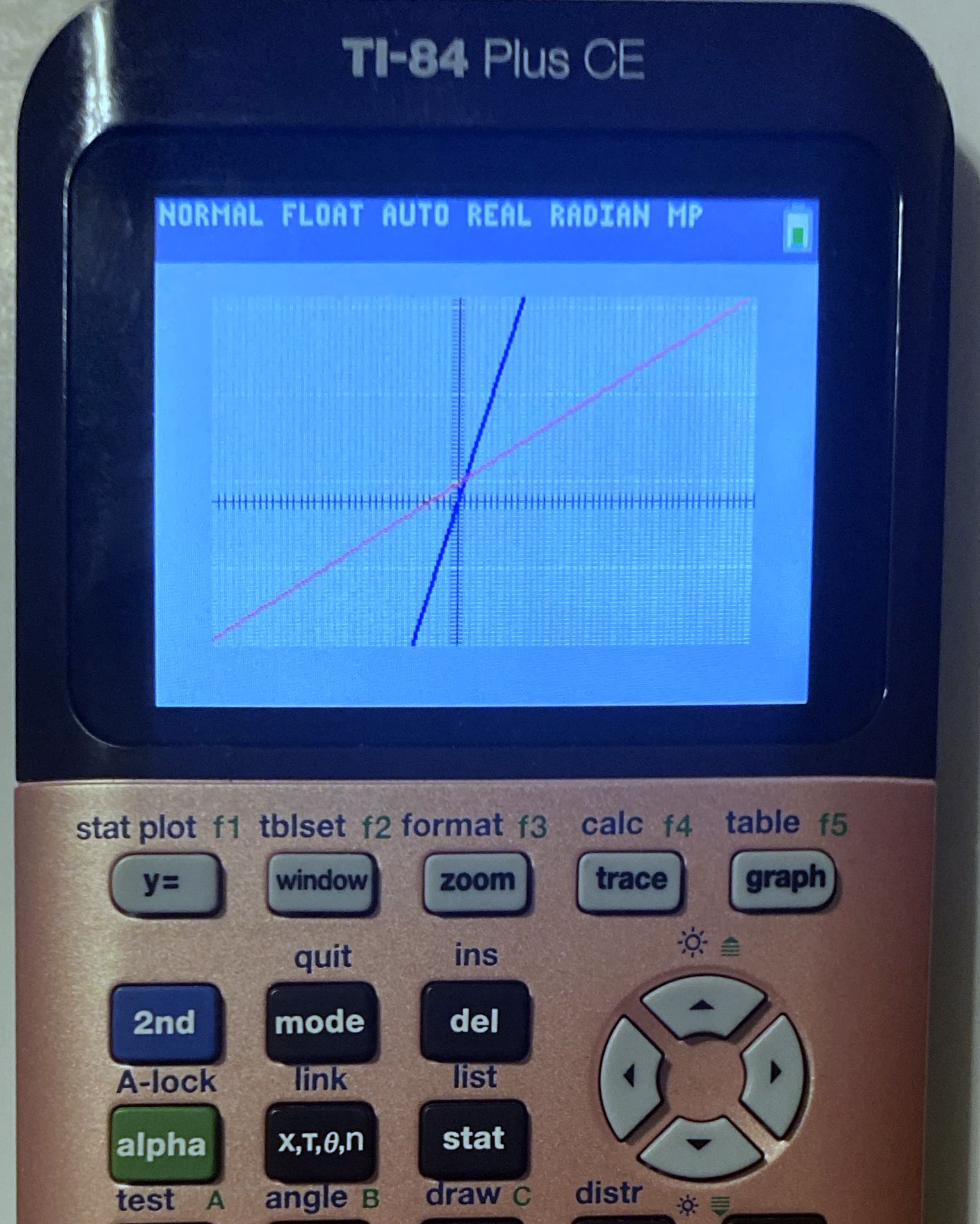
On a graph, exponential growth bends upward. That bend is important. It shows that the rate of change is increasing as the quantity increases. A line with a steep slope can grow quickly, but it still adds the same amount over equal intervals. An exponential curve keeps changing its own pace.
Compare \(y = 10x\) with \(y = 2^x\). At first, the line can be larger. When \(x = 3\), the linear value is 30, while the exponential value is only 8. But the exponential function is not trying to win early. When \(x = 10\), the line is 100 and the exponential value is 1,024. The curve eventually overtakes the line because repeated multiplication beats repeated addition when the number of steps becomes large enough.
This does not mean every exponential function immediately explodes. A growth factor of 1.01 grows much more slowly than a factor of 2. A small starting amount also needs time to become noticeable. Still, the shape of the curve reveals the same underlying structure: the amount changes by a percentage or factor, not by a fixed added amount.
Where Exponential Growth Appears in Real Life
Exponential growth appears whenever the next change depends on the current amount. In finance, compound interest grows because interest can earn more interest. In biology, a population can grow exponentially for a while if each generation produces more individuals and resources are not yet limiting. In technology, a message or video can spread quickly when each person shares it with multiple new people. In science, repeated cell division can produce surprisingly large numbers from a small starting group.
Real life, however, rarely allows pure exponential growth forever. Populations run into food, space, disease, or competition. Investments face changing rates, fees, withdrawals, and risk. Online sharing slows when most interested people have already seen the message. These limits do not make exponential growth unimportant; they make it more important to understand carefully. The model explains the early acceleration, while context explains when the pattern changes.
A useful habit is to ask what is being multiplied. If a quantity grows from 100 to 120 to 144, the added amounts are 20 and then 24, but the multiplier is consistent: each step multiplies by 1.2. If a quantity grows from 100 to 120 to 140, the added amount is consistent: each step adds 20. The numbers may look similar at the beginning, but they belong to different patterns.

Common Mistakes With Exponential Growth
One common mistake is treating percentage growth like simple addition. Growing by 10 percent twice is not the same as growing by 20 percent once. Starting from 100, a 10 percent increase gives 110. Another 10 percent increase gives 121, because the second increase is based on 110, not 100. The repeated multiplier is \(1.1^2\), which equals 1.21.
Another mistake is forgetting that exponential growth and exponential decay are close relatives. If the growth factor is greater than 1, the quantity increases. If the factor is between 0 and 1, the quantity decreases. A factor of 0.8 means the amount keeps 80 percent of its value each step, which is a 20 percent decrease. The exponent still counts repeated multiplication.
A third mistake is assuming that a graph must be exponential just because it curves upward. Some other functions curve too, including quadratic functions such as \(y = x^2\). The key question is whether equal steps in \(x\) multiply the output by a consistent factor. If the output is multiplied by the same number again and again, the pattern is exponential.
Exponential growth gets big fast because it does not merely move forward; it carries its past with it. Each step begins from the new total and multiplies again. Once that idea clicks, the curve stops looking mysterious. It becomes a clear picture of repeated multiplication, quietly building momentum until the numbers can no longer be ignored.





Add comment