
 Rishay Dinesh
Introduction
Black holes are some of the strangest and most powerful objects in the universe. They form when massive stars collapse under their own gravity, creating regions in space where the pull is so strong that nothing, not even light, can escape. For a long time, black holes existed only in theory, but scientists have since gathered evidence that they are real and common in space. They remain one of the most exciting topics in physics because they test the limits of our knowledge and challenge how we understand the universe. While movies and books often make black holes look like dangerous monsters that eat everything, the true science is far more interesting. Learning about black holes helps us understand gravity, time, and the very structure of galaxies.
What Is a Black Hole?
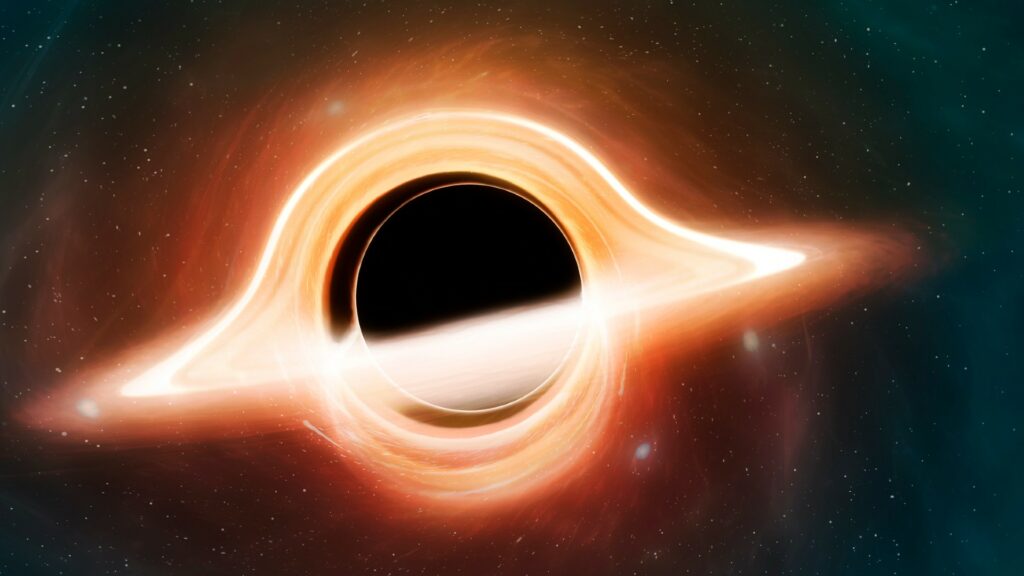
A black hole is a place in space where gravity becomes so strong that nothing can escape it. On Earth, gravity pulls objects like apples to the ground or keeps the moon in orbit. A black hole’s gravity is millions of times stronger, so strong that if anything gets too close—whether it is a star, a planet, or even light—it can never return. The boundary around a black hole is called the event horizon. Once something crosses that invisible line, it disappears from the universe forever. Scientists cannot look inside a black hole because no light escapes, but they can study the space around it and learn how it behaves.
How Black Holes Form
Most black holes begin as massive stars. Stars shine for millions or billions of years by burning hydrogen into helium through nuclear fusion. This process releases energy and keeps the star balanced against its own gravity. When the fuel runs out, the balance is lost, and gravity takes over. The star collapses inward under its own weight. If the star is heavy enough—at least several times the mass of our sun—the collapse crushes everything into a tiny point called a singularity. That point is the heart of the black hole. Around it lies the event horizon, the boundary that marks no return. Black holes created this way are called stellar black holes, and astronomers have found many examples in the universe.
The Event Horizon
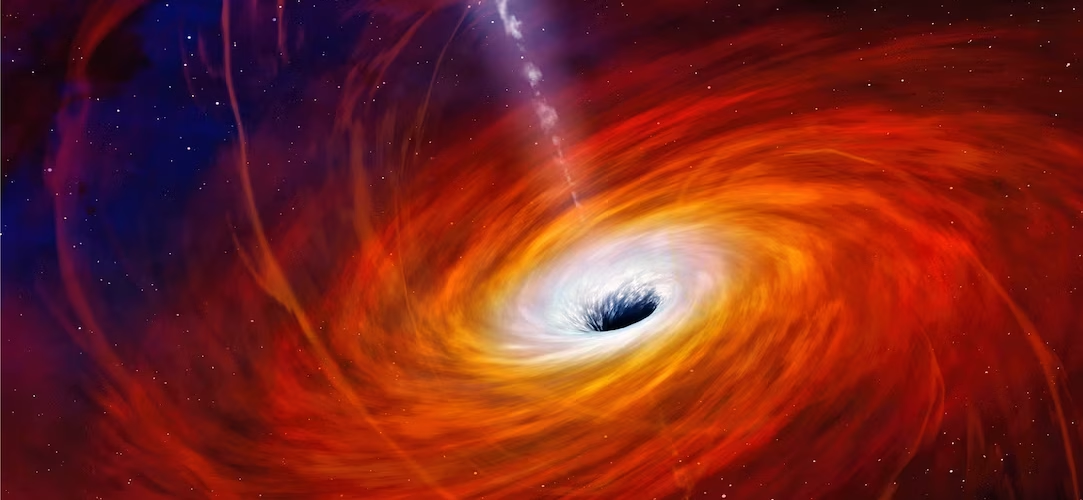
The event horizon is one of the most important features of a black hole. It is like a one-way door that nothing can pass through in reverse. Light, matter, and even time seem to stop at this boundary. From the outside, the event horizon looks like a dark sphere because no light escapes. Scientists study how matter behaves as it falls toward the event horizon. Gas and dust swirl into disks that heat up and glow brightly before disappearing. These glowing disks allow telescopes to find and measure black holes even though the holes themselves remain invisible. The event horizon shows where the rules of normal space end and the mysteries of extreme gravity begin.
Types of Black Holes
Not all black holes are the same size. Stellar black holes are the smallest type that astronomers can detect, usually a few times heavier than the sun. At the other extreme are supermassive black holes, which weigh millions or billions of times more than the sun. These giants sit at the centers of galaxies, including our own Milky Way. Scientists also believe that medium-sized black holes, called intermediate black holes, may exist, though they are harder to find. Some theories even suggest that tiny black holes called primordial black holes formed shortly after the Big Bang, but these remain unproven. Each type of black hole plays a role in shaping the universe, from swallowing stars to influencing the growth of galaxies.
Supermassive Black Holes
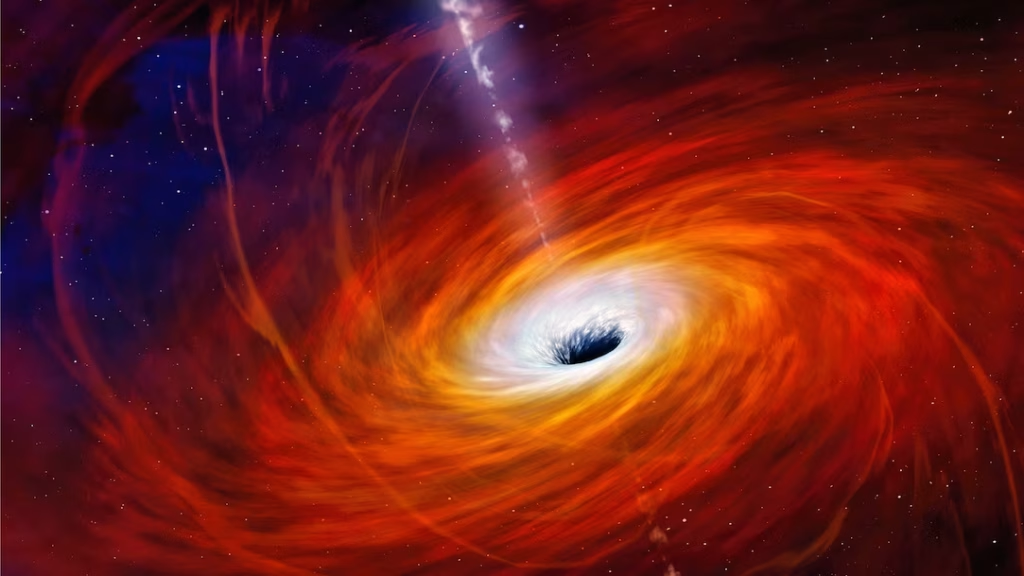
Supermassive black holes are especially fascinating because of their enormous size and influence. Every large galaxy seems to have one at its center. Our Milky Way contains Sagittarius A*, a black hole that weighs about four million times as much as the sun. In 2022, astronomers used the Event Horizon Telescope to capture the first image of this black hole’s shadow, proving its existence. Supermassive black holes control the movement of stars and gas in their galaxies. They also release powerful jets of energy that stretch for thousands of light-years. These jets may help shape galaxies by moving gas and slowing or speeding up the birth of new stars. Studying supermassive black holes gives us clues about how galaxies form and evolve over billions of years.
How Scientists Find Black Holes
Black holes themselves cannot be seen, but scientists find them by watching their effects on nearby objects. If a star orbits around an invisible point, the hidden object is likely a black hole. Astronomers also use X-ray telescopes to study the hot gas falling into black holes. As matter spins faster and faster near the event horizon, it gives off X-rays that travel across space. In recent years, scientists have also detected gravitational waves, which are ripples in space-time caused by two black holes colliding. These discoveries prove that black holes are real and allow scientists to measure their size, mass, and location.
Black Holes and Time
Black holes do not just trap matter—they also affect time itself. Einstein’s theory of relativity explains that time runs slower in stronger gravity. Near a black hole, time stretches so much that a person close to it would experience time differently from someone far away. For example, if you orbited close to a black hole and returned, you might have aged only a few hours while years passed for people on Earth. This idea sounds like science fiction, but it is supported by real physics. Movies like Interstellar showed this effect in action, helping audiences imagine what it might feel like to experience time near a black hole.
Do Black Holes Swallow Everything?
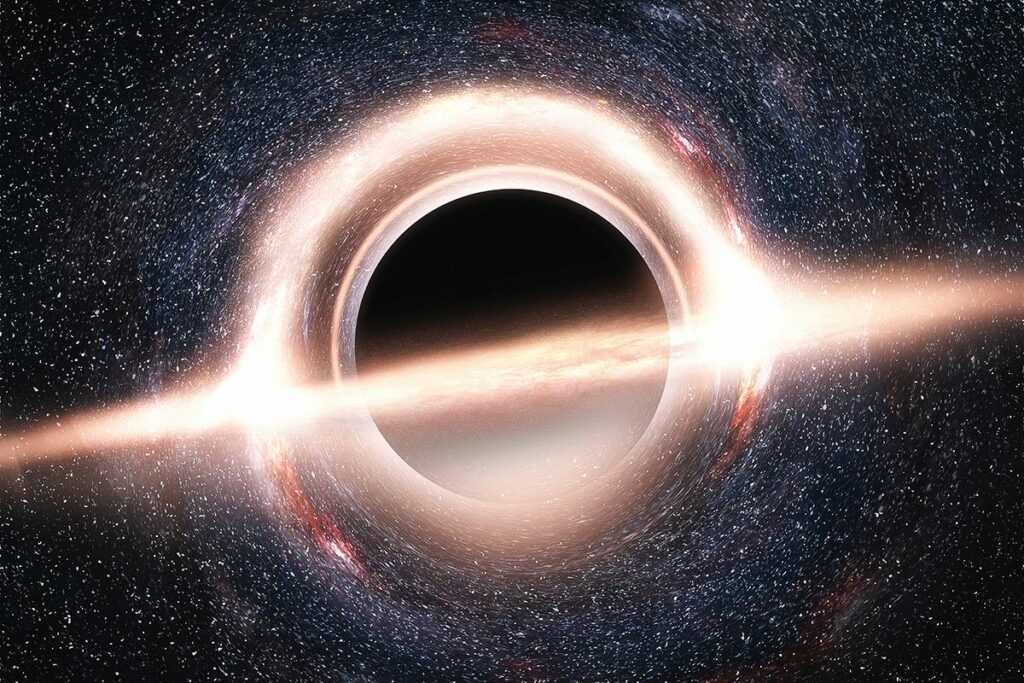
A common myth is that black holes act like cosmic vacuum cleaners, sucking in everything in their path. The truth is less dramatic. A black hole only pulls strongly on objects that come very close. If the sun suddenly turned into a black hole of the same mass, Earth would keep orbiting just as it does now, because the gravity at Earth’s distance would not change. We would freeze in the dark without sunlight, but Earth would not get pulled into the black hole. This shows that black holes are powerful, but they are not endless monsters swallowing the universe.
Black Holes and Energy
While black holes trap light and matter, they also create some of the most energetic events in the universe. As matter falls in, it forms a swirling disk called an accretion disk. The friction and pressure inside this disk heat it to millions of degrees. Some of the matter escapes along magnetic fields, shooting out as jets of particles moving near the speed of light. These jets shine across galaxies and influence the gas and dust needed to form new stars. Black holes, in this way, act as both destroyers and creators. They consume matter but also release energy that shapes their surroundings.
Hawking Radiation
In the 1970s, physicist Stephen Hawking proposed a surprising idea. He suggested that black holes are not completely black. Instead, they give off tiny amounts of radiation, now called Hawking radiation. This radiation happens because of quantum effects near the event horizon. Over a very long time, Hawking radiation could cause black holes to shrink and disappear. Small black holes would vanish faster, while giant ones would last longer than the age of the universe. Although scientists have not yet observed Hawking radiation directly, the theory changed how we think about black holes and connected them to the world of quantum physics.
Why Black Holes Matter
Black holes are not just fascinating objects; they are also essential to understanding the universe. They test the limits of physics, pushing our theories of gravity, energy, and time. They also play a role in the life cycle of galaxies, affecting how stars form and how galaxies grow. Without studying black holes, we would miss critical clues about the history and future of the cosmos. For high school students, learning about black holes shows how science combines imagination, observation, and evidence to explore mysteries that once seemed impossible.
Conclusion
Black holes are some of the most mysterious and powerful objects in space. They form from collapsing stars, create regions where gravity is so strong that nothing escapes, and challenge everything we know about physics. From stellar black holes to supermassive ones at the centers of galaxies, they shape the universe in ways we are only beginning to understand. Scientists continue to study them using telescopes, gravitational wave detectors, and advanced theories. While many questions remain—such as what lies beyond the event horizon—one fact is clear: black holes matter because they push the limits of human knowledge and reveal the deepest truths about our universe.


 Akshay Dinesh



Add comment