 Akshay Dinesh
Every year, as late winter turns toward spring in the Southern Hemisphere, satellites begin to watch a familiar change high above Antarctica. The protective ozone layer thins dramatically over the polar region, creating what scientists call the Antarctic ozone hole. It is not an empty hole in the sky, and it is not the same as the ozone pollution that can make summer air unhealthy near the ground. It is a seasonal zone of unusually low ozone in the stratosphere, the atmospheric layer that sits above most weather.
The timing can seem strange at first. Antarctica is still bitterly cold when the process begins, and sunlight has been absent from the pole for much of the winter. Yet those two facts are exactly what set up the chemistry. Extreme cold prepares chlorine and bromine compounds for action, while the return of spring sunlight turns them into ozone-destroying agents. The result is one of the clearest examples of how human-made chemicals, atmospheric circulation, temperature, and sunlight can combine far from where the chemicals were first released.
The Ozone Layer Is a Thin Shield, Not a Solid Ceiling
Ozone is a molecule made of three oxygen atoms. Most of the ozone that protects life on Earth is found in the stratosphere, roughly 10 to 30 miles above the surface, though its exact height varies with latitude and season. There, ozone absorbs much of the Sun’s ultraviolet-B radiation before it reaches people, plants, animals, and marine ecosystems. Without that shield, more UV-B would reach the surface, raising risks such as sunburn, skin cancer, cataracts, and damage to sensitive organisms.
The ozone layer is often described as if it were a thick blanket, but the amount of ozone is actually very small compared with nitrogen and oxygen in the atmosphere. Scientists commonly measure total column ozone in Dobson units, a unit named for British physicist G. M. B. Dobson. If all the ozone above one location were compressed to sea-level pressure, even a normal column would be only a few millimeters thick. That thinness helps explain why changes in chemistry can matter so much.
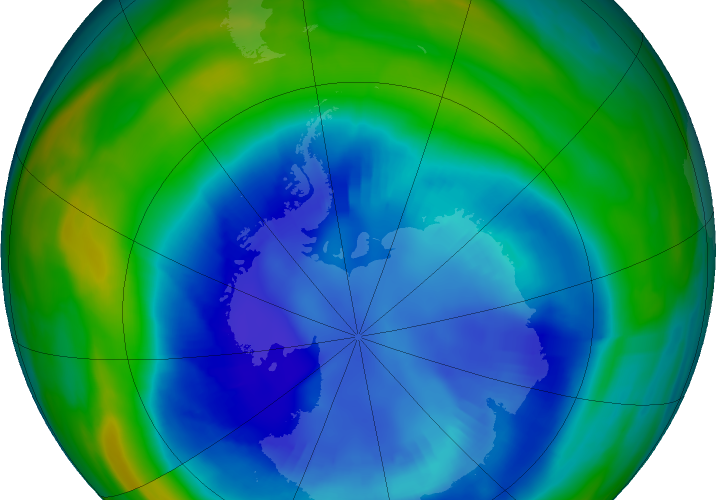
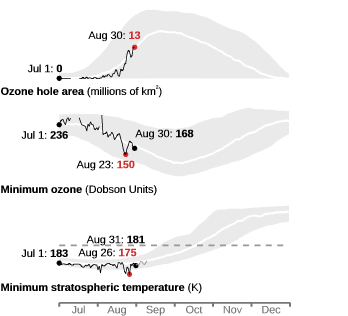
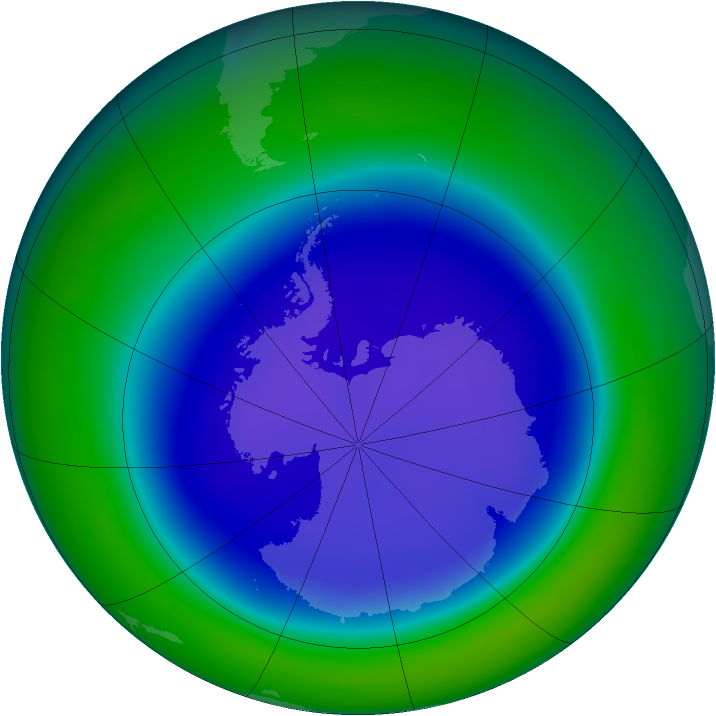
The Antarctic ozone hole is usually defined as the area where total column ozone drops below 220 Dobson units. NASA and NOAA track its size, depth, and timing each year using satellites, balloons, and ground-based instruments. In a typical season, the hole begins to grow around August, often reaches its largest size from September into early October, and then breaks down later in spring as the polar atmosphere warms and mixes with air from lower latitudes.
Why Antarctica Creates the Perfect Setup
The ozone hole became so dramatic over Antarctica because the polar stratosphere is unusually isolated in winter. Strong winds circle the continent in a pattern called the polar vortex, keeping extremely cold air trapped over the pole. That isolation prevents much mixing with ozone-rich air from elsewhere. It also lets temperatures fall low enough for polar stratospheric clouds to form, even though the stratosphere is normally very dry.
Those clouds are not ordinary rain clouds. They form at very high altitudes in intense cold, and their surfaces provide a place for chemical reactions that would happen much more slowly in open air. During the dark polar winter, relatively stable chlorine compounds are converted into forms that can become highly reactive once sunlight returns. The chemicals are waiting, in a sense, for sunrise.
When spring light reaches the Antarctic stratosphere, ultraviolet radiation breaks apart these prepared chlorine and bromine compounds. The freed atoms then take part in chain reactions that destroy ozone molecules over and over. A single chlorine atom can help break apart many ozone molecules before it is locked away again in a less reactive form. That recycling is why small amounts of reactive halogens can have a large effect.
The Arctic can lose ozone too, but its atmosphere is usually less stable and less cold for as long. Weather patterns disturb the northern polar vortex more often, allowing warmer air and mixing to interrupt the chemistry. Antarctica’s geography helps make its winter vortex stronger and more persistent, which is why the largest and most reliable ozone hole forms over the Southern Hemisphere.
How Human-Made Chemicals Made the Hole Possible
The main human cause was a family of chemicals once widely used in refrigeration, air conditioning, aerosol propellants, foam production, and industrial processes. Chlorofluorocarbons, often called CFCs, were prized because they were stable, nonflammable, and useful in everyday technology. That stability made them convenient near the ground, but it also allowed them to survive long enough to drift into the stratosphere.
Once CFCs reach the stratosphere, stronger ultraviolet light can break them apart and release chlorine. Halons, another group of ozone-depleting substances, release bromine, which is even more efficient at destroying ozone molecule for molecule. The British Antarctic Survey’s Farman, Gardiner, and Shanklin reported the severe Antarctic ozone decline in 1985, and satellite records soon confirmed that the problem was large, seasonal, and centered over the polar region.
The discovery led to one of the most important environmental treaties in modern history: the Montreal Protocol, agreed in 1987. Countries committed to phasing out many ozone-depleting substances, and later amendments tightened controls and added related chemicals. The treaty did not work by asking individuals to solve the problem one spray can at a time. It changed production, trade, and industrial standards at a global scale.
That matters because the chemicals involved linger for decades. Even after production falls, older CFCs and halons continue to move through the atmosphere. Ozone recovery therefore happens slowly, more like turning a huge ship than flipping a switch. The United Nations-backed Scientific Assessment of Ozone Depletion has reported that the ozone layer is on a path toward recovery if current controls remain in place, with Antarctic ozone expected to return to roughly 1980 levels later this century.
Why the Hole Changes Size From Year to Year
The ozone hole is not the same size every season. Some years are colder and more isolated in the Antarctic stratosphere, allowing more polar stratospheric clouds to form and giving ozone-destroying chemistry more time to work. Other years, unusual warming events or a weaker polar vortex can reduce the depth or area of depletion. This is why scientists compare long-term trends rather than judging recovery from one year alone.
Volcanic eruptions and large wildfire events can also affect the stratosphere by adding particles that change chemical conditions. Climate change adds another layer of complexity because greenhouse gases cool parts of the stratosphere even as they warm the lower atmosphere. A colder stratosphere can favor some ozone-depleting reactions, while changing circulation can shift how ozone and other gases move around the planet. Ozone science is therefore not a simple before-and-after story.
Measurement is part of the lesson. NASA’s Ozone Watch maps show where total ozone is lowest, while NOAA balloon instruments can sample the atmosphere vertically. Ground stations add long records that help connect modern satellite data with earlier observations. When all those tools point in the same direction, scientists can separate temporary weather effects from the slower signal of chemical recovery.
Why Recovery Is Good News With a Long Timeline
The ozone story is often treated as a solved problem, and in one sense it is a rare environmental success. The world identified the chemicals causing the damage, built an international agreement, strengthened it over time, and saw evidence that the atmosphere is responding. The Montreal Protocol is widely credited with preventing far greater ozone loss and reducing future UV exposure that would have harmed human health and ecosystems.
Still, recovery is not finished. Ozone-depleting substances already released into the atmosphere keep circulating, and the Antarctic ozone hole will continue to appear for many years. Scientists also watch for unexpected emissions, changes in substitute chemicals, and interactions with climate. A smaller hole in one year is encouraging only when it fits the broader pattern.
The most useful way to understand the ozone hole is as a seasonal chemical event inside a changing atmosphere. Cold polar clouds set the stage, sunlight starts the reactions, chlorine and bromine do the damage, and global policy slowly removes the source of the problem. That sequence makes the ozone hole more than a strange polar phenomenon. It shows that invisible changes in the atmosphere can become measurable, that good science can reveal causes, and that coordinated action can give a damaged system a real chance to heal.