 Akshay Dinesh
A song can feel completely different when it moves from a club or theater into a stadium. The melody is the same, the singer may be the same, and the instruments may be mixed by an expert crew, but the space changes the experience. In a small venue, sound reaches most listeners quickly and directly. In a stadium, it has to travel across long distances, bounce from hard surfaces, compete with crowd noise, and stay clear enough for people sitting far from the stage.
That is why a stadium concert is not simply a louder version of a smaller show. It is a large-scale sound problem. Engineers have to think about physics, architecture, weather, speaker placement, timing, and the way thousands of bodies absorb sound. When everything works well, the result can feel huge and exciting. When it does not, the same concert can sound muddy, delayed, or strangely different from one section to another.
Stadiums Were Not Built Like Listening Rooms
Many small music venues are designed around listening. Their walls, ceilings, curtains, and seating areas often help control reflections so the audience hears a blend of direct sound and room sound. A theater may still have echoes, dead spots, and difficult corners, but its shape usually supports the performance. The audience is close enough that the singer’s voice, drums, guitars, or amplified instruments arrive with less delay and less loss of detail.
A stadium has a different job. It is usually built to hold a sports field, wide sightlines, crowd movement, concession areas, and tens of thousands of seats. Hard concrete, metal, glass, and plastic surfaces can reflect sound strongly. Open roofs, partial roofs, and uneven seating bowls make the sound field less predictable than in a controlled hall. Even before a single note is played, the building is already shaping what listeners will hear.
One major challenge is scale. Sound travels through air at roughly 343 meters per second at room temperature, which is fast but not instant. In a small room, the difference between the front and back rows may be only a fraction of a second. In a stadium, a listener hundreds of feet away from the main speakers can hear direct sound noticeably later than someone near the stage. Reflections from the back wall, upper deck, roof, or scoreboard may arrive after that, creating a blurred trail behind the original sound.
This is why volume alone cannot solve a stadium. Turning the main speakers up may make the front rows painfully loud while still leaving distant seats unclear. It can also feed more energy into reflective surfaces, making the overall mix less intelligible. Good stadium sound depends on aiming, timing, and coverage, not just raw power.
Distance Changes Clarity Before It Changes Volume
People often notice loudness first, but clarity is usually the bigger issue. As sound spreads out, its energy is shared across a wider area. High frequencies are especially vulnerable because they are easier for air, wind, humidity, and surfaces to absorb or scatter. Those high frequencies carry much of the crispness in consonants, cymbals, guitar attacks, and the edge of a singer’s voice. When they fade, the music can still be loud while feeling dull or hard to understand.
Low frequencies behave differently. Bass wavelengths are long, so they wrap around obstacles and fill large spaces more easily. That can make stadium bass feel powerful, but it also creates problems. Low notes can build up in some sections and thin out in others, depending on how waves from different speakers combine. Two seats that look similar may not hear the same bass balance, especially if subwoofers are spread across the stage or around the venue.
In a small venue, the listener usually hears more of the original sound before the room has time to smear it. In a stadium, the first sound may be followed by many reflections. A snare drum hit can bounce from a side wall, the seating bowl, the roof edge, and the far end of the venue. Each reflection is a little late. If those late sounds are strong enough, the ear has trouble separating the musical detail from the room’s response.
This matters most for vocals and rhythm. A guitar chord can survive some blur because the harmony lasts long enough for the ear to gather it. Spoken words and fast lyrics are less forgiving. Drums, bass lines, and rhythmic patterns also depend on timing. A stadium mix that is impressive during a slow chorus may become less clear during a fast verse or dense arrangement.
Modern Concert Systems Aim Sound Like Light
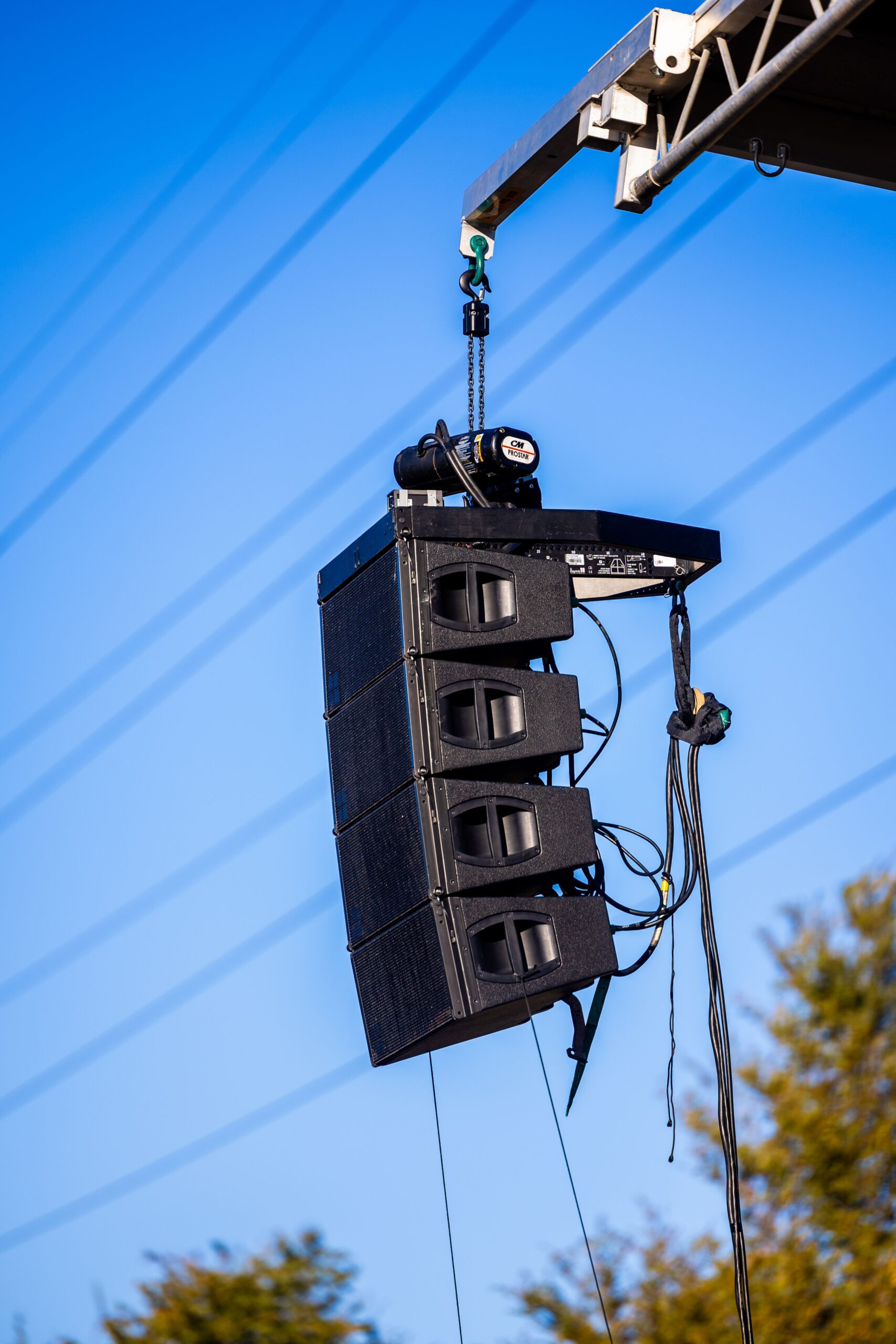
Large concerts use sound reinforcement systems designed to cover specific areas rather than simply blast in every direction. A common tool is the line array: a vertical stack of speakers hung beside or above the stage. Each box in the array points at a slightly different part of the audience. Together, they help send sound toward seating sections while reducing wasted energy toward ceilings, walls, or empty space.
The idea is similar to aiming lights. A spotlight pointed at the floor will not help the balcony, and a speaker pointed at a roof can create reflections that return as mud. Engineers model the venue, choose speaker angles, adjust levels, and tune the system so the front, middle, and upper seats receive a more even mix. The goal is not for every seat to sound identical, which is nearly impossible, but for the musical balance and timing to stay believable across the venue.
Delay speakers are another important tool. These are extra speakers placed farther from the stage to support distant audience areas. They are called delay speakers because their sound is intentionally held back by a tiny amount. The delay lines up the support speaker with the sound arriving from the stage, so listeners do not hear a separate echo from the extra speaker. When the timing is right, the listener feels as if the sound is still coming from the performance instead of from a random tower nearby.
The timing has to be precise. If a support speaker plays too early, it can pull the apparent sound away from the stage. If it plays too late, it can sound like an echo. Engineers use measurement microphones, software, and careful listening to align the system. They also adjust equalization so one area is not overly bright, boomy, or harsh compared with another.
The Crowd Becomes Part of the Acoustic System
A stadium sounds different when it is empty than when it is full. People absorb sound, especially in the mid and high frequencies. Clothing, hair, bodies, banners, and soft materials reduce some reflections that would bounce around an empty concrete bowl. That can help clarity, but it also changes the balance that engineers heard during setup. A sound check in an empty stadium is only an approximation of the real show.
The crowd also creates its own sound. Singing, cheering, clapping, and talking raise the noise floor. During a huge chorus, the audience may become part of the music, which can be thrilling. During quieter sections, the same crowd energy can cover details that would be easy to hear in a smaller venue. The larger the audience, the more the concert becomes a shared event rather than a purely controlled listening experience.
Open-air stadiums add another layer. Temperature, wind, humidity, and even the direction of air movement can affect how sound carries. A breeze may push high frequencies slightly away from one side of the audience. Warm and cool layers of air can bend sound subtly, especially over long distances. These effects are usually not dramatic enough to rewrite the whole show, but in a large venue they can help explain why sound feels different from one night or section to another.

Why Some Seats Sound Better Than Others
Two people at the same concert can honestly describe two different sound experiences. A seat near the front may have strong direct sound from the main speaker arrays, powerful bass, and a clear connection to the stage. It may also be extremely loud and less balanced if it sits too close to one side. A seat farther back may have a better overall blend, but it may depend more on delay speakers and reflections.
Upper-deck seats can be tricky because they may receive more reflected sound from roofs or side structures. Seats far to the side may hear more of one speaker array than the other, changing stereo balance and vocal clarity. Seats under overhangs may have a boxed-in quality because sound reflects from nearby surfaces. On the floor, listeners may be surrounded by bodies that absorb high frequencies, especially if they are far behind the front sections.
This does not mean the most expensive seat always has the best sound. A visually impressive view can still sit in a difficult acoustic area. A slightly more central seat, even if it is farther away, may hear a more balanced mix. For many amplified concerts, being centered between the main speaker arrays and not tucked under an overhang can matter more than being extremely close.
Phone recordings often make the difference even harder to judge. Small microphones compress loud sound, distort bass, and exaggerate crowd noise. A recording from the upper deck may make a show sound worse than it felt in person, while a recording near a speaker may make the bass seem overwhelming. The human ear and brain are better at adapting to a live space than a phone microphone is.
Small Venues Trade Scale for Detail
Small venues have their own problems. They can be too loud, too boomy, too reflective, or poorly mixed. But they give sound less distance to travel, fewer massive surfaces to bounce from, and a stronger sense of closeness. The audience can often hear subtle details: the breath before a vocal line, the texture of a guitar, the room tone around a piano, or the attack of a drumstick on a cymbal.
Stadiums offer something else. They turn music into a large public event, where sound, lights, screens, crowd response, and scale all combine. The tradeoff is that some detail may give way to impact. A stadium concert may not reproduce every part of the recording with perfect precision, but it can create a feeling that a small room cannot: thousands of people hearing and reacting to the same musical moment at once.
The best stadium sound tries to keep both values alive. It uses speaker arrays, delay systems, careful mixing, and acoustic planning to preserve clarity while still letting the show feel enormous. When a stadium concert sounds good, it is not an accident. It is the result of many small timing, aiming, and tuning decisions working together across a very large space.
That is the real reason stadium concerts sound different from small venues. The music is not only passing through speakers. It is passing through distance, architecture, air, crowds, and timing. A great performance still matters most, but the room, even when that room is a stadium, becomes part of the instrument.