Akshay Dinesh
Set notation is a compact way to talk about groups of things without losing track of what belongs where. At first, the symbols can look like a private code: curly braces, sideways U shapes, membership marks, complements, and empty sets. The idea behind them is much simpler. A set is just a collection, and set notation gives that collection clear boundaries.
That matters because many math problems are really sorting problems in disguise. Which numbers are allowed? Which students took both tests? Which outcomes count as success? Which values satisfy an equation? Once the group is defined clearly, the rest of the work becomes less slippery.
What a Set Actually Says
A set is a collection of distinct elements. The elements might be numbers, letters, people, shapes, outcomes, ordered pairs, or almost anything else that can be named clearly. A small set can be written with curly braces: \(A = \{2, 4, 6, 8\}\). That sentence says that set \(A\) contains the numbers 2, 4, 6, and 8.
The order usually does not matter. The set \(\{2, 4, 6, 8\}\) is the same set as \(\{8, 6, 4, 2\}\). Repetition does not create a new element either, so \(\{2, 2, 4, 6, 8\}\) still contains the same four distinct numbers. This is one reason sets are useful: they focus attention on membership, not on sequence.
The symbol \(\in\) means “is an element of.” If \(A = \{2, 4, 6, 8\}\), then \(4 \in A\). The symbol \(\notin\) means “is not an element of,” so \(5 \notin A\). These tiny statements are useful because they let a longer problem become a series of yes-or-no membership checks.
Sets can also be described with a rule. The set of even whole numbers less than 10 could be written as \(\{x \mid x \text{ is an even whole number less than } 10\}\). The vertical bar means “such that.” Instead of listing every element, the notation gives a condition for joining the set.
Union Means Everything in Either Group
The union of two sets combines their members. It is written with the symbol \(\cup\). If \(A = \{1, 2, 3, 4\}\) and \(B = \{3, 4, 5, 6\}\), then \(A \cup B = \{1, 2, 3, 4, 5, 6\}\). The numbers 3 and 4 appear in both original sets, but they are only listed once in the union because a set does not count duplicate membership.
Union matches the inclusive meaning of “or.” An element belongs to \(A \cup B\) if it is in \(A\), in \(B\), or in both. That last phrase matters. In everyday speech, “or” sometimes sounds like choosing one option but not the other. In set notation, union includes the overlap unless the problem says otherwise.
A school example makes the idea easier to feel. Suppose \(P\) is the set of students in physics club and \(C\) is the set of students in coding club. The set \(P \cup C\) includes everyone who is in at least one of those clubs. A student in both clubs still belongs in the union, but that student is not counted twice.
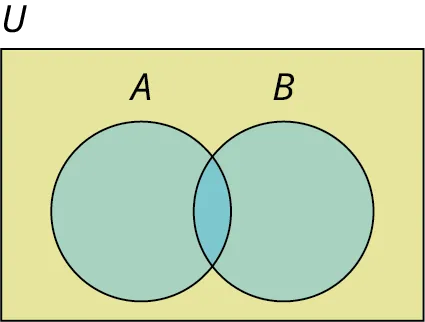
Intersection Means the Overlap
The intersection of two sets contains only the elements they share. It is written with the symbol \(\cap\). Using the same sets as before, \(A = \{1, 2, 3, 4\}\) and \(B = \{3, 4, 5, 6\}\), the intersection is \(A \cap B = \{3, 4\}\). Those are the only elements that pass both membership tests.
Intersection matches the idea of “and.” An element belongs to \(A \cap B\) only if it is in \(A\) and in \(B\). In the club example, \(P \cap C\) would be the students who are in both physics club and coding club. If a student belongs to only one of the clubs, that student is part of the union but not the intersection.
Sometimes two sets have no overlap. If \(E = \{2, 4, 6\}\) and \(O = \{1, 3, 5\}\), then \(E \cap O\) has no elements. That result is called the empty set, written as \(\varnothing\) or \(\{\}\). The empty set is not the same as zero. Zero can be an element of a set; the empty set means there are no elements at all.
Union and intersection often appear together in counting problems. OpenStax’s contemporary mathematics materials use Venn diagrams to show why overlapping regions must be handled carefully: if you add the size of \(A\) and the size of \(B\), the overlap has been counted twice. For two sets, the common counting relationship is \(n(A \cup B) = n(A) + n(B) – n(A \cap B)\). The subtraction is not a trick. It simply removes the extra copy of the shared region.
Complements Depend on the Universal Set
A complement describes what is outside a set but still inside the world the problem is considering. That larger world is called the universal set, often written as \(U\). If \(U = \{1, 2, 3, 4, 5, 6\}\) and \(A = \{2, 4, 6\}\), then the complement of \(A\) is \(A’ = \{1, 3, 5\}\). Some books write this as \(A^c\) instead of \(A’\).
The universal set is not a decorative detail. It decides what the complement can include. If the universal set is “whole numbers from 1 through 6,” then \(A’\) cannot include 7, 9, or 11, even though those numbers are also not in \(A\). They are outside the problem’s agreed boundary.
This is where many mistakes begin. A student sees “not in \(A\)” and starts imagining every possible thing that is not in the set. Set notation asks a tighter question: not in \(A\), but still inside \(U\). In a probability problem, \(U\) might be all possible outcomes of rolling a die. In a survey, \(U\) might be all people who answered. In an algebra problem, \(U\) might be all real numbers, integers, or allowed input values.
Venn Diagrams Turn Symbols Into Regions
A Venn diagram is not required for every set problem, but it is one of the best ways to check whether the symbols mean what you think they mean. Circles represent sets. The rectangle around them represents the universal set. Overlap regions show intersections, and all shaded regions together can show a union, a complement, or a more complicated expression.
For two sets, the basic regions are manageable: only \(A\), only \(B\), both \(A\) and \(B\), and neither. With three sets, the diagram becomes richer. There are regions for each single set, each pairwise overlap, the three-way overlap, and the area outside all three sets. That is why Venn diagrams are so helpful in survey and probability problems. They force every element into exactly one region.
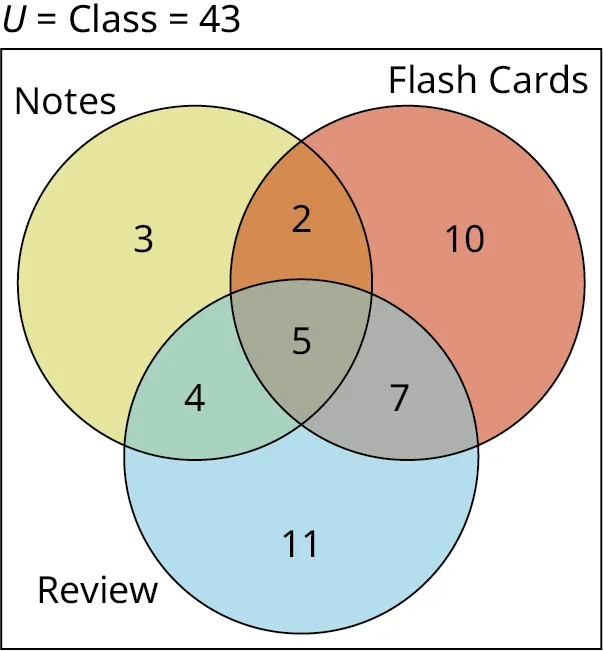
Imagine a class where \(N\) is the set of students who studied notes, \(F\) is the set who made flash cards, and \(R\) is the set who completed a review sheet. The expression \(N \cap F \cap R\) means students who did all three. The expression \(N \cup F \cup R\) means students who did at least one of the three. The complement \((N \cup F \cup R)’\) means students who did none of them, as long as the universal set is the whole class.
That last example shows why symbols are worth learning. A sentence like “students who either studied notes, made flash cards, or completed the review sheet, but not students who did none of them” is easy to misread. The notation \(N \cup F \cup R\) is shorter and, once learned, more precise.
How to Read Set Notation Without Guessing
The safest way to read set notation is to translate one symbol at a time. Start with membership: what elements are being considered? Then identify the operation. \(\cup\) asks for elements in either group. \(\cap\) asks for elements in both groups. A complement asks for elements outside a set but still inside the universal set. Parentheses tell which operation should be handled first.
Take \(A \cap (B \cup C)\). The parentheses say to combine \(B\) and \(C\) first. After that, keep only the elements that are also in \(A\). In words, the expression means “elements in \(A\) that are also in \(B\) or \(C\).” That is different from \((A \cap B) \cup C\), which means “elements in both \(A\) and \(B\), plus all elements in \(C\).” The symbols are similar, but the grouping changes the meaning.
A good habit is to test an expression with a small example. Use tiny sets, list the elements, and see what survives each operation. If the expression is visual, sketch a rough Venn diagram and shade the target region. If the problem asks for a count, make sure overlapping elements are not counted twice. These checks slow the work down for a moment, but they prevent the most common errors.
Set notation becomes easier when it stops looking like decoration and starts acting like a reading system. Curly braces define the group. \(\in\) checks membership. \(\cup\) gathers elements from either side. \(\cap\) keeps only the overlap. Complements point outside a set but inside the universal set. Once those pieces are familiar, many problems in algebra, probability, logic, data analysis, and computer science become clearer because the groups themselves are no longer vague.