

 Akshay Dinesh
A product in calculus looks harmless at first. If one function is multiplied by another, it is tempting to differentiate each piece and multiply the new results together. That shortcut feels natural because the derivative of a sum does work piece by piece. But products behave differently. When two factors both change, the total product changes for two reasons at once: the first factor changes while the second is still there, and the second factor changes while the first is still there.
The product rule is the derivative rule that keeps both effects. If two differentiable functions are written as \(f(x)g(x)\), then the derivative is \(f'(x)g(x) + f(x)g'(x)\). In words, differentiate the first factor and keep the second, then keep the first factor and differentiate the second. The two pieces are added because both changes contribute to the new rate of change.
Why multiplying derivatives is not enough
The easiest way to see the problem is to test a simple product. Suppose \(y = x \cdot x\). Since \(x \cdot x = x^2\), the derivative should be \(2x\). If someone multiplied the derivatives instead, they would get \(1 \cdot 1 = 1\), which is clearly wrong except at one particular value of \(x\). The product rule fixes that mistake by recognizing that each copy of \(x\) has its own chance to change.
Using the product rule on \(x \cdot x\), let \(f(x)=x\) and \(g(x)=x\). Then \(f'(x)=1\) and \(g'(x)=1\). The derivative becomes \(1 \cdot x + x \cdot 1\), which simplifies to \(2x\). The result matches the power rule because the product rule has counted both changing factors.
This is not just a technical detail. A product often represents a total made from two parts, such as price times quantity, width times height, or speed times time. If both parts are changing, the total does not respond to only one of them. It responds to both, and the derivative has to measure both contributions.
The rule in a form you can actually use
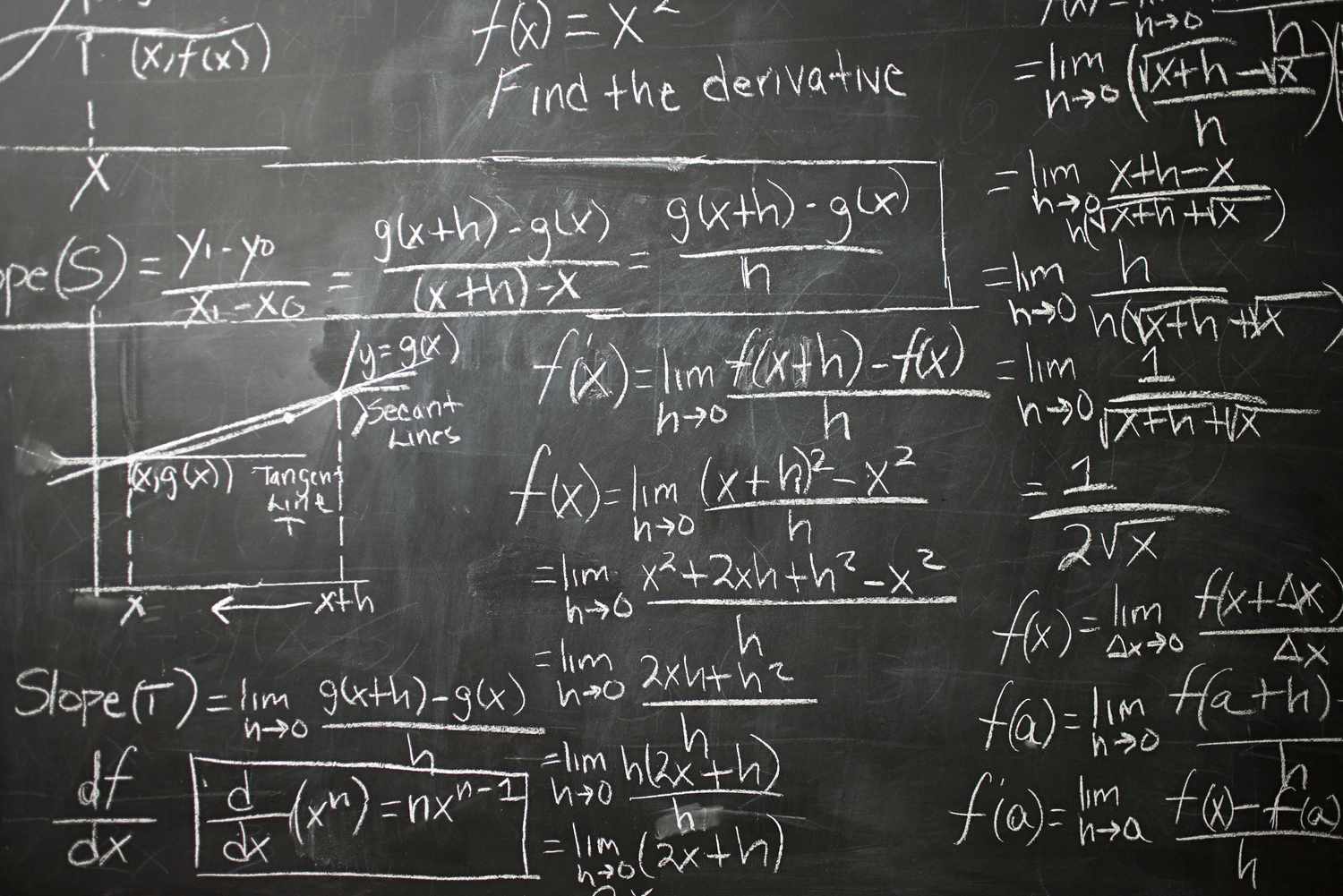
Written compactly, the product rule is \((fg)’ = f’g + fg’\). A slightly more expanded version is \(\frac{d}{dx}[f(x)g(x)] = f'(x)g(x) + f(x)g'(x)\). Both forms say the same thing. One factor is differentiated at a time while the other factor stays in place.
A common memory phrase is first derivative times second, plus first times second derivative. That phrase is useful, but it should not replace understanding. The word plus matters because the product can change through either factor. The untouched factor also matters because the size of one factor affects how much the other factor’s change changes the whole product.
OpenStax presents the product rule as one of the first advanced differentiation rules after the basic power, sum, and difference rules. That order makes sense. Students usually learn that derivatives can be distributed across addition and subtraction, then have to unlearn the idea that every operation behaves so neatly. MIT OpenCourseWare also treats the product rule as a central step in moving from basic derivatives to more realistic expressions.
A worked example with two familiar factors
Consider \(y = x^2\sin x\). This function is a product of \(x^2\) and \(\sin x\). The first factor is \(f(x)=x^2\), so \(f'(x)=2x\). The second factor is \(g(x)=\sin x\), so \(g'(x)=\cos x\). The product rule gives \(y’ = 2x\sin x + x^2\cos x\).
Both terms have a job. The first term, \(2x\sin x\), measures the change from \(x^2\) while \(\sin x\) is kept as the multiplier. The second term, \(x^2\cos x\), measures the change from \(\sin x\) while \(x^2\) is kept as the multiplier. Neither term is optional. If one is missing, the derivative is describing only half of the product’s motion.
This example also shows why the product rule is often easier than expanding. Some products can be rewritten before differentiating, but many cannot be made simpler. A polynomial times a trigonometric function, an exponential times a polynomial, or a logarithm times a power usually needs the product rule directly. The rule saves you from forcing expressions into forms they do not naturally have.
How the product rule connects to area
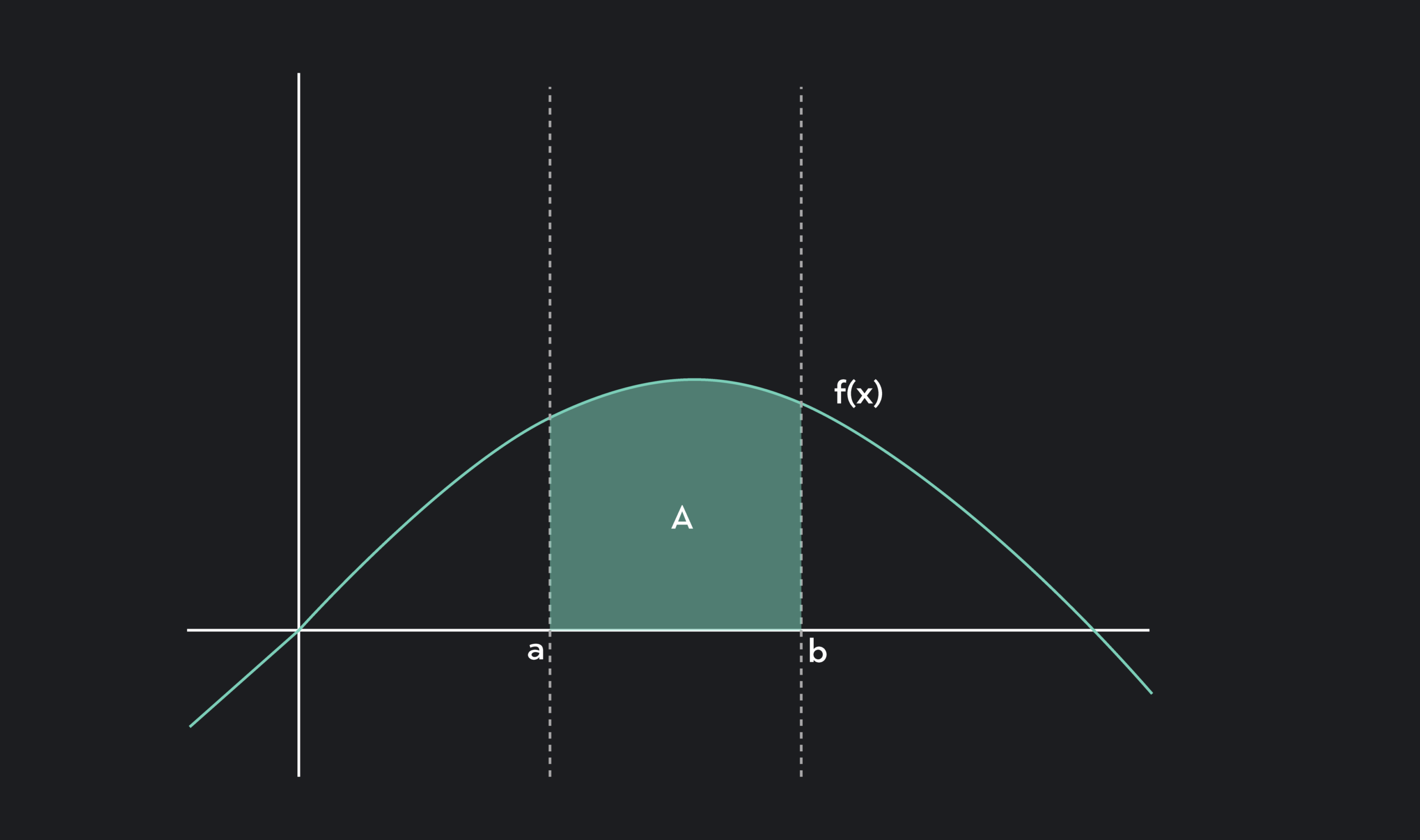
A useful intuition comes from rectangles. Imagine a rectangle whose width is \(f(x)\) and whose height is \(g(x)\). Its area is \(f(x)g(x)\). If \(x\) changes a little, the width may change and the height may change too. The new area includes a strip added by the changing width and another strip added by the changing height.
The width-change strip is roughly \(f'(x)g(x)\). The height-change strip is roughly \(f(x)g'(x)\). There is also a tiny corner where both changes happen at once, but as the change in \(x\) gets extremely small, that corner becomes too small to affect the derivative. What remains is exactly the product rule: one contribution from each changing side.
This picture helps explain why the rule has two terms instead of one. The product is not a single object changing in one simple way. It is built from two objects, and each object can push the total up or down. If one factor is increasing while the other is decreasing, the two terms may even work against each other.
Where students usually make mistakes
The first mistake is multiplying the derivatives: writing \((fg)’ = f’g’\). This usually happens because the expression looks symmetrical and the shortcut feels efficient. A quick test with \(x \cdot x\) exposes the problem. The product rule needs the original factors as well as their derivatives.
The second mistake is forgetting that the product rule can combine with the chain rule. For \(y = x^2\sin(3x)\), the product rule handles the multiplication, but the derivative of \(\sin(3x)\) still needs the chain rule. The derivative is \(2x\sin(3x) + x^2 \cdot 3\cos(3x)\). The product rule tells you where the pieces go; it does not automatically finish every derivative inside those pieces.
The third mistake is using the product rule when ordinary simplification would be cleaner. If \(y = x^2 \cdot x^5\), you could use the product rule and eventually get \(7x^6\). But rewriting the expression as \(x^7\) and using the power rule is faster. Good calculus is not about using the most complicated rule available. It is about reading the structure of the expression and choosing the rule that matches it.
The fourth mistake is dropping parentheses too early. In a product such as \((x^2+1)(x^3-4x)\), the derivative should begin as \(2x(x^3-4x) + (x^2+1)(3x^2-4)\). If the original factors are not kept grouped, signs and terms can drift. Parentheses are not decoration here; they protect the structure of the calculation.

When the rule becomes more than a formula
The product rule becomes more meaningful when it is seen as a rule for combined change. In economics, revenue can be written as price times quantity sold. If price changes and quantity also changes, the change in revenue has two parts. In geometry, an area can change because width changes, height changes, or both. In physics, an expression may multiply a changing coefficient by a changing variable, and the derivative has to keep both movements.
That is why the product rule sits near the center of differential calculus. It is not a rare trick for a special kind of homework problem. It is a basic way to handle quantities that are built by multiplication. Once expressions become realistic, products appear everywhere.
A steady approach helps. First, identify the two factors. Then write their derivatives separately. Next, build the two product-rule terms without simplifying too soon. Finally, check whether any factor also needs another rule, such as the chain rule. This order keeps the work organized and makes mistakes easier to catch.
The product rule may look longer than the shortcut students often wish were true, but its length is the point. A product changes through both factors. The derivative has to honor both changes, and the formula \(f’g + fg’\) does exactly that.





Add comment