 Akshay Dinesh
Polynomials are one of the first places where algebra starts to feel like a language. A polynomial can describe a simple line, the curve of a thrown ball, the area of a rectangle with unknown side lengths, or the smooth path of a digital animation. The same basic structure appears again and again: variables, whole-number powers, and coefficients that tell each term how much weight it carries.
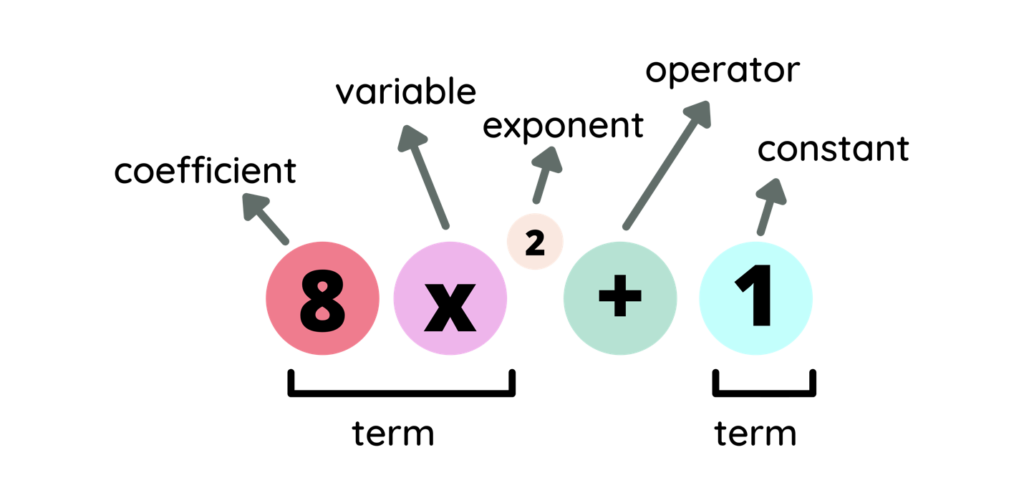
At first, polynomial expressions can look crowded. A term such as $-3x^4$ contains a sign, a coefficient, a variable, and an exponent, all packed into a small space. Once those parts become familiar, polynomials become much easier to read. They are not just strings of symbols; they are organized expressions that can be simplified, evaluated, graphed, factored, and used to solve problems.
What Makes an Expression a Polynomial
A polynomial is an expression made from variables raised to whole-number exponents, multiplied by constants, and joined by addition or subtraction. A polynomial in one variable often has the general form $a_nx^n + a_{n-1}x^{n-1} + \dots + a_1x + a_0$. The values $a_n, a_{n-1}, \dots, a_0$ are coefficients, and the exponents on $x$ must be whole numbers such as 0, 1, 2, 3, and so on.
For example, $3x^4 – 2x^3 + 5x^2 – x + 7$ is a polynomial. Its highest power of $x$ is 4, so its degree is 4. The coefficients are 3, -2, 5, -1, and 7. The constant term is 7 because it does not change when the value of $x$ changes.
Some expressions are not polynomials. An expression such as $\frac{1}{x}$ is not a polynomial because it is the same as $x^{-1}$, which uses a negative exponent. An expression such as $\sqrt{x}$ is not a polynomial because it is the same as $x^{1/2}$, which uses a fractional exponent. Polynomials keep the powers of the variable whole and nonnegative, and that rule gives them many predictable algebraic properties.
Terms, Degree, and Standard Form
A polynomial is built from terms. In $4x^5 – 3x^3 + x – 2$, the terms are $4x^5$, $-3x^3$, $x$, and $-2$. Each term has a degree based on the exponent of its variable. The term $4x^5$ has degree 5, while the term $x$ has degree 1 and the constant term $-2$ has degree 0.
The degree of the whole polynomial is the highest degree of any term with a nonzero coefficient. That small detail matters. In $0x^6 + 2x^3 – 5$, the degree is 3, not 6, because the $x^6$ term has a coefficient of 0 and does not actually contribute to the expression.
Polynomials are often written in standard form, with terms arranged from highest degree to lowest degree. Writing $7 – x + 5x^2 – 2x^3 + 3x^4$ as $3x^4 – 2x^3 + 5x^2 – x + 7$ does not change its value, but it makes the structure easier to see. Standard form helps you identify the degree quickly, compare like terms, and prepare for operations such as addition, multiplication, and division.
How Polynomial Operations Work
Adding and subtracting polynomials depends on combining like terms. Like terms have the same variable raised to the same power. If $P(x) = 3x^2 + 4x + 5$ and $Q(x) = 2x^2 – x + 7$, then $P(x) + Q(x) = 5x^2 + 3x + 12$. The $x^2$ terms combine, the $x$ terms combine, and the constants combine.
Subtraction requires one extra habit: distribute the minus sign before combining. If $P(x) = 4x^3 – 3x^2 + 2x – 1$ and $Q(x) = x^3 + x^2 – 3x + 5$, then $P(x) – Q(x)$ becomes $4x^3 – 3x^2 + 2x – 1 – x^3 – x^2 + 3x – 5$. After like terms are combined, the result is $3x^3 – 4x^2 + 5x – 6$.
Multiplication uses the distributive property. Every term in one polynomial must multiply every term in the other. For instance, $(x + 2)(x^2 – 3x + 1)$ becomes $x(x^2 – 3x + 1) + 2(x^2 – 3x + 1)$. That gives $x^3 – 3x^2 + x + 2x^2 – 6x + 2$, which simplifies to $x^3 – x^2 – 5x + 2$.
Division works by matching leading terms. To divide $x^3 + 2x^2 – 5x – 6$ by $x – 2$, start by asking what must multiply $x$ to produce $x^3$. The answer is $x^2$. Continue subtracting each new product until no terms remain or the leftover expression has lower degree than the divisor. In this case, the quotient is $x^2 + 4x + 3$ with no remainder.
Why Factoring Is So Useful
Factoring reverses multiplication. Instead of expanding a product into a polynomial, you rewrite a polynomial as a product of simpler expressions. This is especially useful because many equations become easier to solve once a polynomial is factored.
The first factoring move is usually to look for a greatest common factor. In $6x^3 + 9x^2$, both terms share $3x^2$, so the expression factors as $3x^2(2x + 3)$. Pulling out the common factor makes the remaining structure easier to handle.
Quadratics often use a different pattern. The expression $x^2 + 5x + 6$ factors as $(x + 2)(x + 3)$ because 2 and 3 multiply to 6 and add to 5. The difference of squares is another common pattern: $a^2 – b^2 = (a – b)(a + b)$. That means $x^2 – 9$ factors as $(x – 3)(x + 3)$.
Factoring is not just a trick for worksheets. It reveals the hidden structure of an expression. If a polynomial is written as $(x – 3)(x + 3)$, you can immediately see that it equals zero when $x = 3$ or $x = -3$. That connection between factors and zeros becomes a major idea in algebra, graphing, and later calculus.
Where Polynomials Show Up
Polynomials are useful because they can model change while still being manageable. A linear polynomial can describe a steady rate, such as earning the same amount of money per hour. A quadratic polynomial can describe situations involving area, gravity, or curved paths. Higher-degree polynomials can create more flexible curves for data modeling, engineering design, and computer graphics.
In physics, a quadratic expression can describe the position of an object moving with constant acceleration. In economics, polynomial models can approximate cost, revenue, and profit over a useful range of values. In computer graphics, polynomial-based curves help create smooth shapes in fonts, animations, and design software. The details vary by field, but the algebraic idea is the same: a polynomial gives a structured way to describe a changing quantity.
Common Mistakes That Make Polynomials Harder
- Combining unlike terms: $3x^2 + 4x$ cannot become $7x^3$ or $7x^2$. The powers must match before terms can combine.
- Losing negative signs: Subtracting a polynomial changes the sign of every term inside it, not just the first term.
- Multiplying only part of an expression: In $(x + 2)(x^2 – 3x + 1)$, both $x$ and 2 must multiply every term in the second polynomial.
- Factoring too soon without checking for a common factor: A greatest common factor can make the rest of the problem much simpler.
The best way to become comfortable with polynomials is to slow down and read the structure before calculating. Identify the terms, check the degree, arrange the expression neatly, and watch the signs. Polynomials reward careful organization. Once the pieces are clear, the operations become less like memorized procedures and more like a dependable algebraic toolkit.