

 Akshay Dinesh
Every year on June 14, the United States marks Flag Day, a date that can feel familiar without being fully understood. It is not the same kind of holiday as Independence Day, Veterans Day, or Memorial Day. Schools, towns, veterans groups, and civic organizations may hold ceremonies, but most people still go to work or class. That quieter place on the calendar is part of what makes Flag Day interesting. It asks a simple historical question: how did one piece of cloth become a national symbol strong enough to earn its own annual observance?
The answer begins during the American Revolution, but it does not end there. The flag adopted in 1777 was first a practical military and political marker for a new country fighting for recognition. Over time, the Stars and Stripes gathered meanings that no single Congress could write into a resolution: union, sacrifice, protest, belonging, argument, memory, and hope. Flag Day matters because it shows how symbols are made not only by governments, but also by the people who keep returning to them.
The June 14 Resolution
On June 14, 1777, the Second Continental Congress approved a short resolution describing the flag of the new United States. The resolution called for thirteen stripes, alternating red and white, and thirteen white stars in a blue field. The thirteen stripes and thirteen stars represented the thirteen states that had declared independence from Britain the year before. It was a brief decision, but it gave the young country a recognizable banner at a time when recognition mattered.
The Library of Congress and National Archives both point to that 1777 resolution as the core reason Flag Day falls on June 14. The date is not tied to a battlefield victory or a presidential birthday. It marks the adoption of the national flag itself. That makes Flag Day unusual: it commemorates the moment a symbol was officially chosen, while leaving room for later generations to debate what that symbol means.
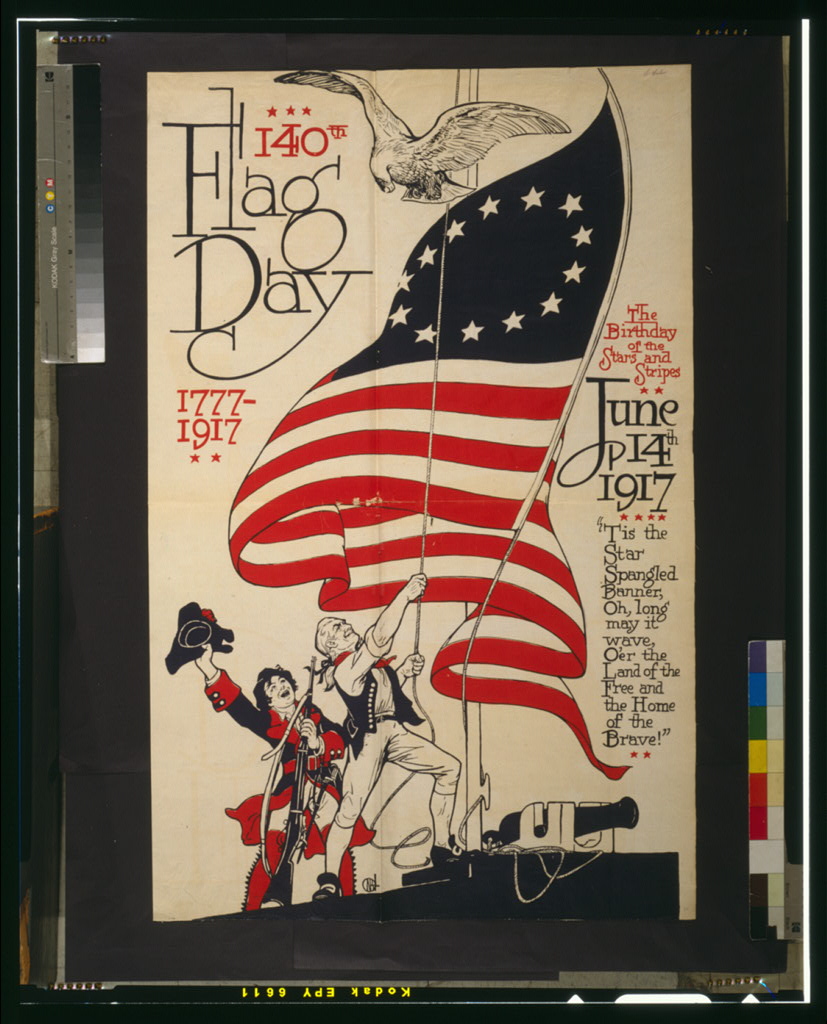
The first flag was not identical to the one seen today. The modern flag has fifty stars, one for each state, and thirteen stripes to remember the original states. As the country expanded, the star field changed many times. The stripes, however, returned to thirteen after early experiments with adding more stripes became impractical. That design choice helped the flag carry two ideas at once: growth through new states and continuity with the Revolutionary era.
From Wartime Marker to Public Symbol
In the Revolutionary period, flags had practical uses. Armies needed banners for identification, communication, and morale. A flag helped soldiers know where their unit was and gave ships a way to identify allegiance. It also helped the United States present itself as a political community rather than a loose collection of colonies in rebellion. A flag did not win independence, but it helped make independence visible.
That visibility grew more powerful after the Revolution. As the United States faced new wars, political divisions, immigration, expansion, and social change, the flag became a public object that people used in many different ways. It appeared in schools, parades, public buildings, military funerals, campaign events, protests, and homes. Some uses were solemn. Some were commercial. Some were deeply contested. That range is part of the flag’s history, not a distraction from it.
The flag also became connected to songs, pledges, and rituals. Francis Scott Key’s 1814 poem about the flag over Fort McHenry later became the national anthem. The Pledge of Allegiance, written in the late nineteenth century and revised later, made the flag part of classroom life for generations of students. These rituals gave the flag a daily presence that went far beyond the original 1777 resolution.
How Flag Day Became an Observance
Flag Day did not become a national observance immediately. For much of the nineteenth century, the date was marked locally or not at all. The first national centennial observance came in 1877, one hundred years after the flag resolution. That celebration helped connect the date to public memory, but it still did not make Flag Day a permanent part of the national calendar.
Teachers played an important role in keeping the idea alive. In the late nineteenth century, school ceremonies became a common way to teach children about citizenship, national history, and public symbols. Bernard J. Cigrand, a Wisconsin schoolteacher, is often remembered as a major advocate for Flag Day after holding a June 14 observance with students in 1885 and later campaigning for broader recognition. Other educators and civic groups also promoted flag ceremonies in schools and communities.
President Woodrow Wilson gave Flag Day national attention in 1916 by issuing a proclamation calling for June 14 to be observed as Flag Day. The timing mattered. The United States was still outside World War I, but public debates over patriotism, national unity, and international conflict were intense. A flag observance could feel like a unifying civic gesture, though different Americans understood that unity in different ways.
Congress later gave the observance a firmer legal place. In 1949, President Harry S. Truman signed legislation designating June 14 as National Flag Day. Even then, Flag Day did not become a federal holiday that closes government offices nationwide. Federal law calls for the president to issue an annual proclamation and encourages display of the flag during National Flag Week. The result is a holiday that is official, but still quieter than many others.
Why the Date Still Teaches Something
Flag Day is easy to reduce to decoration, but the history behind it is richer than that. The flag was adopted during a revolution, became more familiar through war and public ceremony, and was promoted by teachers and civic groups before Congress formally recognized the day. That path shows how national symbols gain meaning through repeated use. A symbol may be chosen in a meeting, but it becomes powerful through memory, ritual, and argument.
The flag’s meaning has never been perfectly simple. For some people, it stands mainly for military service and national sacrifice. For others, it represents constitutional ideals, civic participation, or the promise that the country can become fairer than it has been. It has also appeared in protest, when people have used the flag to challenge the nation to live up to its stated principles. A mature understanding of Flag Day leaves room for that complexity.
That complexity is especially important for students. Learning about the flag should not stop with colors, stars, and stripes. It should include the Revolution, the expansion of the states, the Civil War and Reconstruction, immigration, civil rights, court cases over speech and flag salute requirements, and the many communities that have claimed the flag as part of their story. A symbol that appears simple on the surface can open the door to a much deeper study of national life.
A Small Holiday With a Long Memory
Flag Day falls on June 14 because that is the day in 1777 when the Continental Congress adopted the Stars and Stripes as the flag of the United States. The date remembers a specific act, but the observance reaches far beyond that moment. It points to how people use symbols to carry history, express loyalty, mourn loss, argue about ideals, and imagine a shared future.
Its quieter status may actually make it useful. Without the large public rituals of Independence Day or Memorial Day, Flag Day leaves space to ask better questions. What makes a symbol endure? Who gets to shape its meaning? How can a country honor its history honestly while still arguing about its future? Those questions are bigger than one day in June, which is why the small holiday still deserves attention.





Add comment