 Akshay Dinesh
When a large earthquake appears in the news, people often ask, “How big was it on the Richter scale?” The question is understandable, but it is usually not how modern seismologists describe the event. Most widely reported earthquake sizes today are magnitudes, often moment magnitudes, not old-style Richter numbers. The difference matters because earthquakes are not just one shake at one place. They are ruptures along faults, recorded by many instruments, interpreted from several kinds of seismic waves, and sometimes revised as more data arrive.
The familiar word Richter survives because it gave the public a simple way to compare earthquakes. A magnitude 6 sounds bigger than a magnitude 5, and it is. But the original Richter scale was designed for a particular kind of measurement in a particular region. For small and moderate local earthquakes, related local-magnitude methods can still be useful. For very large earthquakes, however, scientists need a scale that better reflects the physical size of the fault movement. That is where moment magnitude comes in.
What a Magnitude Number Is Trying to Measure
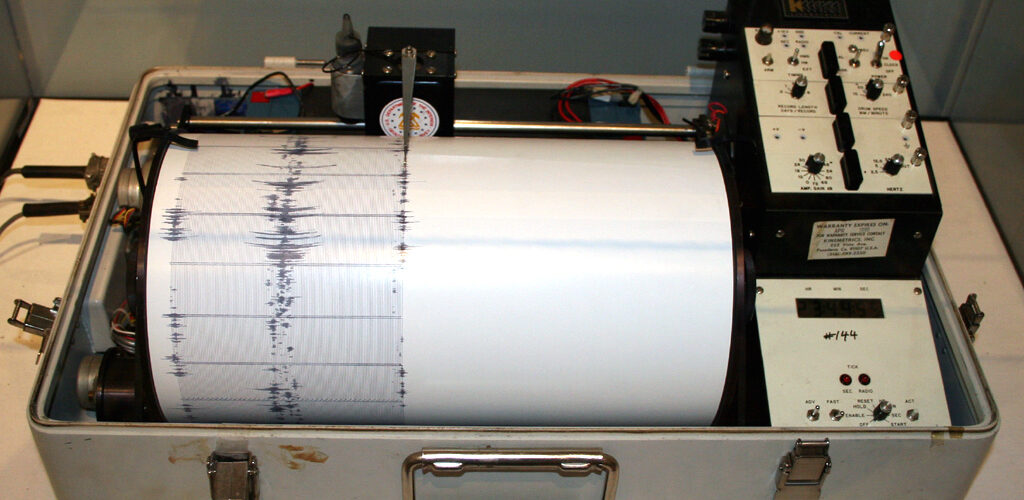
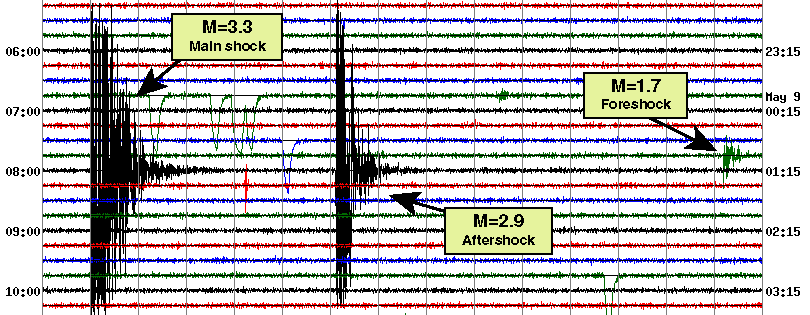
An earthquake begins when built-up stress overcomes friction along a fault. Rock that had been stuck suddenly slips, releasing energy into the surrounding crust. Some of that energy travels outward as seismic waves, which can shake buildings, move the ground, and appear as jagged traces on a seismogram. Magnitude is meant to describe the size of the earthquake source, not the amount of damage in one town.
That distinction can be surprisingly easy to miss. A deep magnitude 6 earthquake under a sparsely populated region may cause less visible damage than a shallower, smaller earthquake near fragile buildings. Soil, building design, distance from the fault, and depth all affect how strongly people feel shaking at a specific place. The U.S. Geological Survey separates magnitude from intensity for this reason: magnitude describes the earthquake as a whole, while intensity describes what the shaking does at a location.
Magnitude scales are also logarithmic. One whole-number step means the recorded wave amplitude is about ten times larger. The energy difference is much larger, commonly described as roughly 32 times more energy for each whole magnitude step. A magnitude 7 earthquake is not just a little larger than a magnitude 6. It represents a much more powerful rupture, even before local ground conditions and building vulnerability shape the damage people actually see.
What the Richter Scale Actually Measured
Charles F. Richter developed his local magnitude scale in the 1930s while working in southern California with Beno Gutenberg. The method used the amplitude of waves recorded on a standard seismograph, with corrections for distance from the earthquake. For its original purpose, this was a major advance. It gave seismologists a consistent way to compare local earthquakes instead of relying only on descriptions such as “severe” or “minor.”
The key word is local. The original Richter scale was tied to southern California earthquakes, the instruments used at the time, and distances close enough for that setup to work well. It was not built to handle every earthquake on Earth, especially the giant earthquakes that rupture long stretches of fault and send waves around the planet. As seismic networks expanded and instruments improved, scientists needed additional magnitude scales for body waves, surface waves, and larger global events.
Another problem is saturation. Some older magnitude scales do not keep increasing reliably as earthquakes become enormous. They may measure a part of the signal that stops growing in a useful way, even when the actual fault rupture is much larger. That is why two great earthquakes can look too similar on an older scale even though one released far more energy. The scale has run out of room, like a measuring cup being used for a swimming pool.
Why Moment Magnitude Became the Standard
Moment magnitude, often written as Mw, is built from seismic moment. Seismic moment connects three physical pieces of the earthquake: how much fault area slipped, how far it slipped on average, and how rigid the rock was. Those details get closer to the real size of the rupture than simply measuring the tallest wiggle on one kind of instrument. Seismologists can estimate seismic moment from seismograms and, for some events, from ground-deformation measurements.
The modern moment magnitude scale was developed from work by Hiroo Kanamori and later Thomas Hanks and Kanamori in the 1970s. Its numbers were designed to line up reasonably well with older magnitude values for many earthquakes, so a magnitude 5 would still feel like the same general category. The advantage is that moment magnitude keeps working better for large earthquakes. A huge subduction-zone earthquake can rupture hundreds of miles of fault, and moment magnitude can reflect that large physical source more honestly.
This is why the USGS says moment magnitude gives the most reliable estimate of earthquake size for very large events. In a first report, an agency may release a quick preliminary magnitude based on the data available in the first minutes. Later, as more stations report and analysts review the waveforms, the listed magnitude can change slightly. That does not mean scientists are guessing casually. It means the measurement improves as the earthquake’s full signal becomes clearer.
Magnitude Is Not the Same as Damage
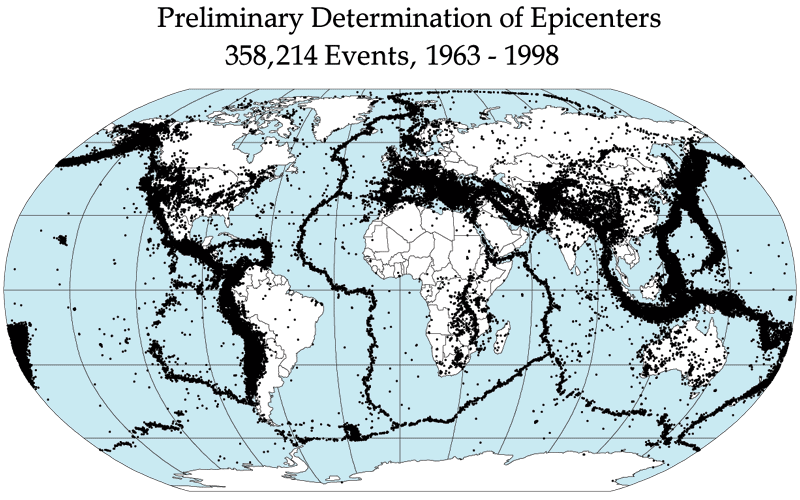
A single magnitude number can be useful, but it cannot tell the whole story of risk. Two earthquakes with the same magnitude can have very different effects. A shallow rupture directly beneath a city can be much more dangerous than a deeper event offshore or far from population centers. Soft sediment can amplify shaking, while stronger building codes can reduce collapse risk. The local consequences depend on more than the earthquake’s source size.
That is where intensity scales enter the picture. The Modified Mercalli Intensity scale describes observed shaking and damage, using levels that depend on what people feel and what happens to structures. A single earthquake has one magnitude, but it can produce many intensities across a region. Near the epicenter, dishes may fall, walls may crack, or roads may buckle. Farther away, people may feel only a gentle sway or nothing at all.
This difference helps explain why magnitude headlines can mislead when they are read as damage forecasts. A magnitude 7 earthquake is serious, but the expected damage still depends on depth, distance, fault direction, soil, landslide risk, tsunami potential, and the built environment. The number tells scientists a lot about the event’s size. It does not replace maps, local alerts, engineering information, or emergency guidance.
How to Read Earthquake Reports More Carefully
When reading an earthquake report, start with the word magnitude rather than assuming “Richter.” If the report says M or Mw, it is probably referring to a modern magnitude estimate, often moment magnitude for larger events. If it says local magnitude, that is closer to the historical Richter idea and may be appropriate for smaller regional earthquakes. The label matters because different scales are built from different parts of the seismic record.
Next, look for depth and location. A magnitude number without depth is incomplete, especially for understanding surface shaking. A shallow event can concentrate energy closer to people, while a deep event may be felt over a broad area but cause less intense surface motion near the epicenter. Distance also matters. An earthquake under the ocean raises different questions from one under a city, especially if it involves a fault capable of moving the seafloor.
It also helps to treat early numbers as provisional. Seismic networks detect waves rapidly, and speed matters for public information. But early estimates may rely on limited data. As more waveforms arrive from more stations, the location, depth, and magnitude can be refined. A change from 6.8 to 7.0 is not a failure of science; it is a measurement improving as the event is analyzed with a larger record.
Why the Old Name Still Sticks
The Richter scale remains famous because it gave earthquake size a memorable public language. It turned a complicated instrument record into a number people could repeat, compare, and remember. That kind of language does not disappear quickly. Even when news reports use modern data, the older name often lingers as a shorthand for earthquake magnitude.
For careful reading, though, “Richter” is usually not the best word. Earthquake measurement has moved beyond one local scale and one style of instrument. Modern seismology uses networks of sensors, digital records, waveform analysis, and physical models of fault rupture. Moment magnitude is not perfect, and no single number can describe all effects of an earthquake, but it is better suited to the large events people most often hear about.
The next time an earthquake is reported, the sharper question is not “What was it on the Richter scale?” A better question is, “What magnitude was it, how deep was it, where did it occur, and how strong was the shaking where people live?” That set of questions respects both sides of the story: the physical size of the earthquake and the human experience of the ground moving.