 Akshay Dinesh
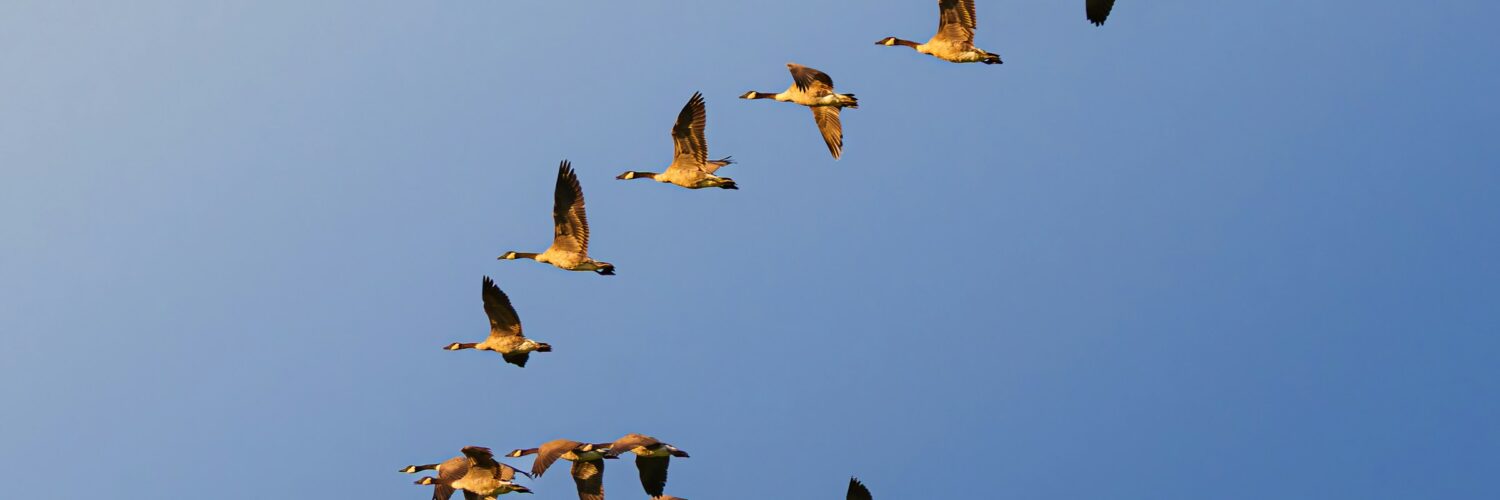
On a fall evening, a line of geese or cranes can make the sky look almost drawn with a ruler: one bird in front, two angled lines behind it, each body shifting slightly as the flock moves. The pattern is beautiful, but it is not only decorative. For many large migrating birds, a V formation is a way of turning difficult long-distance flight into a shared aerodynamic task.
The basic idea is simple enough to see but subtle enough to keep scientists interested. A flying bird does not move through still air without leaving a trace. Its wings push air downward to hold the body up, and that moving air curls into rotating patterns behind and beside the wings. A bird behind the leader can sometimes place itself where the air is already rising, gaining a small lift advantage instead of fighting every bit of gravity alone.
The Problem Long-Distance Flight Creates
Migration is expensive. Birds crossing hundreds or thousands of miles must carry enough fuel, choose favorable weather, avoid predators, find resting places, and keep their muscles working for hours at a time. Small songbirds often migrate at night and move in loose waves, but larger birds such as geese, pelicans, cranes, and ibises are easier to notice because they travel in visible formations during the day.
Body size changes the problem. A large bird has broad wings that can produce strong lift, but each wingbeat also costs energy. When a flock is traveling for a long stretch, even a small reduction in effort can matter. Saving a little energy hour after hour can help birds fly farther before stopping, arrive with more reserves, or handle difficult weather with a wider margin.
That is why the V formation is most common among larger birds with steady, powerful flight. The shape is not a magic rule followed by all migrants. Many birds do not use it, and some species shift between lines, clusters, and looser groups depending on wind, flock size, terrain, and behavior. Still, when the familiar V appears, it often points to the same underlying challenge: how to move a group through air while wasting as little effort as possible.
How Wings Leave Useful Air Behind
A wing creates lift by changing the motion of air around it. Air pressure differs above and below the wing, and the wing also deflects air downward. Near each wingtip, some of that moving air curls into a rotating trail called a wingtip vortex. The region directly behind a bird can include downwash, air pushed downward, but off to the side there can be upwash, air moving upward.
Upwash is the key to the V. A following bird does not want to sit directly in the hardest part of the disturbed wake. Instead, it benefits by flying slightly behind and to the side of the bird ahead, where rising air can help support its weight. In plain terms, the follower can borrow a little help from air that the leader has already set in motion.
This is not the same as coasting. The following bird still has to flap, steer, and maintain speed. The advantage is more like walking behind a windbreak or cycling in a draft: the work is not removed, but the surrounding flow becomes more favorable. The V shape lets several birds take useful side positions without crowding into the same patch of air.
What the Ibis Study Showed
For a long time, the V-formation explanation made aerodynamic sense, but measuring it in real birds was difficult. The movements are fast, three-dimensional, and constantly changing. A 2014 Nature study led by Steven Portugal at the Royal Veterinary College gave researchers an unusually detailed look by fitting northern bald ibises with tiny GPS and motion sensors during migration training flights.
The researchers found that the birds in V positions were not randomly spaced. They tended to place themselves where aerodynamic theory predicted upwash would be useful. Even more striking, the ibises adjusted their wingbeats so that a following bird’s wingtips moved in a coordinated path with the bird ahead. That timing helped the follower catch rising air through the wingbeat cycle instead of meeting the wake at an unhelpful moment.
The same study also found different timing when one bird flew more directly behind another. In that position, the birds appeared to use a pattern that could reduce the harmful effect of downwash. That distinction matters because it shows the formation is not just a fixed shape in the sky. It is a moving negotiation among position, timing, wake structure, and the sensory ability of each bird.
The study did not prove that every V-flying species uses exactly the same strategy. Ibises are not geese, and trained migration flights are not identical to every wild flock. But the work strongly supported the idea that birds can exploit the air left by flockmates with surprising precision. What looks like a simple line from the ground can be a finely tuned response to invisible currents.
Why the Leader Changes
The front position is useful for the flock but demanding for the bird in it. The leader does not receive the same aerodynamic help from a bird ahead, so it often carries more of the immediate burden. In many flocks, leadership shifts over time. A bird may move out of the front, another may slide into place, and the formation reforms without needing a visible signal that humans can easily read.
That rotation makes sense if the formation is partly about energy sharing. A flock that leaves one bird at the front for too long may lose the benefit of cooperation if the leader tires. By changing positions, the group can spread the cost of breaking through the air while allowing others to take advantage of side positions.
There may be other benefits too. A V gives birds a clearer view than a tight cluster would. Each bird can see neighbors, keep track of the flock’s direction, and avoid collisions while still staying close enough to gain from the formation. Communication also matters. Calls from geese in flight may help maintain contact, coordinate movement, or keep the flock together when visibility or distance changes.
The formation is therefore not only a physics trick. It is also behavior. Each bird must respond to the air, the birds around it, and the route ahead. The pattern survives because it solves several problems at once: lift, spacing, attention, and group movement.
Why Not All Birds Use a V
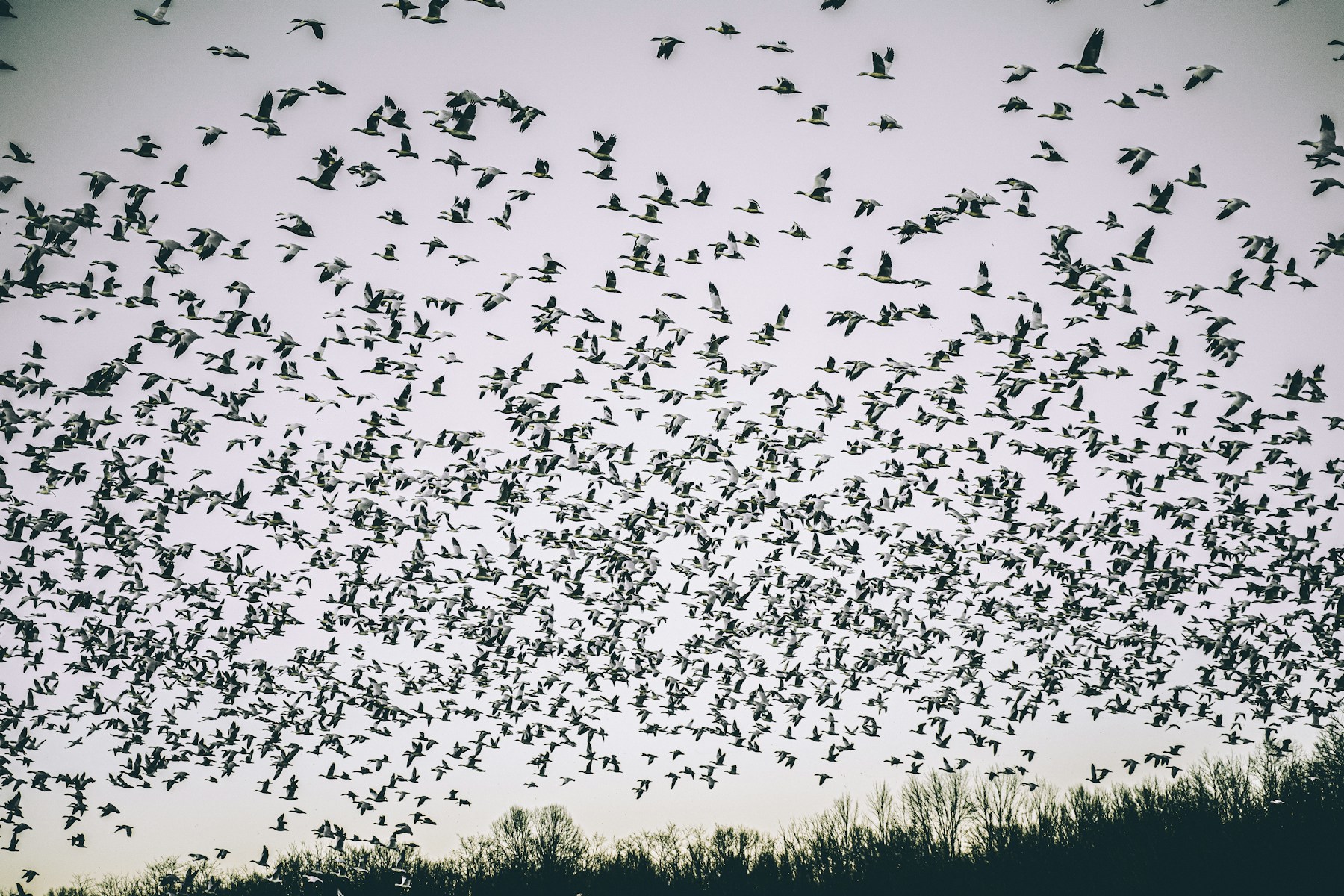
If V formations save energy, it is fair to ask why every migrating bird does not use them. The answer begins with scale. Very small birds interact with air differently from large birds, and many travel at night in broad, loose movements rather than in the obvious daytime lines people notice from the ground. Some birds rely more on soaring in thermals, ridge lift, or ocean winds than on steady flapping behind a neighbor.
Social behavior matters as well. A V formation requires birds to tolerate close spacing and respond to one another’s movements. Species that migrate alone, in pairs, or in loose mixed groups may not have the same opportunity or need. The benefit also depends on wing shape, speed, flock size, weather, and how long the birds must stay airborne.
That variety is part of what makes migration so impressive. A warbler crossing a continent at night, a hawk circling on rising warm air, a shorebird making a nonstop ocean flight, and a goose flying in a V are all solving the same broad problem in different ways. Each strategy fits a body, a route, and an environment.
The V formation stands out because it makes hidden physics visible. It shows that migration is not only about instinct or endurance. It is also about air itself: lift, drag, timing, and the small advantages that become powerful over distance. The next time a V-shaped flock passes overhead, the shape is worth reading as more than a sign of the season. It is a moving example of how living things use the physical world with remarkable precision.