

 Akshay Dinesh
A system of equations asks for values that make more than one equation true at the same time. In Algebra 1 and Algebra 2, that usually means finding an ordered pair, such as (x, y), that works in two different linear equations. The challenge is not that the equations are mysterious. The challenge is that two variables are moving at once, so guessing quickly becomes messy. Substitution and elimination are two reliable ways to reduce the system until one variable can be solved cleanly, then the other can be found and checked.
Both methods are doing the same basic job: they turn a two-variable problem into a one-variable problem. Substitution does this by replacing one expression with another equal expression. Elimination does it by combining equations so one variable cancels out. Once that idea clicks, the methods stop feeling like separate tricks and start feeling like two different routes to the same destination.
What a System Is Really Asking
Consider the system x + y = 10 and x – y = 2. The first equation says the two numbers add to 10. The second says the first number is 2 more than the second. A solution has to satisfy both statements at once, not just one of them. The ordered pair (6, 4) works because 6 + 4 = 10 and 6 – 4 = 2.
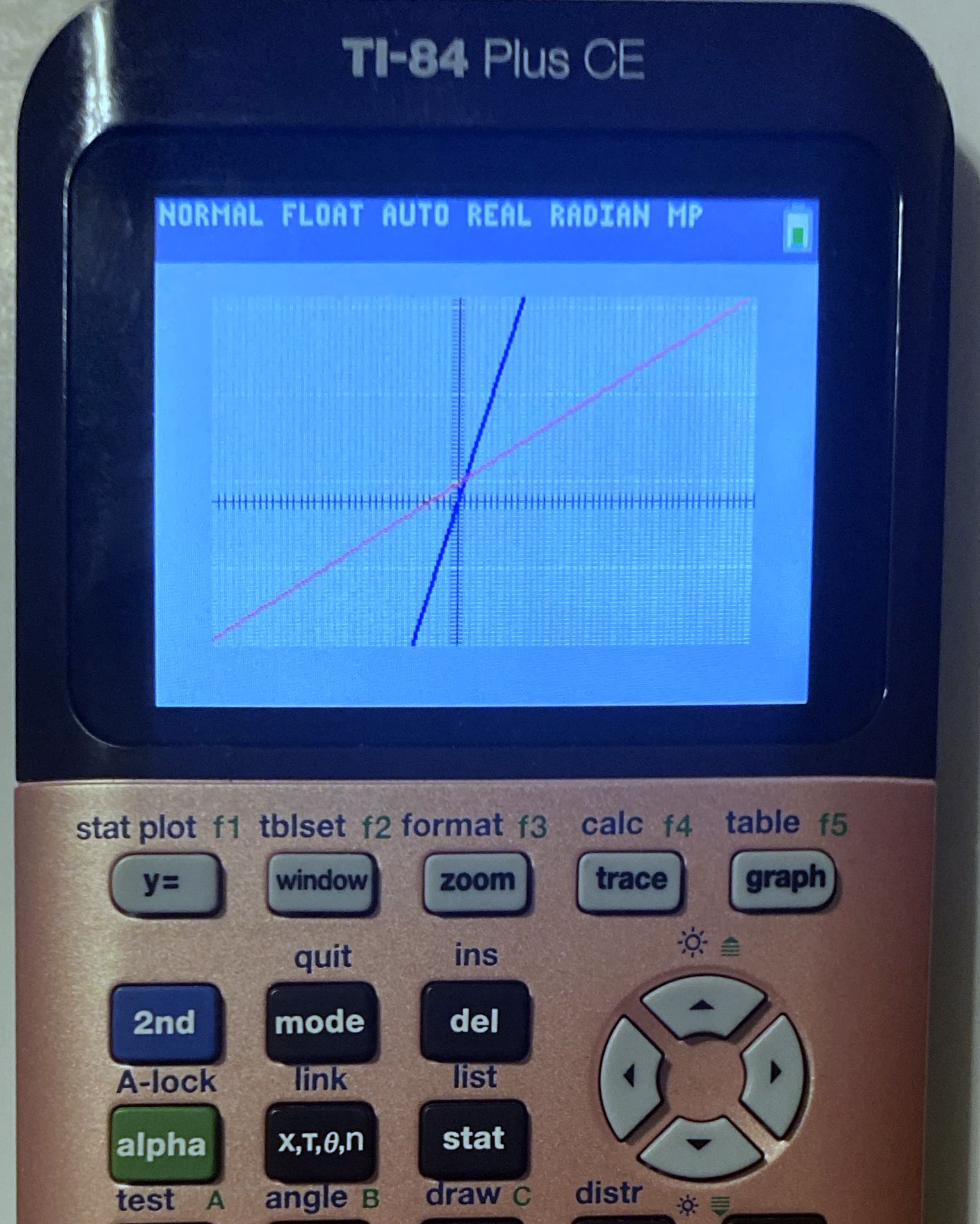
On a graph, each linear equation is a line. The solution to a two-line system is the point where the two lines intersect. That picture is useful, but algebra gives a more exact route than reading a point from a graph. When the intersection is not at a neat grid point, substitution or elimination can still find it.
Systems also help model real situations. A student might compare two phone plans, a business might compare costs and revenue, or a word problem might describe two totals at once. If one equation gives a total amount and another gives a relationship between the parts, solving the system reveals the values hiding inside both statements.
How Substitution Turns One Equation Into a Replacement
Substitution works best when one equation already has a variable by itself, or when it can be rearranged without much effort. Suppose a system is y = 2x + 1 and x + y = 10. The first equation tells exactly what y equals. Because y and 2x + 1 have the same value, the expression 2x + 1 can replace y in the second equation.
That gives x + (2x + 1) = 10. Now there is only one variable: 3x + 1 = 10, so 3x = 9 and x = 3. The first equation then gives y = 2(3) + 1, so y = 7. The solution is (3, 7).
The power of substitution is its directness. It uses one equation as a definition for part of the other equation. This is especially helpful when one equation looks like y = something, x = something, or when a word problem naturally says one quantity in terms of another. It can become less pleasant when both equations contain awkward coefficients, because solving one equation for a variable may create fractions early in the work.
How Elimination Cancels a Variable
Elimination is often the smoother choice when both equations are in standard form, such as Ax + By = C. The goal is to add or subtract the equations so one variable disappears. For example, take 3x + 2y = 16 and 3x – y = 7. The x-terms already match, so subtracting the second equation from the first removes 3x.
When the equations are subtracted, (3x + 2y) – (3x – y) = 16 – 7. The 3x terms cancel, and 2y – (-y) becomes 3y. That leaves 3y = 9, so y = 3. Substituting y = 3 into 3x – y = 7 gives 3x – 3 = 7, so 3x = 10 and x = 10/3. The solution is (10/3, 3).
Sometimes the coefficients do not match at first. In that case, multiply one or both equations by a number that makes one variable line up. If the system is 2x + 3y = 13 and 4x – y = 5, multiplying the first equation by 2 gives 4x + 6y = 26. Now subtracting 4x – y = 5 removes x and leaves a one-variable equation. The method is flexible because the same legal operation applied to a whole equation preserves its solutions.
Choosing the Better Method
A good method choice can save several lines of work. Substitution is usually faster when a variable is already isolated, when a coefficient is 1 or -1, or when the wording of a problem gives one quantity in terms of another. Elimination is usually faster when the equations are lined up in standard form, when matching coefficients are already present, or when multiplying creates a clean cancellation.
Here is a practical way to decide. If you see y = or x =, try substitution first. If the equations look like two neat rows with x terms under x terms and y terms under y terms, look for elimination. If either route creates fractions immediately, check whether the other route stays cleaner. Fractions are not wrong, but they can make small arithmetic mistakes easier.
The two methods can also work together. After elimination finds one variable, you still use substitution to find the other. After substitution creates a one-variable equation, you still plug the result back into one of the originals. The name of the method describes the main move, not every step in the solution.

A Complete Example With a Check
Use elimination to solve 2x + y = 11 and 5x – y = 10. The y-terms are already opposites, so adding the equations is the cleanest move. The left side becomes 7x, and the right side becomes 21. So 7x = 21, which gives x = 3.
Now use one original equation to find y. In 2x + y = 11, replace x with 3: 2(3) + y = 11. That gives 6 + y = 11, so y = 5. The possible solution is (3, 5).
The final check matters because a system has to satisfy both equations. In the first equation, 2(3) + 5 = 11, which is true. In the second equation, 5(3) – 5 = 10, which is also true. Because the ordered pair works in both original equations, (3, 5) is the solution.
Common Mistakes That Change the Answer
The most common substitution mistake is replacing a variable in only part of an equation. If y = 2x + 1, every instance of y being replaced must become the whole expression 2x + 1. Parentheses help protect the replacement, especially when subtraction is involved. Writing x – (2x + 1) is different from writing x – 2x + 1.
In elimination, sign errors do most of the damage. Subtracting an equation means subtracting every term in it, not just the first one. If an equation has -y, subtracting that term turns it into +y. Many wrong answers come from losing track of that double negative.
Another mistake is checking the answer in the equation created during the process instead of the original system. A transformed equation may confirm part of the work, but it does not prove the ordered pair satisfies the starting conditions. The safest habit is simple: after solving, plug the ordered pair into both original equations.
Why These Methods Matter Beyond One Homework Page
Substitution and elimination are early examples of a much larger mathematical habit: simplify a complicated relationship without changing what is true. Later courses use the same idea in different forms. Linear algebra uses row operations to solve larger systems. Calculus and physics use substitution to rewrite expressions in more useful forms. Economics and science use systems to compare constraints, rates, costs, and outcomes.
For now, the important skill is choosing a clean path and keeping each step legal. Substitution says, “If these two expressions are equal, one can stand in for the other.” Elimination says, “If whole equations stay balanced, they can be combined to cancel a variable.” Both methods remove clutter until the solution becomes visible. The best sign of understanding is not memorizing which method has the better name; it is knowing why the method leaves the original system’s solution unchanged.




Add comment