Akshay Dinesh
A Nobel Prize often appears to honor a single flash of genius, but many discoveries are built by teams. Experimental physicists may depend on engineers, software specialists, statisticians, technicians, and researchers spread across dozens of institutions. Even so, one Nobel Prize can be shared by no more than three people. That limit is not a recent custom or a committee preference. It is written into the Nobel Foundation’s statutes.
The rule gives the prizes a memorable human face, but it also creates a difficult problem: how can three names represent work that may have required hundreds or thousands of contributors? The answer involves the language of the prize citation, the way prize money is divided, and a careful distinction between recognizing a decisive contribution and crediting everyone who made a discovery possible.
The three-person limit comes from the Nobel statutes
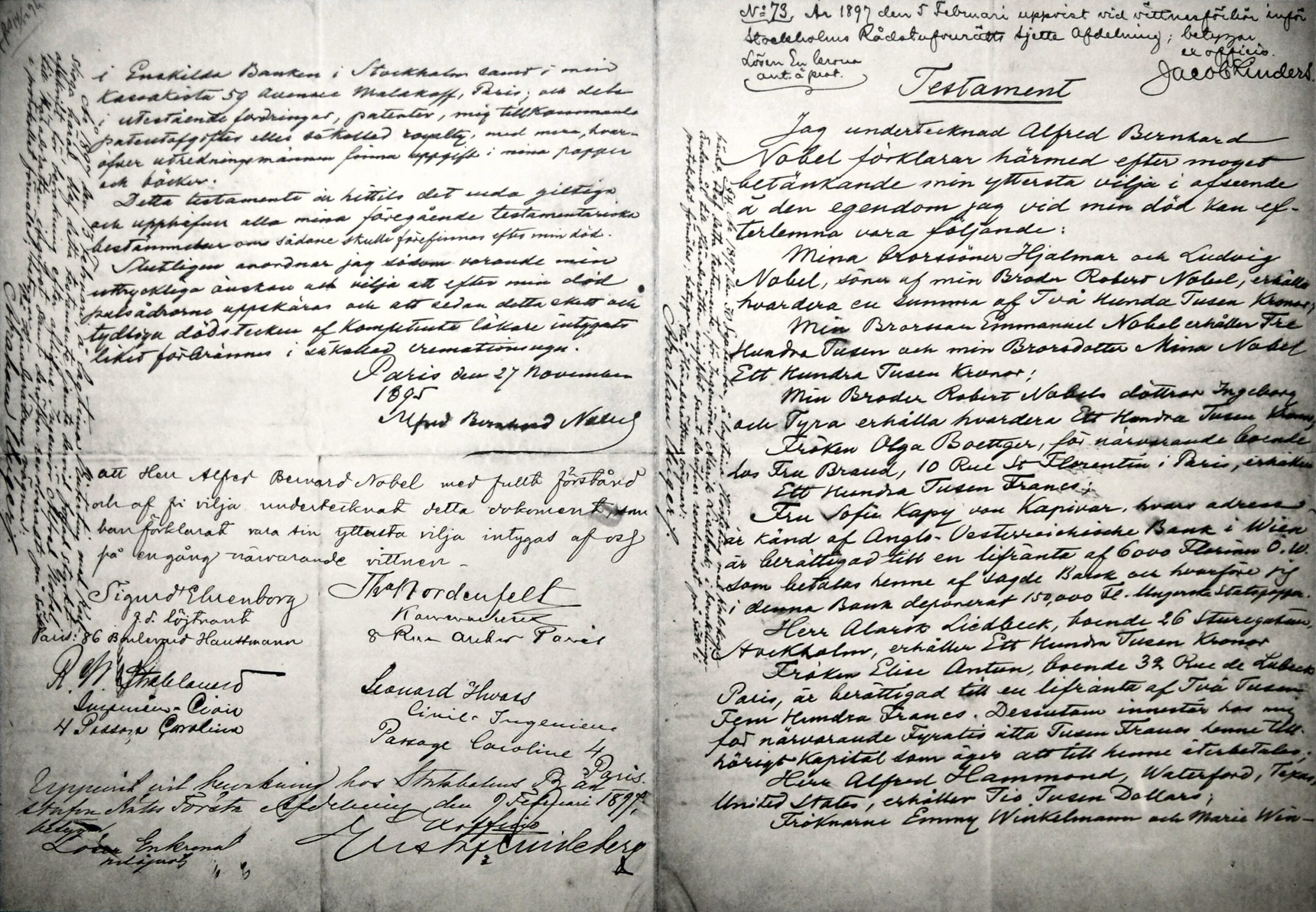
Alfred Nobel’s 1895 will established prizes in physics, chemistry, physiology or medicine, literature, and peace. It named the fields, the awarding institutions, and the broad standard that the prizes should honor work bringing the greatest benefit to humankind. It did not supply a complete operating manual for every question the new foundation would face.
The Nobel Foundation’s statutes added the detailed rule used today. Section 4 says that a prize may be divided between two deserving works. When a rewarded work was produced by two or three people, they may receive the prize jointly, but the prize amount cannot be divided among more than three people. The later economics prize follows the same maximum.
This means the limit applies to each prize category in a given year, not to the whole Nobel season. Physics may have as many as three laureates, chemistry may have three more, and so on. It also does not mean every prize must be shared. One person may receive the full award when the awarding body decides that a single contribution best fits the citation.
Shared prizes are not always divided into equal thirds
Three names on an announcement do not automatically mean that each person receives one-third of the prize. The awarding body first decides what work, or combination of works, it is recognizing. It can then divide the award to reflect that structure.
Sometimes three laureates share one contribution equally. In other cases, half of the prize recognizes one discovery and the other half recognizes a second discovery made by two people. The result is one half-share and two quarter-shares. The 2020 Nobel Prize in Physics followed that pattern: Roger Penrose received one half for theoretical work showing that black-hole formation is a robust prediction of general relativity, while Reinhard Genzel and Andrea Ghez each received one quarter for observations of the compact object at the center of the Milky Way.
The citation therefore matters as much as the number of names. A shared prize can connect researchers who worked together, people who made independent advances toward the same result, or separate contributions that opened a larger field. The division describes the committee’s interpretation of the achievement; it is not a precise measurement of each person’s total scientific value.
Modern science can be much larger than three names
The limit is easiest to understand when a discovery can be traced to one small group. It becomes harder in fields built around enormous instruments, shared data, and long chains of specialized work. A particle detector, space telescope, genome project, or gravitational-wave observatory may take decades to design and operate. No single person can build the hardware, calibrate every sensor, write all the analysis software, check every result, and interpret every signal.
The 2017 Nobel Prize in Physics made the tension especially visible. It went to Rainer Weiss, Barry Barish, and Kip Thorne for decisive contributions to the LIGO detector and the observation of gravitational waves. The Royal Swedish Academy of Sciences also described LIGO as an international collaboration involving more than 1,000 researchers from over 20 countries. In his Nobel lecture, Thorne put the effort at roughly 1,200 scientists and engineers and said the whole collaboration deserved primary credit.
The three laureates represented distinct turning points. Weiss developed the detector concept and analyzed the noise problems that such an instrument would have to overcome. Thorne helped build the intellectual and institutional case for gravitational-wave detection. Barish transformed LIGO into a large, organized international project capable of completing the instrument and reaching the discovery. Their selection told a coherent story, but it did not turn the remaining contributors into bystanders.

Committees recognize a contribution, not an entire workforce
A Nobel committee cannot solve the numbers problem by simply choosing the three most senior people on a project. Its task is to identify the achievement described in the prize citation and determine which eligible nominees made the most decisive contributions to it. That requires historical judgment as well as scientific evaluation.
The process begins with nominations from qualified people, not public applications or self-nominations. Committees consult specialists, review the evidence, and prepare recommendations for the prize-awarding body. The records remain confidential for at least 50 years, so the public usually cannot see which combinations were debated or why one possible citation was preferred over another.
Large collaborations make this framing crucial. A committee might recognize an original idea, the design of an experiment, leadership that turned a proposal into a working project, or an analysis that established a discovery. Different wording could point toward different people. The three-person ceiling therefore shapes the question before the names are chosen: the committee needs a contribution that can be explained through no more than three laureates.
That pressure can leave important work outside the award. An official historical review of the Nobel Prize in Physiology or Medicine acknowledged that a field may be difficult to reward when worthy contributors cannot be reduced to three in a logical and fair way. The limit does not prove that a fourth person mattered less. It means the prize’s format could not accommodate every form of credit.

A Nobel Prize is one kind of credit, not the whole record
The Nobel Foundation’s statutes allow an awarding body to honor an institution or association, which might appear to offer a way around the limit. In practice, organizations have received the Nobel Peace Prize, while the science prizes have continued to name individuals. That preserves the tradition of individual laureates but leaves team-based science with an old problem inside a modern research system.
Scientific credit does not stop at the ceremony. Research papers record authorship, collaborations publish full membership lists, professional societies give team awards, institutions document engineering and technical work, and later histories can recover contributions that a short citation could not contain. None has the global visibility of a Nobel announcement, but together they provide a fuller account of how knowledge was made.
The three-person rule helps explain both the power and the limitation of the Nobel Prize. A small number of laureates gives the public names and stories to remember. Yet a discovery can be larger than its prize citation. Reading past the three names—to the instruments, institutions, and teams behind them—does not diminish the laureates. It reveals the scale of the achievement they came to represent.