 Akshay Dinesh
The Constitution gives Congress a long list of powers, but no written list can name every practical step a government may need to take. Congress can tax, borrow money, regulate interstate commerce, create courts below the Supreme Court, raise armies, maintain a navy, and carry out other national responsibilities. Those powers sound clear until a real problem appears. To collect taxes, does Congress need offices, forms, penalties, records, and agencies? To borrow money, can it create financial tools? To regulate commerce, can it set up rules that make regulation work?
The Necessary and Proper Clause answers that problem. Found at the end of Article I, Section 8, it allows Congress to make laws that are useful for carrying out the powers the Constitution gives to the federal government. The clause is sometimes called the elastic clause because it gives Congress flexibility. That nickname can be helpful, but it can also mislead. The clause stretches congressional power only when the stretch is tied to another constitutional power; it does not create a free-floating authority to legislate about anything Congress finds convenient.
Enumerated Powers Need Working Tools
The framers did not write the Constitution as a detailed instruction manual for every national task. They gave Congress enumerated powers, meaning powers specifically listed in the text. Those powers include broad responsibilities such as laying and collecting taxes, providing for national defense, regulating commerce among the states, establishing post offices, securing patents and copyrights, and making rules for the armed forces. The list matters because Congress is not a general legislature for every subject in American life. It must point to a constitutional source of authority.
Still, listed powers often require ordinary working tools. A power to collect taxes would be weak if Congress could not create a revenue system. A power to raise an army would be incomplete if Congress could not organize recruitment, pay soldiers, buy equipment, and set rules for military administration. A power to establish post offices would make little sense if Congress could not create postal routes, set mailing rules, hire workers, or punish interference with the mail.
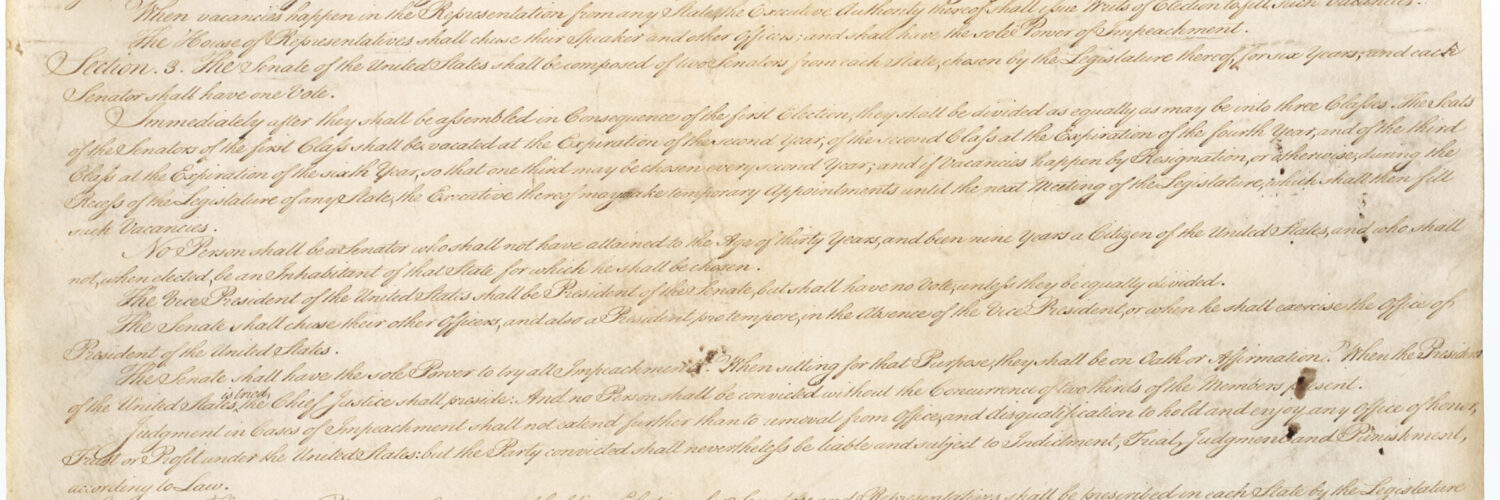
The Necessary and Proper Clause bridges the gap between a power and the practical laws needed to make that power operate. It appears after the list of congressional powers, almost like the final hinge on a long door. The clause says Congress may make laws necessary and proper for carrying into execution its own powers and other powers vested by the Constitution in the federal government. In plainer language, Congress may choose reasonable means to carry out constitutional ends.
What Implied Powers Mean
An implied power is not written out word for word, but it is connected to a power that is written. The idea is easy to see outside law. If a school gives a teacher authority to run a class, the teacher probably has implied authority to arrange seats, collect assignments, take attendance, and set reasonable classroom procedures. Those actions are not the main purpose of the job, but they help the assigned responsibility work.
Congressional implied powers work in a similar way, though the stakes are much higher. Congress cannot simply announce that a law is useful and stop there. The law has to be connected to an enumerated power or to another power that the Constitution gives to the federal government. That connection is what keeps implied powers from becoming unlimited powers.
The word necessary has caused debate from the beginning. In ordinary speech, necessary can mean absolutely required, with no alternative. But in constitutional law, the word has often been read more broadly. A law may be necessary if it is a useful, appropriate, or plainly adapted way to carry out a legitimate constitutional power. That does not mean any law is acceptable. It means the Constitution allows judgment about means, not only commands that are mathematically unavoidable.
McCulloch v. Maryland Set the Classic Test
The most famous early decision on the clause was McCulloch v. Maryland, decided by the Supreme Court in 1819. Congress had created the Second Bank of the United States. Maryland objected and placed a tax on the bank’s Baltimore branch. The case asked whether Congress had power to create a national bank even though the Constitution does not specifically say, “Congress may create a bank.” It also asked whether Maryland could tax an institution created by the federal government.
Chief Justice John Marshall’s opinion became one of the central explanations of implied powers. The Court reasoned that Congress had several listed fiscal powers, including taxing, borrowing, spending for national purposes, and regulating currency-related national affairs. A bank could be a useful means for carrying out those powers. Because the end was legitimate and the means were appropriate, the bank could stand even though the specific tool was not named in the Constitution.
The decision also rejected Maryland’s tax. That part of the case is often connected with federal supremacy, but the implied-powers part is just as important. Marshall’s reasoning treated the Constitution as a framework for a functioning government, not a cramped list that made national powers fail whenever an exact tool was not named. The case did not say Congress could do whatever it wished. It said Congress could choose suitable means when pursuing powers the Constitution actually gives it.
Why the Clause Is Flexible but Not Unlimited
The Necessary and Proper Clause is powerful because modern government often faces problems the framers could not have described in eighteenth-century terms. Communications networks, aviation, national banking systems, food and drug regulation, environmental protection, cybersecurity, and disaster response all involve tools and institutions that did not exist in 1787. The clause helps explain how Congress can address modern conditions while still working from the Constitution’s text.
That flexibility is also why the clause has been controversial. Critics have long worried that implied powers can be used to expand federal authority too far. If Congress can claim almost any tool is related to a listed power, the list of enumerated powers may lose force. Supporters answer that national powers need room to function, especially when economic and social problems cross state lines. The debate is not about whether implied powers exist at all. It is about how close the connection must be between the means Congress chooses and the constitutional power Congress claims to be carrying out.
Courts have not always drawn that line in the same place. At times, they have given Congress broad room to choose means. At other times, they have insisted that the Necessary and Proper Clause cannot be used to erase limits built into federalism or individual rights. The clause works alongside the rest of the Constitution. It cannot override the First Amendment, the Tenth Amendment, due process, equal protection principles, or structural limits on federal power.
How It Shows Up in Real Law
The clause often appears behind laws that create the machinery of national government. Congress can establish departments and agencies, set procedures for collecting revenue, create penalties that support valid federal rules, and design systems for carrying federal programs into effect. Many people notice the final policy more than the constitutional scaffolding underneath it. A law may look like a tax rule, a banking rule, a commerce rule, or a criminal enforcement rule, but the Necessary and Proper Clause may help explain why Congress can build the supporting structure around it.
For students, the clause is especially useful because it reveals how constitutional interpretation often works. The hard question is rarely just, “Does the Constitution contain these exact words?” A better question is, “What power is Congress trying to carry out, and is this law a reasonable way to carry it out?” That question forces readers to connect text, purpose, limits, and consequences instead of treating the Constitution as either a rigid checklist or a blank page.
The clause also helps explain why constitutional disagreements can be serious without being simple. Two people may agree that Congress has power to regulate interstate commerce, yet disagree about whether a particular law is truly tied to commerce. Two people may agree that Congress can tax and spend, yet disagree about what conditions may be attached to federal funds. The Necessary and Proper Clause does not end those arguments. It gives them a legal vocabulary.

Why the Clause Still Matters
The Necessary and Proper Clause sits in a small space at the end of Article I’s list of congressional powers, but it carries a large share of the Constitution’s practical force. Without it, federal powers could become strangely brittle. Congress might be told to govern national problems while being denied many of the tools needed to do so. With it, Congress has flexibility, but that flexibility remains tied to powers the Constitution actually grants.
The best way to understand the clause is to see it as a rule about means and ends. The end must be constitutional. The means must be appropriate to that end. When those two parts fit, Congress can act even if the exact tool is not named in the text. When they do not fit, the clause cannot supply power on its own.
That balance is why the clause keeps returning in constitutional debates. It explains how a short eighteenth-century document can govern a changing country, but it also keeps attention on limits. Congress is not trapped inside only the most literal tools named in 1787, and it is not released from the Constitution’s boundaries. The Necessary and Proper Clause lives in the space between those two mistakes, giving American government enough flexibility to work while still requiring a constitutional reason for the work it does.