 Akshay Dinesh
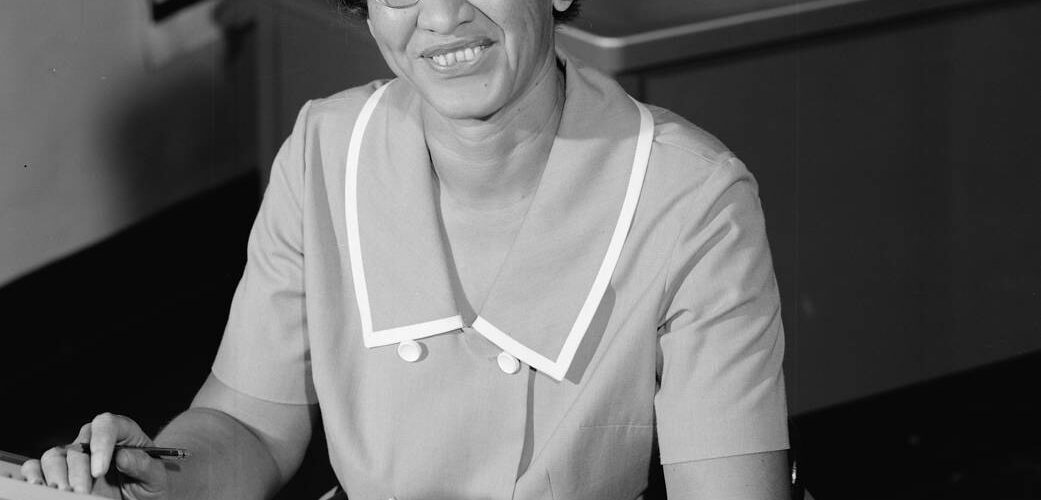
Katherine Johnson became famous because astronauts trusted her numbers. That is a simple way to tell the story, but it is not a small one. In the early years of American spaceflight, before electronic computers had fully earned confidence inside mission planning, Johnson worked through the mathematics that helped turn rockets, capsules, tracking stations, and human courage into a flight path that could be checked. Her work connected schoolroom arithmetic to orbital mechanics, and it showed how careful calculation can become a matter of life and death.
Johnson’s career also makes the word computer sound different. Long before the word usually meant a machine, it often meant a person who computed: someone trained to process measurements, solve equations, and verify results by hand or with mechanical calculators. At the National Advisory Committee for Aeronautics, and later at NASA, women mathematicians did much of this demanding numerical work. Johnson stood out not only because she was gifted with numbers, but because she kept asking to understand the larger problem those numbers were meant to solve.
A Child Who Moved Faster Than the School System
Katherine Coleman was born on August 26, 1918, in White Sulphur Springs, West Virginia. She loved counting early and moved through school quickly. Because Greenbrier County did not offer public high school for Black students at the time, her family arranged for her to continue her education in Institute, West Virginia, where West Virginia State College operated a high school. That decision mattered: talent needs opportunity, and Johnson’s family treated education as something worth reorganizing life around.
By thirteen, she was attending high school on the college campus. By eighteen, she had graduated from West Virginia State College with degrees in mathematics and French, after taking every math course available to her. One of her mentors was W. W. Schieffelin Claytor, a mathematician who encouraged her to pursue advanced mathematics when many academic doors were still partly closed to Black women. Johnson later became one of three Black students selected to integrate West Virginia University’s graduate programs in 1939, though she left after one session to start a family.
That early part of her life is easy to rush past because the spaceflight work is so dramatic. Yet it explains something important about her later success. Johnson was not simply a natural genius who appeared at NASA fully formed. She had been trained to think precisely, encouraged by strong teachers, and shaped by a family that found paths around unfair barriers without pretending those barriers were harmless.
From Teaching to Langley’s Computing Rooms
Johnson taught before joining the aeronautics world. In 1952, a relative told her that NACA’s Langley laboratory in Hampton, Virginia, was hiring mathematicians. She began work there in 1953, first in the West Area Computing section, a segregated group of Black women mathematicians led by Dorothy Vaughan. The work was technical, repetitive at times, and crucial. Flight research produced measurements that had to be turned into usable answers.
Within weeks, Johnson was assigned to the Flight Research Division. She analyzed test-flight data and worked on aeronautical problems before the space program became her main stage. The timing was extraordinary. Sputnik’s launch in 1957 pushed the United States more urgently toward spaceflight, and NACA became NASA in 1958. Johnson moved into the Space Task Group, where engineers and mathematicians were trying to answer a new set of questions: how to launch a person into space, bring the capsule through a planned path, and return the astronaut safely to Earth.
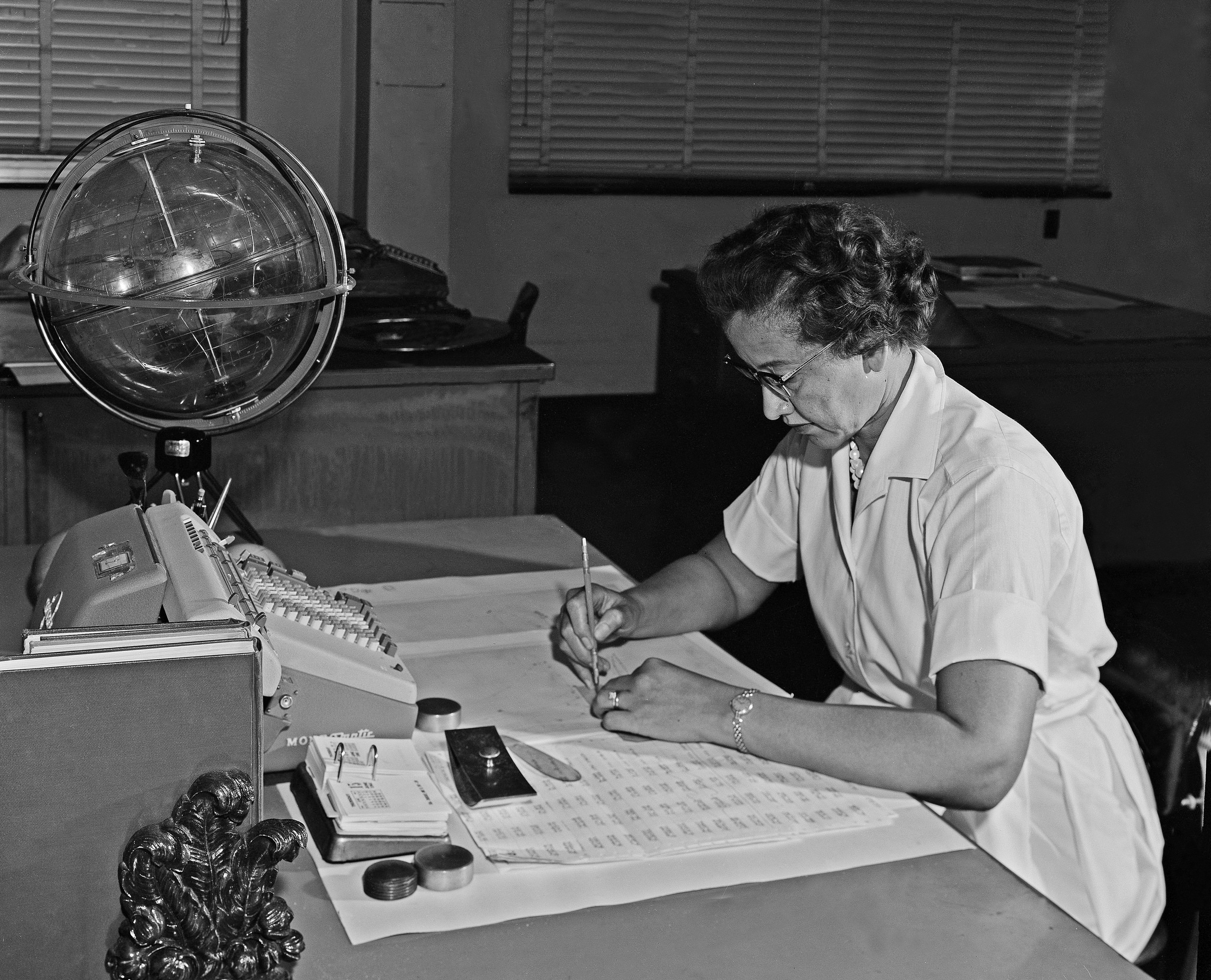
Her skill was not only speed. It was judgment. Spaceflight calculations involve relationships among time, velocity, gravity, angle, and location. A small error can grow into a large miss over hundreds of miles. Johnson wanted to know where equations came from and how they connected to the mission, not merely fill in numbers. That habit made her valuable in rooms where a calculation had to be trusted, questioned, corrected, and explained.
The Orbit Check That Made Her Famous
Johnson calculated the trajectory for Alan Shepard’s Freedom 7 mission in May 1961, the first American human spaceflight. That flight was suborbital, but it still required precise planning: launch, arc, splashdown, and recovery all depended on mathematical prediction. NASA could not simply send a capsule upward and hope the ocean was nearby when it returned.
Her best-known moment came with John Glenn’s Friendship 7 mission in 1962. NASA was using electronic computers to calculate Glenn’s orbital flight, but the technology was still new enough that trust had to be earned. According to NASA’s account, Glenn wanted Johnson to personally check the computer-generated numbers before he flew. The request was not sentimental. It showed that Johnson’s mathematical reputation had become part of mission confidence.
That story is often told as a moment of individual brilliance, and it was. But it also reveals a larger transition in scientific work. Electronic computers were becoming faster than human calculation, yet machines still needed people who understood the mathematics well enough to verify the output. Johnson’s value was not replaced by the new technology; it changed shape. She helped bridge the era of hand calculation and the era of machine computation.
Why the Math Was More Than Arithmetic
Orbital flight is not just a bigger version of drawing a line on a map. A spacecraft is falling around Earth while moving forward fast enough not to fall straight down. Its path depends on gravity, launch speed, angle, altitude, fuel limits, tracking data, and the planned location of recovery crews. The mathematics has to predict motion through changing conditions, and the result has to be usable by engineers and astronauts making real decisions.
Johnson worked on launch windows, trajectory analysis, and backup navigation charts. Those backup charts mattered because early spacecraft depended on electronics that could fail. If an astronaut needed another way to navigate, the paper calculations had to be clear and accurate. Later, Johnson contributed to Apollo-era work, including calculations related to the relationship between lunar modules and command modules. NASA also credits her with work on the Space Shuttle program and the Earth Resources Satellite before her retirement in 1986.
Her career is a reminder that mathematics is not separate from human stories. Equations can seem abstract on a classroom page, but in Johnson’s work they became decisions about timing, direction, and safety. A correct answer was not only a number; it was a capsule found in the ocean, an astronaut returning home, or a mission plan that engineers could defend.
Recognition That Came Late, But Not Empty
For much of Johnson’s career, the public knew little about the Black women mathematicians who helped make early spaceflight possible. Their work was essential, but it was often treated as background labor. The later attention surrounding Hidden Figures, Margot Lee Shetterly’s book and the film based on it, helped many readers and students understand that the space race was not built only by the famous names on mission patches and press conferences.
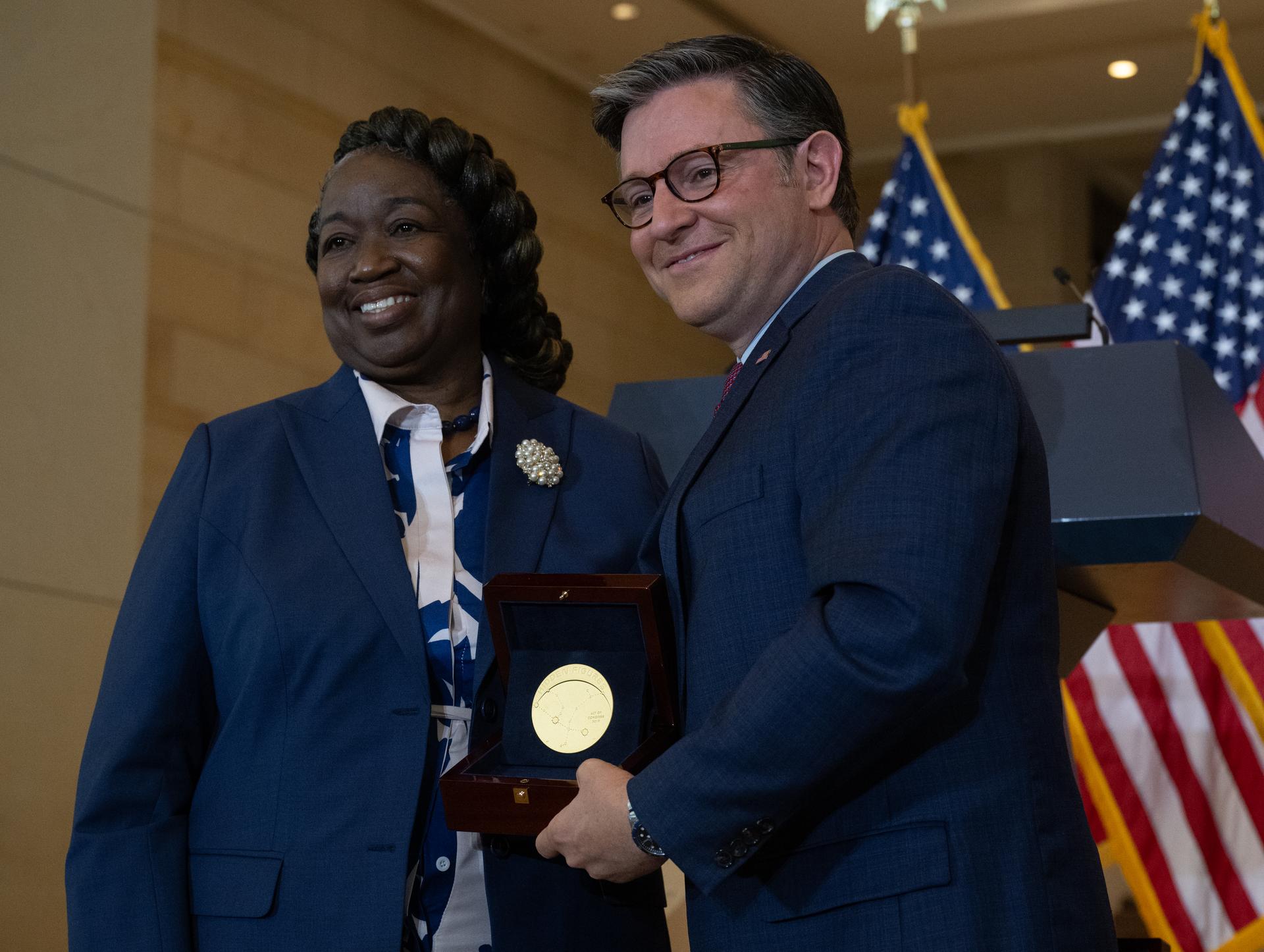
Johnson received the Presidential Medal of Freedom in 2015. In 2016, NASA named the Katherine G. Johnson Computational Research Facility at Langley in her honor. In 2024, NASA’s Hidden Figures were honored with Congressional Gold Medals, recognizing Johnson, Dorothy Vaughan, Mary Jackson, Christine Darden, and the broader group of women who served as computers, mathematicians, and engineers at NACA and NASA.
Late recognition cannot undo the limits placed on Johnson and her colleagues by segregation and sexism. It can, however, correct the record in a way that changes what students imagine when they picture scientific achievement. Johnson’s story widens the frame. It shows that history is often made by people whose names are not immediately attached to the machines, missions, or monuments they helped make possible.
What Katherine Johnson’s Work Still Teaches
Katherine Johnson died on February 24, 2020, at age 101. Her legacy is sometimes summarized as inspiration, and it is that. But inspiration is more useful when it stays connected to the work itself. Johnson was not important only because she overcame barriers, or only because her story became famous. She was important because she did difficult mathematics accurately under conditions where accuracy mattered.
Her life also teaches a sharper lesson about confidence. NASA trusted machines more deeply when people like Johnson could explain, check, and challenge the numbers. Students who wonder why math matters can find one answer in her career: mathematics helps people model reality before they act in it. It gives shape to uncertainty. It turns a dangerous guess into a plan that can be tested.
Johnson’s story belongs in space history, civil rights history, computing history, and the history of education. It is a story about a girl whose family made school possible, a woman who entered rooms not built with her in mind, and a mathematician whose careful work helped astronauts cross a boundary that had once seemed unreachable. The most lasting part of that story is not fame. It is the quiet force of knowing the work so well that when the numbers had to be right, people came to her.

 Rishay Dinesh